
Why Do Tattoo Artists Wear Black Gloves? Safety and Grip
Tattoo artists wear gloves because tattooing can involve blood, non-intact skin, contaminated equipment, and surfaces that can transfer infectious material. Many artists prefer black nitrile because a well-specified product can offer close fit, tactile control, and grip while the dark color supports visual focus and studio presentation. Black itself is not a safety rating: it does not prove barrier performance, examination status, sterility, thickness, or compliance.
This answer has two parts. The need for appropriate gloves belongs to a bloodborne-pathogen and contamination-control system. The preference for black is mostly operational and visual. A studio that explains only the color risks turning appearance into a substitute for product evidence and correct glove changes.
Why tattoo artists wear gloves at all
A tattoo procedure can bring the artist's hands into contact with blood, body fluids, non-intact skin, ink, contaminated wipes, used equipment, work surfaces, and waste. Disposable gloves create a barrier between the worker and those contacts, but they work only as one layer in a larger system.
Where employees have occupational exposure, OSHA's Bloodborne Pathogens standard addresses universal precautions, engineering and work-practice controls, personal protective equipment, handwashing, training, exposure-response duties, and other employer responsibilities. It requires disposable gloves to be replaced when contaminated, torn, punctured, or when their barrier function is compromised; they are not to be washed or decontaminated for reuse.
NIOSH's body-art resource Good, Clean Art was developed around real concerns about exposure to blood and bloodborne diseases among tattooists and piercers. Its practical lesson is that glove use belongs beside hand hygiene, clean work practices, safe handling of sharps, cleaning, and training.
No glove makes a needle safe. The puncture resistance measured for a glove film is not a needlestick guarantee, and gloves do not replace a sharps container or safer work practices. That boundary matters when marketing pages call nitrile "puncture resistant" without naming the product, thickness, method, or hazard.
Five reasons many artists prefer black nitrile
1. Close fit and tactile control
A tattoo artist performs precise, repetitive movements and adjusts grip over a long session. A properly sized nitrile examination glove can be a practical candidate when the exact formulation offers the needed fit and tactile response. The studio should test every required size with its real grips, barriers, bottles, caps, controls, and wiping motions.
A glove that is too tight may be stressed during donning and increase fatigue. A loose glove can bunch at the fingertips, reduce control, or snag. The material name does not solve fit; dimensions and formulation vary by product.
2. Grip and handling of small items
Surface texture can help with bottles, caps, wipes, and equipment controls, especially when moisture or ink is present. Verify where the texture is located and whether it interferes with delicate movements. "Textured" can mean fingertips only, fingers, or a broader surface, and the useful choice depends on the artist's workflow.
3. Visual contrast around ink and supplies
Black can create strong contrast against white wipes, light barriers, and bright inks. It may make the workstation feel visually organized and help the artist focus on the objects being handled. That is a usability preference, not evidence that the glove provides a better barrier than an otherwise equivalent glove in another color.
4. Less distracting staining
Ink stains can dominate a light glove's appearance. Black masks many stains and can reduce visual distraction for the artist or client. The trade-off is critical: dark gloves may also hide blood, dark ink, grease, or soil. A glove that looks clean may still be contaminated. Change decisions must follow contact and workflow triggers rather than visible dirt.
5. Consistent studio presentation and color coding
Many studios use black across clothing, furniture, barriers, and PPE, so black gloves fit the visual identity. A studio may also assign colors to roles or zones. Those choices can improve recognition if the rule is simple and trained.
Color coding fails when staff treat it as a protective classification. A black glove does not automatically become an examination glove, a sterile glove, a thicker glove, or a compliant tattoo glove. The exact label and supporting file still control.
The clean-to-contaminated touch map
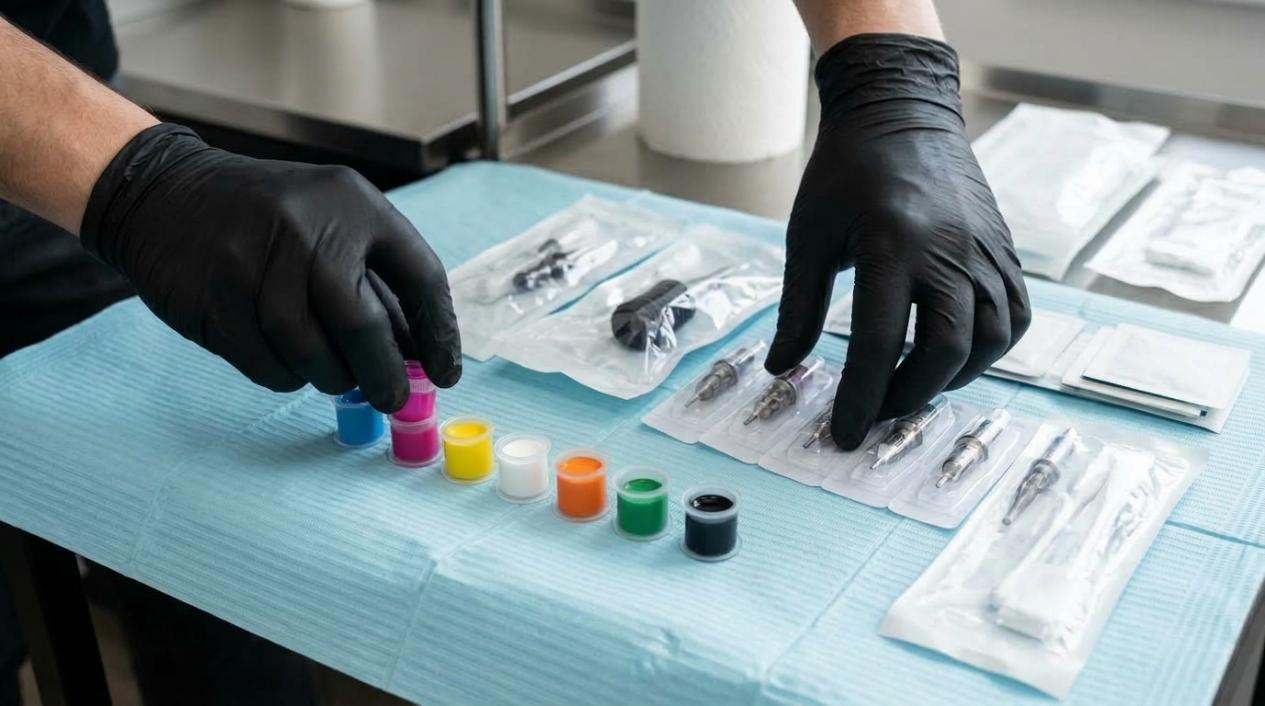
The strongest tattoo-glove article is not a list of material benefits; it shows what breaks the workflow. Before the session, the artist prepares clean or single-use supplies, protective barriers, ink portions, and waste/sharps controls according to the studio's procedure. Once gloved work begins, every touch has a status.
Common contacts that can require stopping, removing gloves, washing hands, and donning a fresh pair under the applicable procedure include:
- a phone, keyboard, camera, payment device, or personal item;
- a drawer, cabinet, door handle, lamp control, chair control, or unprotected bottle;
- the artist's face, hair, clothing, eyewear, or mask;
- a used wipe, contaminated barrier, waste container, or dropped item;
- torn or punctured glove film, a glove that rolls down, or visible loss of barrier integrity;
- movement from cleanup back to prepared supplies or client contact;
- a new client, new procedure, or other task boundary defined by the studio and local rule.
Planning reduces these breaks. Place supplies before donning, barrier frequently touched equipment, use hands-free controls where feasible, and keep replacement gloves plus handwashing facilities accessible. Do not solve poor layout by wearing the same gloves longer.
When to change gloves during a tattoo session
A defensible rule is event-based, not time-based. Gloves change when they are contaminated, torn, punctured, removed, or compromised; when the artist touches something outside the controlled task; and between clients or other defined procedure boundaries. Contamination does not need to be visible.
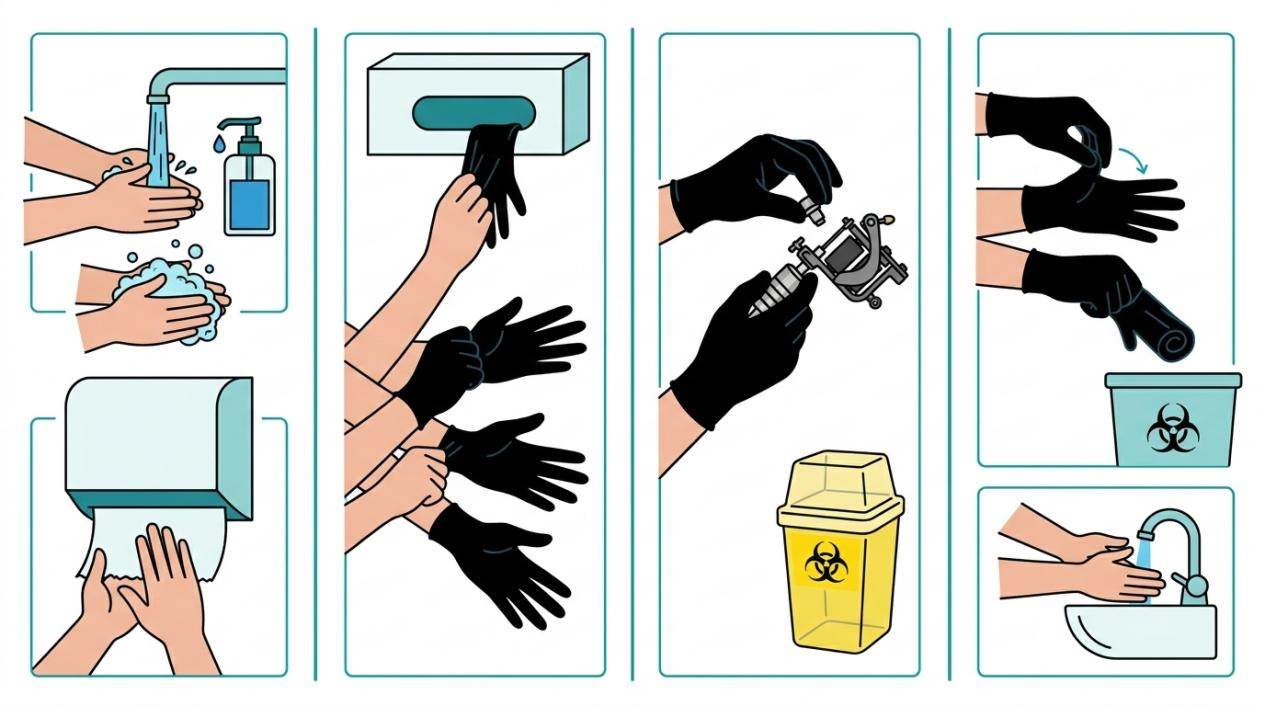
Use a simple cycle:
- Prepare the workstation and supplies before the procedure.
- Wash and thoroughly dry hands, then don a fresh, correctly sized pair.
- Perform one defined task without touching unrelated or unprotected surfaces.
- Stop immediately after a contaminating touch, tear, puncture, or process break.
- Remove the gloves without touching contaminated outer surfaces, then discard them.
- Wash and thoroughly dry hands after removal and before a fresh pair.
- Reset any surface, barrier, or supply made unsafe by the break before continuing.
State and local body-art rules can be more specific. For example, the county-hosted California Safe Body Art Act includes requirements around unused disposable examination gloves, hand hygiene, and replacement after contact outside the prepared procedure area. It is a California example, not a nationwide rule. Studios must check the current law and enforcing health authority for every location.
How to specify the right tattoo glove
"Black nitrile" is the beginning of a specification, not the end. A studio buyer should record:
- legal manufacturer, factory, brand, model, and catalog number;
- intended use and any relevant examination/medical-device status;
- material declaration, color, powder status, and formulation information available for sensitivity review;
- thickness by location, dimensions, cuff length, surface texture, size range, and handedness;
- barrier, leak, physical-performance, biocompatibility, and quality documentation relevant to intended use;
- sterility status and packaging, where the specific task and jurisdiction require it;
- lot traceability, shelf life, storage, change notification, complaint process, and recall communication;
- box dispensing behavior, case quantity, lead time, and a technically reviewed backup SKU.
INTCO's black nitrile glove product family can be a commercial starting point. The current page describes a black nitrile family for industrial, laboratory, and food-processing contexts. A tattoo studio should not infer examination status or suitability for blood exposure from that family page alone; request the exact product dossier and map it to the studio's intended use and applicable rules.
The site's separate guide to black nitrile applications across industries explains how task evidence changes between tattooing, cleaning, and foodservice. This page stays tattoo-specific so the two resources do not compete for the same search job.
Fit trial before case purchase
Give artists representative sizes and have them perform non-client setup motions: open sealed supplies, position barriers, hold the machine grip, operate protected controls, cap containers, and remove gloves safely. Record fingertip bunching, cuff roll, tearing during donning, slippage, fatigue, loss of control, and failed attempts. Do not encourage artists to work through skin symptoms.
Approve one primary SKU and one reviewed substitute. "Same color, material, and size" is not enough for substitution. Check dimensions, thickness, formulation, texture, quality records, intended use, labeling, and real fit.
What black nitrile gloves cannot do
Black nitrile gloves cannot:
- prevent needlestick injury or make unsafe recapping/handling acceptable;
- replace an exposure-control plan, training, hepatitis B vaccination duties where applicable, or post-exposure evaluation;
- prove sterility, examination status, or compliance with a state/local body-art rule;
- remain safe after touching a phone, drawer, lamp, chair control, clothing, or other unrelated surface;
- become reusable after washing or disinfection;
- guarantee that no user will experience irritation or sensitization;
- make contamination visible against a dark surface.
Double-gloving is also not a universal repair. A defined procedure may call for layers in a particular task, but two unsuitable gloves do not become needle-proof, and extra layers can reduce tactility. Follow the applicable exposure assessment and written procedure.
Studio buyer checklist and FAQ
Before approving a case, confirm the exact product, intended use, current regulatory record where applicable, sizes, quality and barrier documentation, storage life, and lot traceability. Review the studio's glove-change map with the people who actually perform the work. Then check that replacement boxes, disposal, handwashing, and the sharps container are positioned so correct behavior is practical.
Why do tattoo artists wear black gloves?
They wear appropriate gloves to support a barrier and contamination-control system. Many prefer black for fit, grip, contrast, stain masking, and studio appearance, but color itself provides no extra safety certification.
Are black nitrile gloves safer than blue nitrile gloves?
Not because of color. Compare the exact products' intended use, formulation, thickness, fit, barrier and quality evidence, and applicable regulatory status.
Do tattoo gloves have to be sterile?
Do not generalize. Requirements depend on the task and the applicable state or local body-art rule. Verify the current rule and product labeling for the studio's location and procedure.
Can gloves be disinfected and reused?
Disposable gloves must not be washed or decontaminated for reuse. Remove, discard, wash and dry hands, and don a fresh pair according to the studio's procedure.
When should an artist change gloves?
Change after contamination, a touch outside the controlled task, tearing, puncture, removal, or compromised barrier function; between clients and other required task boundaries; and whenever applicable rules or the exposure-control plan require it.
The best explanation for black tattoo gloves is therefore not "black is safer." Artists need a verified barrier product and a disciplined clean-to-contaminated workflow. Black nitrile is popular when the exact glove also fits the hand, supports precision, and meets the task's evidence and regulatory requirements. Safety comes from the whole system, not the color.