
Do Medical Gloves Expire? Shelf-Life Guide
Do medical gloves expire? Yes. A medical glove can pass its manufacturer-designated shelf life. The date depends on the exact product, packaging, storage conditions, and stability data—not a universal rule for nitrile, latex, or vinyl. Follow the carton label and manufacturer’s instructions, and quarantine stock whose identity, history, or package integrity is uncertain.
The broad question “do gloves expire?” covers unopened inventory. It does not mean a disposable glove can be worn longer, washed, or used again. Maximising glove life is an inventory-control task: preserve sealed stock, issue the oldest suitable lots first, and discard each glove after its intended single use.
Health and safety notice: This article is for general health education only and does not constitute medical diagnosis or treatment advice. If you have a health concern, consult a licensed healthcare professional. Professional review status: pending. Do not publish externally until the glove-use and compliance guidance has been reviewed by a qualified infection-control, occupational-safety, quality, or regulatory professional.
1. Confirm the label: do medical gloves expire?
Begin with the smallest saleable package and the shipping carton. Look for an expiration or “use before” date, manufacture date, lot or batch number, storage instructions, sterile status, and the manufacturer’s identification. Keep the label associated with the gloves after a carton is opened; separating loose boxes from their lot information destroys the trail you may need during a complaint or recall.
Questions such as “do nitrile gloves expire?” and “do latex gloves expire?” cannot be answered by material alone. Do not replace the label with a generic rule such as “latex lasts three years” or “nitrile lasts five.” Those figures appear frequently in commercial guidance, but they are not a guarantee for every formulation. Colourants, accelerators, package materials, sterilisation method, residual chemicals, and storage exposure can all affect stability.
Shelf life is an evidence-based claim. The FDA’s guidance on medical-device shelf life explains that manufacturers evaluate whether a device remains within acceptable specifications over time. For medical gloves, the FDA recognises ASTM D7160-16 (Reapproved 2023), a practice for determining expiration dating through testing and data analysis.
If a non-sterile box has no printed expiration date, do not invent one. The CDC notes that FDA-cleared non-sterile disposable gloves are not required to carry expiration-date labelling, although some manufacturers designate a shelf life. Ask the supplier for the current specification, lot traceability, and written storage requirements. If the supplier cannot identify the product or support its shelf-life claim, isolate the stock while your quality or safety owner decides its disposition.
2. Separate unopened shelf life from time on the hand
“How long do gloves last?” describes two different clocks.
The first is unopened shelf life: the period during which a properly packaged and stored product is expected to meet its specifications. The second is use duration after donning: the much shorter period before a single glove must be changed because the task, patient, surface, contamination status, or glove condition has changed.
A shelf-life date never authorises extended wear. The FDA’s medical glove guidance for users says medical gloves are disposable, must be changed if they rip or tear, and must never be washed, disinfected, shared, or reused. OSHA’s bloodborne-pathogens standard likewise requires disposable single-use gloves to be replaced as soon as practical when contaminated and as soon as feasible when torn, punctured, or unable to function as a barrier.
There is no safe universal number of minutes for every nitrile glove. A glove may need replacement immediately after a tear, between patients, between incompatible tasks, after hazardous contact, or at a facility-defined interval. Chemical and chemotherapy work must follow product-specific permeation data and the employer’s written procedure; exam-glove shelf-life information does not establish chemical breakthrough time.
The practical rule is simple: preserve unopened inventory for as long as its validated shelf life allows, but treat every donned glove as single-use PPE governed by the task.
3. Record each lot when it arrives
A carton can be perfectly stored and still become unusable because nobody knows what it is. At receiving, create a lot-level record before stock reaches the shelf. Capture:
- supplier and manufacturer;
- product name, material, size, and catalogue number;
- medical, sterile, food-contact, industrial, or chemical-use classification;
- lot or batch number;
- manufacture and expiration dates, when provided;
- quantity received and receiving date;
- storage requirements on the label;
- carton damage, moisture, heat exposure, or seal concerns;
- location assigned in the warehouse.
A photograph of one representative label per lot can supplement searchable records. Your inventory system should answer three questions within minutes: Which lots expire next? Where are they? Which customers or departments received them?
Quarantine cartons with conflicting dates, unreadable lot codes, water damage, broken seals, or evidence of prolonged heat exposure. “We can still sell the good-looking boxes” is not a receiving decision; it is a quality decision that needs documented authority.
For recurring supply, define the minimum remaining shelf life accepted at delivery. Base it on consumption, transit time, buffer stock, and customer requirements. Write it into the purchase specification so a technically unexpired but commercially unusable shipment does not become your warehouse problem.
4. Store sealed cartons away from heat, light, moisture, ozone, and chemicals
Keep gloves in their original packaging in a clean, cool, dry, and shaded location. Avoid windows, hot roofs, radiators, steam lines, direct contact with exterior walls that condense moisture, and vehicles or containers that may experience uncontrolled temperature extremes. Do not place cartons beside solvents, fuels, cleaning chemicals, electrical equipment that can generate ozone, or ignition sources.
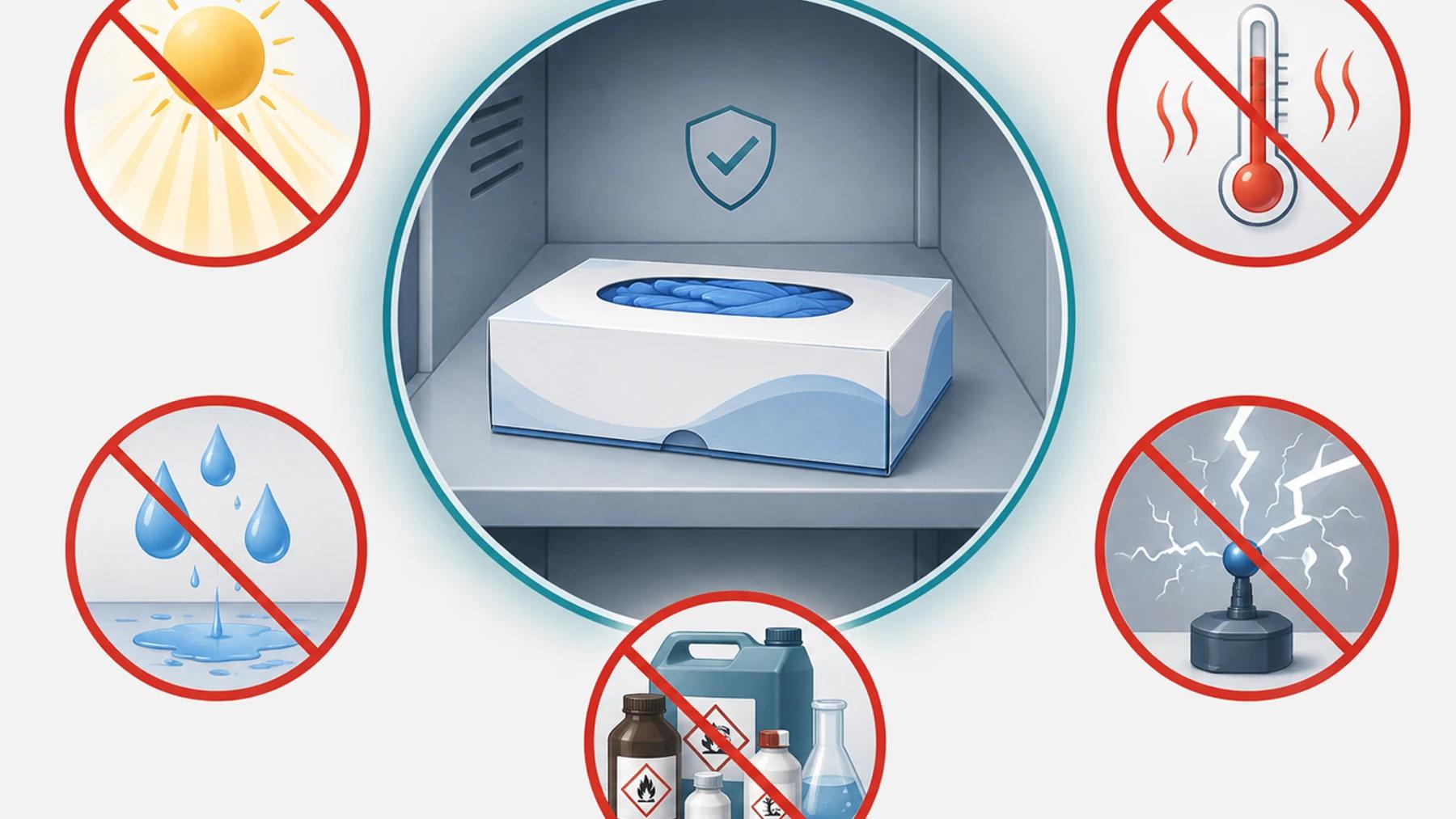
Those controls matter because formulations age through different mechanisms. Heat accelerates reactions. Ultraviolet light can damage polymers. Moisture can weaken packaging. Ozone is particularly relevant to natural rubber, while volatile chemicals can affect materials without a visible spill.
A search for “nitrile gloves shelf life” may surface a generic number, but follow the exact product label instead. The storage instructions for INTCO nitrile exam gloves and latex exam gloves, for example, both call for a cool, dry place away from direct sunlight, ozone, and ignition sources. That does not prove that every nitrile and latex product has identical limits; it shows why the relevant specification must travel with each SKU.
Monitor locations that can affect product quality, not merely the room closest to the office. Put data loggers near the warmest upper rack, exterior wall, loading door, and areas with previous leaks or HVAC failure. For an excursion, record the time and conditions, identify affected lots, stop issuance if warranted, and ask whether the exposure falls within validated tolerances.
Once a dispenser box is opened, protect it from splash, dust, sunlight, and cross-contamination. Do not leave boxes in bathrooms, on sinks, on vehicle dashboards, or beside chemicals. If local policy requires an opened date, write it on the box without covering the original label.
5. Rotate stock by earliest expiry, not by arrival date alone
FIFO—first in, first out—is useful only when older deliveries also expire first. Disposable gloves can arrive with different remaining shelf lives, so use FEFO: first expired, first out. Arrange pick faces so the earliest acceptable expiry is issued first, while newer-dated reserve stock stays behind it.
FEFO needs system support. Record expiry by lot, block accidental picking of quarantined stock, and run an exception report far enough ahead to transfer or consume short-dated inventory appropriately. A simple traffic-light report can work: normal, review soon, and quarantine/expired. The time windows should reflect your consumption rate and customer requirements rather than an arbitrary number of days.
Count open boxes as part of cycle checks. A warehouse may show healthy total inventory while the clinical area has five partially opened boxes of the same size aging in separate rooms. Set a reasonable par level at each point of use and replenish more frequently instead of overfilling every dispenser.
Do not relabel a glove with a later date because an outer carton was replaced or because another brand carries a longer shelf life. The expiry and lot identity belong to the original manufactured product and its packaging system.
6. Inspect the package and glove immediately before use
Inspection is a last defence, not a way to extend shelf life. Before issuing a box, check that the label is readable, the correct lot was selected, the package is dry and intact, and the product matches the intended task. Before donning, look for obvious defects such as tears, pinholes, cracks, brittleness, stickiness, abnormal hardening, loss of elasticity, or severe unexplained discolouration. Stop using a box if several gloves show the same defect.
Then perform a functional check while donning: the glove should unroll normally, stretch without cracking, fit as expected, and remain intact during the task. Replace it immediately if it tears, punctures, leaks, or otherwise appears unable to provide a barrier.
Appearance alone cannot confirm barrier integrity. Small holes may be invisible, and chemical resistance cannot be judged by touch. An apparently normal expired glove does not automatically qualify for patient care, aseptic work, hazardous-drug handling, biohazard exposure, or chemical protection. Use inspection to catch failures, not to overrule the label, test evidence, or institutional policy.
When defects are found, retain the box and lot information long enough to investigate. Record the failure rate, photographs, storage location, and task. A pattern across one lot may justify supplier notification or broader quarantine; isolated damage concentrated at one dispenser may point to local heat, contamination, or handling.
7. Quarantine expired or questionable stock by risk level
Expired stock should move to a marked hold area. Lock it in the inventory system, identify affected lots and quantities, and assign a qualified person to decide whether it must be returned, destroyed, used only for an approved non-protective purpose, or handled under an emergency policy. The question “can you use expired gloves?” has no responsible yes-or-no answer without this risk context.Use the risk hierarchy below as a conservative starting point:
| Intended use | Routine decision for expired or uncertain stock |
|---|---|
| Surgical or other sterile procedure | Do not use stock past its designated shelf life or with compromised sterile packaging. |
| Patient care, blood/body-fluid exposure, biohazard work | Do not substitute visual inspection for current, compliant stock and facility policy. Quarantine for formal review. |
| Chemotherapy, hazardous drug, or chemical exposure | Do not use without current product-specific permeation evidence and an approved procedure. |
| Food handling or regulated production | Follow applicable facility, customer, and regulatory requirements; do not assume medical expiration automatically defines food-use acceptability. |
| Training with no pathogen or hazardous-substance exposure | May be considered only if institutional policy permits and the box is clearly segregated from protective-use stock. |
| Cleaning or household task with no meaningful hazard | A local risk assessment may permit non-protective use, but never represent the glove as providing validated medical or chemical protection. |
The CDC’s contingency and crisis guidance for conserving disposable medical gloves discusses limited use of some past-shelf-life non-sterile gloves during supply shortages, while stating that sterile gloves past their designated shelf life should not be used for surgery or other sterile procedures. This is emergency capacity guidance, not routine permission to ignore labels. Apply it only within an authorised institutional plan and current regulatory context.
Never mix expired boxes back into active stock after removing the date label. Never donate them as medical PPE without transparent dating and recipient acceptance. Record the final disposition so the same lot cannot quietly re-enter circulation.
8. Ask suppliers for evidence, not a generic number
The best time to solve an expiration problem is before the purchase order is signed. Ask the supplier to provide:
- the labeled shelf life and storage conditions for the exact catalog number;
- the basis for the dating claim, including the applicable stability protocol or standard;
- confirmation of whether the claim applies to the final packaging configuration;
- the lot-number format and traceability process;
- sterile barrier and sterility-dating information, when applicable;
- transport-excursion guidance;
- change-notification terms for formulation or packaging;
- the minimum remaining shelf life guaranteed at shipment and delivery.
ASTM expiration-dating practices help manufacturers design and analyse stability studies; they do not turn an unsupported generic number into a product guarantee. Likewise, a certificate for one glove family should not be assumed to cover another thickness, colour, additive, sterilisation method, or package unless the manufacturer documents that relationship.
Apply the same discipline to sustainability claims. A biodegradable nitrile glove should retain its stated protective performance throughout its labelled shelf life, while biodegradation is intended for specified disposal conditions. Procurement teams should verify both claims separately instead of assuming that faster end-of-life degradation means shorter warehouse life—or that it justifies keeping expired stock.
Your final operating rule can fit on one page: buy lots with adequate remaining life, record them at receipt, store them to the label, rotate by FEFO, inspect before use, change gloves whenever the task or condition requires, and quarantine anything expired or uncertain. That preserves the value of disposable-glove inventory without pretending that “maximising lifespan” means stretching a single-use product beyond its evidence.