
What Are Black Nitrile Gloves Used For? 3 Industries
Black nitrile gloves are used in tattooing, commercial cleaning, and foodservice when a task benefits from a close fit, dexterity, a dark visual cue, and the barrier performance of a particular nitrile product. The color itself proves none of those properties. Buyers must still verify the exact glove's intended use, thickness, quality level, food-contact or medical status, and compatibility with the hazards involved.
That distinction prevents an attractive black glove from becoming a universal but unsafe substitute. A tattoo studio may need disposable gloves appropriate for anticipated blood or other potentially infectious material exposure, based on the applicable occupational safety requirements and the specific task. A cleaning team may need chemical-resistant utility gloves instead of thin disposable nitrile. A foodservice operation needs documented food-contact suitability and a change procedure that works during production. These are three different specifications, even when every glove looks black.
What black color does—and does not—tell a buyer
Black can support an operating system. It may help a business distinguish one task zone from another, reinforce a consistent visual presentation, or provide contrast against light-colored materials. In tattoo work, dark gloves can keep ink staining from dominating the client's view. In a kitchen, a color assignment can make a station rule easier to observe. In cleaning, black may align with a uniform or make a torn light-colored liner easier to notice.
Color can also hide dark soil, ink, grease, or blood. A glove that looks clean may be contaminated. Staff must change it based on task, contact, damage, and procedure—not on appearance alone.
Black does not establish:
- puncture, tear, permeation, degradation, or breakthrough performance;
- examination, surgical, industrial, or food-contact status;
- sterility, thickness, texture, cuff length, or acceptable quality level;
- protection from every disinfectant, solvent, oil, food, sharp, or hot surface;
- freedom from natural rubber latex or from every possible irritant or sensitizer;
- compliance with a particular U.S. federal, state, or local rule.
The useful question is therefore not "Are black nitrile gloves good?" It is "Is this exact black nitrile glove documented and validated for this task?"
Compare black nitrile glove uses across three industries
| Industry and task | Why black nitrile may be considered | Evidence to verify | Change or stop trigger | When another glove/control is needed |
|---|---|---|---|---|
| Tattoo setup and procedure support | Fit, tactile control, visual consistency, contrast with light surfaces | Intended use, applicable occupational and body-art requirements, relevant barrier and quality documentation, and size/fit. | Between clients/tasks; after contamination, tearing, puncture, or compromised barrier | Sharps controls remain essential; gloves do not prevent needlesticks |
| Routine commercial surface cleaning | Dexterity, splash/soil separation, disposable workflow | Chemical label, SDS, employer hazard assessment, product compatibility and duration data | Chemical/task change, degradation, swelling, tears, contamination, removal | Reusable chemical-resistant utility gloves may be required |
| Ready-to-eat food assembly | Visible station coding, fitted handling, texture and control | Exact-SKU food-contact declaration, conditions of use, local code, size/fit | New task, damage, soil, interruption, removal, contamination | Utensils or a different glove may fit the process better |
| Raw-food handling | Fit, grip, controlled transition | Food-contact documentation, task trial, thickness/texture, change procedure | Before ready-to-eat food or clean equipment; after interruption/damage | Cut or thermal hazards require separate protection |
This matrix is a shortlist, not an approval. A single product can appear in more than one row only when its documentation and performance support every intended use. Never carry a glove from one industry or task into another merely because the material and color match.
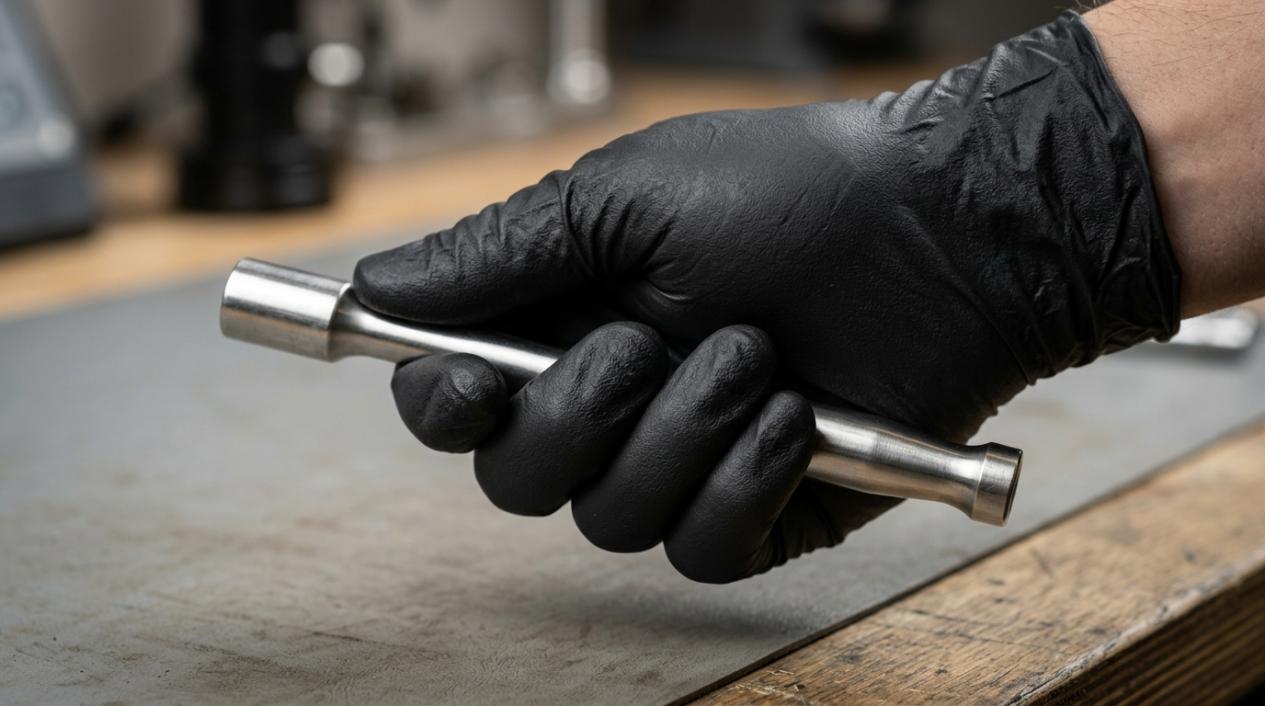
Tattooing: control exposure and workflow, not appearance alone
Tattooists may handle blood, other potentially infectious materials, ink, contaminated equipment, and cleaning products. Under applicable occupational-exposure conditions, OSHA's Bloodborne Pathogens standard requires appropriate controls and PPE; it addresses glove replacement when contaminated, torn, punctured, or when barrier function is compromised. Disposable gloves are not to be washed or decontaminated for reuse.
NIOSH's Good, Clean Art provides guidance on preventing cross-contamination through proper work practices, hand hygiene, workstation cleanliness, and glove changes. NIOSH's Look Sharp provides additional guidance on sharps safety and handling in tattooing and piercing settings. A black glove can support grip, dexterity, and presentation, but it cannot substitute for an exposure-control plan or a sharps container.
For purchasing, verify whether the exact glove is intended and appropriately documented for the studio's exposure and applicable rules. Confirm sizes that allow precise handling without excessive tension during donning. If a worker reports skin symptoms, use the studio's occupational-health procedure rather than assuming that a nitrile or "latex-free" marketing claim eliminates every possible reaction.
This article intentionally stops there. The separate tattoo-focused page should cover glove changes across workstation setup, client contact, phone or drawer contact, contaminated instrument handling, cleanup, and local body-art requirements in more depth.
Cleaning: verify the chemical before choosing disposable nitrile
"Nitrile resists chemicals" is not a complete specification. Compatibility depends on the exact formulation, glove thickness, chemical identity and concentration, contact duration, temperature, movement, degradation, and permeation or breakthrough data. A thin disposable black nitrile glove that works for a brief wipe may be unsuitable for immersion, concentrated degreaser, or extended disinfectant contact.
OSHA's hand-protection rule bases glove selection on the task, conditions, duration, and hazards identified. The cleaning chemical's label and safety data sheet should be checked alongside product-specific compatibility information. When those sources disagree or do not cover the planned use, escalate instead of guessing from material name.
CDC guidance for environmental cleaning in healthcare settings addresses PPE selection, including the use of reusable chemical-resistant utility gloves for certain cleaning tasks. Glove selection should follow the specific task, disinfectant instructions, and applicable safety requirements. Commercial offices, hospitality sites, schools, factories, and healthcare facilities have different hazards and rules, but the decision logic is transferable:
- identify the chemical and task;
- read the current label and SDS;
- verify glove compatibility for the concentration and duration;
- select cuff coverage and reusable/disposable design;
- train removal and hand hygiene;
- replace the glove at the specified trigger;
- inspect reusable gloves and store them away from clean supplies.
The INTCO housekeeping and cleaning gloves page can help a buyer survey product families. It cannot replace the chemical-by-chemical verification above. Never cite the black color as evidence of compatibility.
Foodservice: confirm food contact and change by task
Black nitrile can be considered for foodservice tasks that benefit from close fit, visible station coding, or a dark professional appearance. It is common to see black gloves in open kitchens and barbecue or protein-prep settings, but popularity is not proof of food-contact suitability.
Request a declaration for the exact SKU, color, formulation, manufacturer, and intended conditions of use. Check covered food types, temperatures, and contact conditions; lot traceability; shelf life; and any customer or jurisdiction-specific documents. The INTCO food processing gloves page provides a commercial starting point, while its disposable black nitrile gloves page describes a black nitrile product family for food processing, industrial, and laboratory contexts. Exact product evidence still governs the purchase.
The 2026 FDA Food Code is a model code used by jurisdictions for retail and food-service regulation; state and local adoption can differ. Its operating principles include washing and drying hands before food preparation and before donning gloves for food preparation, preventing inappropriate bare-hand contact with exposed ready-to-eat food, and using single-use gloves for one task. It also allows an approved, task-specific loose-fitting exterior glove over an interior single-use glove under defined conditions. Single-use gloves must be discarded when damaged or soiled, or when they become contaminated during an interruption in the operation.
In practice, change black nitrile gloves before moving from raw food to ready-to-eat food or clean equipment; after touching money, screens, waste, phones, door handles, or cleaning tools; and whenever the glove is removed, damaged, soiled, or contaminated. Wash and thoroughly dry hands before the new food task and fresh pair. Do not let the dark color hide the change trigger.
Treat disposable nitrile as one control, not universal protection
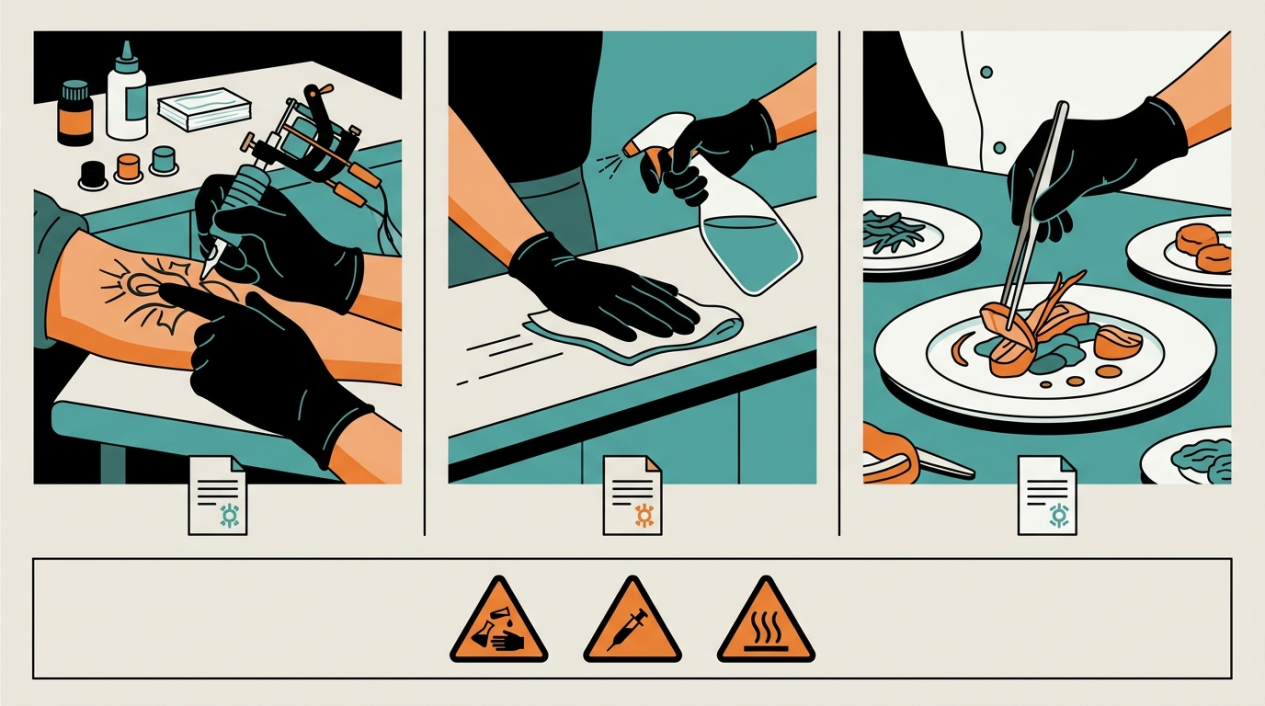
Disposable black nitrile gloves are not cut-resistant gloves, thermal mitts, or automatically chemical-resistant gloves. They do not prevent puncture from a needle or blade. They do not make a hot pan safe to handle. They do not turn an off-label disinfectant use into an approved one. They do not replace tongs, splash protection, ventilation, engineering controls, hygiene, training, or exposure procedures.
Double-gloving also is not a universal repair for the wrong product. In some defined workflows, a written procedure may call for two layers, but adding a second thin glove does not create documented chemical, cut, or heat protection. It may reduce dexterity and introduce new removal errors. Follow the applicable procedure and hazard assessment.
When a task combines hazards—such as cleaning a sharp contaminated instrument or handling a hot greasy component—assess all hazards together. The correct system may require engineering controls, specialized reusable gloves, tools, and sequencing rather than a thicker disposable glove.
Specify the exact black nitrile glove
A B2B specification should make substitutes testable. Record:
- legal manufacturer, factory, brand, product name, model, and catalog number;
- intended use and applicable product category or regulatory status;
- material declaration, black colorant/formulation, powder status, and accelerator information where relevant;
- thickness by location, dimensions, cuff length, surface texture, sizes, and handedness;
- barrier, physical, quality, food-contact, medical, or chemical documentation relevant to the intended task;
- storage conditions, shelf life, lot coding, traceability, complaint handling, and change notification;
- dispenser configuration, case quantity, palletization, lead time, and approved backup SKU;
- prohibited tasks and mandatory change triggers.
Avoid copying a certification or test result from one color, thickness, plant, or product family onto another SKU. Ask the supplier to map each document to the exact item being quoted. If the page says "food safe," "medical grade," or "chemical resistant," request the underlying intended-use and performance evidence.
Fit is part of the specification. A glove that is too tight may be stressed during donning and increase fatigue; a loose glove may bunch, snag, or reduce control. Test all required sizes with representative motions from each approved task. Track tears, slippage, failed donning attempts, premature changes, and user feedback without encouraging staff to work through irritation.
Run a controlled trial and standardize change triggers
Use no more than two documented candidates per task family. Train the same procedure first, then observe representative shifts. Measure glove consumption per completed task, tears, fit failures, change compliance, donning time, employee acceptance, and any process interruptions. For cleaning, include only chemicals and contact durations covered by the trial plan and safety review.
Approve one primary and one reviewed backup SKU for each task family. Put the approved task, sizes, product code, disposal route, and change triggers at the point of use. Review the file whenever the supplier, formulation, plant, package, regulation, chemical, menu, or work process changes.
The result may be three different black nitrile gloves—or a black nitrile glove in one area and a different protective solution elsewhere. Standardization is useful only when it preserves the task-specific evidence.
Buyer FAQ
What are black nitrile gloves used for?
Common professional uses include tattoo workflow, selected commercial-cleaning tasks, and food handling. Suitability depends on the exact glove and task documentation, not color alone.
Why do tattoo artists use black gloves?
Fit, tactile control, appearance, and contrast can be useful, but black is not a safety rating. Tattoo work still requires bloodborne-pathogen controls, correct glove changes, sharps safety, and applicable local compliance.
Are black nitrile gloves food safe?
Some exact products may be documented for food contact. Black color and nitrile material alone do not prove that status or define permitted foods, temperatures, and contact conditions.
Can black nitrile gloves be used with bleach or degreaser?
Do not answer from color or material name. Check the chemical label, SDS, employer hazard assessment, and manufacturer compatibility data for the exact glove, concentration, duration, and temperature.
Do black gloves show contamination?
They may show light-colored material clearly but can conceal dark soil, ink, grease, or blood. Change by defined contact and task triggers, not visible cleanliness.
Black nitrile gloves are valuable when a verified product fits a defined task. The responsible buying sequence is hazard first, documentation second, fit trial third, color last. That approach supports professional presentation without allowing appearance to stand in for protection.