
Why Are Black Nitrile Gloves So Expensive? A Procurement Cost Breakdown
Open two quotes side by side — a case of blue nitrile and a case of black nitrile in the same size, same thickness, same AQL — and the black line item is almost always higher. For a procurement manager filling a recurring order, that gap is not a curiosity; it’s a budget variance that has to be explained to finance every quarter.
The question “why are nitrile gloves so expensive” usually gets a consumer-grade answer: supply and demand, COVID, inflation. That’s true but useless at the RFQ table. What a buyer actually needs is the cost stack — where each cent of the unit price comes from, which of those drivers is fixed chemistry and which is negotiable, and where black specifically adds a premium. This guide breaks the price down the way a manufacturer sees it, then turns that into levers you can pull to bring your landed cost down.
What Goes Into the Price of a Nitrile Glove?
Before isolating the black premium, it helps to see the full cost stack of any nitrile glove. The unit price you’re quoted is the sum of five layers:
- Raw material (NBR). Nitrile butadiene rubber is a synthetic copolymer of acrylonitrile and butadiene — both petrochemical derivatives. Their prices track crude oil and regional petrochemical capacity, so the single largest input in a nitrile glove is also the most volatile.
- Energy. Glove dipping lines run hot, continuous, and 24/7. Coagulation, leaching, and vulcanisation ovens make energy a major and rising share of the cost — especially for manufacturers in higher-tariff power markets.
- Capital and capacity. A modern dipping line is a multi-million-dollar asset. Depreciation, maintenance, and the utilisation rate of that line are baked into every glove. Idle capacity makes gloves more expensive; full, efficient lines make them cheaper.
- Compliance and testing. Certification, lab testing, and AQL inspection are not free — and for medical grade they are substantial (more on this below).
- Logistics. Gloves are light but bulky. Ocean freight, container availability, and currency swings move the landed cost long after the factory price is set.
Notice that only one of these five — raw material — is pure chemistry. The other four are operational, and operational costs are exactly where a large-scale manufacturer’s efficiency shows up in your quote.
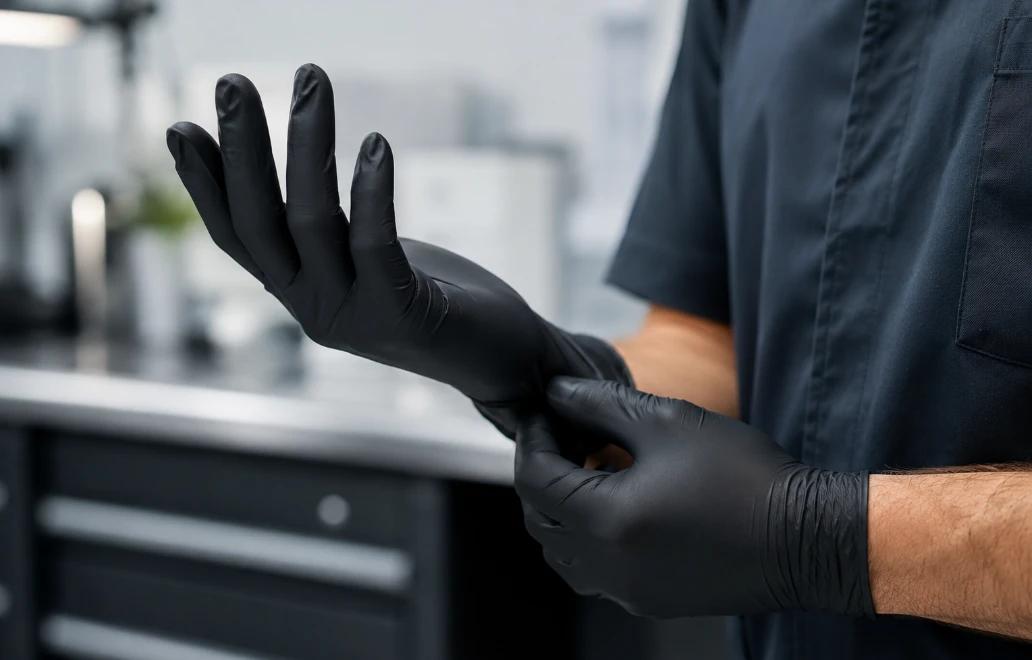
Why Black Nitrile Specifically Costs More
Color is not a free attribute. Most disposable nitrile gloves are blue precisely because blue pigment is cheap, stable, and the default in the industry’s supply chain. Black is a deliberate, costlier choice for three reasons:
The pigment and compounding step. Black nitrile gets its colour from carbon black or specialty black pigment dispersed into the NBR compound. Achieving a deep, uniform black that won’t streak or fade across a high-speed dipping line requires more pigment loading and tighter compound control than a pastel blue. That’s added material and added process tolerance — both of which cost money.
Smaller production runs. Blue is the volume color. Black runs in shorter batches, which means more frequent line changeovers, cleaning, and lower economies of scale per run. Fixed setup cost spread over fewer gloves raises the per-unit price.
Demand-driven premium. Black nitrile is the go-to in tattoo studios, automotive and mechanical work, janitorial fleets, law enforcement, and BBQ/foodservice — sectors that value the professional look and the fact that grime and grease don’t show. Strong, growing demand in those niches supports a price premium that blue, as a commodity, doesn’t carry.
If black is what your operation needs — for branding, for hiding stains, or because your team simply expects it — the premium is real but manageable at volume. INTCO’s disposable black nitrile gloves are produced on the same large-scale lines as our high-volume colors, which is what keeps the black premium to a margin rather than a multiple.
The Hidden Cost Driver: Medical-Grade Certification
Here’s where two black nitrile gloves that look identical can differ in price by 30% or more: certification grade.
A medical-grade exam glove must clear a stack of requirements an industrial glove never touches. In the US that means FDA 510(k) clearance, conformance to ASTM D6319 (the standard governing nitrile examination gloves), biocompatibility testing under ISO 10993, and a pinhole acceptable quality level (AQL) of 1.5 or tighter. Each of those is a recurring cost — lab fees, documentation, tighter inspection, more rejected product — and all of it lands in the unit price.
This is why a buyer can’t compare quotes on price alone. An industrial-grade black nitrile glove at a lower AQL is a legitimately cheaper product; it is not the same product as a 510(k)-cleared, medical-grade nitrile exam glove and should never be substituted into a clinical or regulated setting to save money. The right move is to specify the grade your application truly requires — and pay for certification only where compliance demands it, not by default.
Market Forces Behind Price Volatility
Even with the cost stack fixed, the number on your quote moves month to month. When you’re trying to judge whether a supplier’s increase is fair, these are the four forces actually behind it:
- Petrochemical feedstock prices. Acrylonitrile and butadiene move with crude and with regional petrochemical capacity. A spike upstream reaches your quote within a quarter.
- Capacity and utilisation cycles. The 2020–2022 boom-and-bust left the industry oscillating between shortage pricing and oversupply discounting. Where the cycle sits today shapes your leverage.
- Freight and currency. Container rates and USD exchange swings can move landed cost more than the factory price itself — and they’re outside any single factory’s control.
- Regional energy and labour costs. Two factories quoting the same glove can differ simply because one runs on cheaper, more stable power.
The practical takeaway for a buyer: a quote that rises in lockstep with published NBR and freight indices is defensible. A quote that rises faster than the indices is a negotiation — or a signal to re-bid. Understanding the cost structure is what lets you tell the difference instead of taking “prices are up” at face value.
How Procurement Teams Can Lower the Cost
Knowing why black nitrile is expensive is only useful if it changes what you do next. There are two reliable levers.
Lever 1 — Source from the manufacturer, not the middle of the chain. Every distributor layer between you and the dipping line adds margin. Buying direct from a large-scale producer — and consolidating volume into fewer, larger POs — lets you capture economies of scale, lock pricing against the volatility above, and secure supply continuity when the market tightens. This is also where OEM/ODM partnerships pay off: stable formulation, your specification, your branding, at manufacturer cost. INTCO’s nitrile glove OEM manufacturing is built for exactly this — global capacity, full certification, and private-label programs that take the distributor markup out of your landed cost.
Lever 2 — Right-size the glove to the task. Paying for medical-grade black nitrile on a job that doesn’t need it is a quiet, recurring overspend. For many general-purpose, foodservice, and light-industrial applications, a cost-effective alternative to nitrile makes more sense: INTCO’s Synmax Pro uses chemically modified vinyl to deliver a nitrile-like fit and elongation at a meaningfully lower cost. Reserve premium nitrile for the tasks that genuinely require its chemical and puncture resistance, and you cut spend without cutting protection where it counts.
Frequently Asked Questions
Are black nitrile gloves more expensive than blue nitrile gloves?
Usually yes, at the same grade and thickness. The premium comes from costlier black pigment loading, tighter compound control, shorter production runs, and stronger niche demand — not from any difference in protective performance.
Are black nitrile gloves food-safe?
They can be, if they’re produced to food-contact standards. Don’t assume it from the colour — confirm food-safe certification on the spec sheet, exactly as you would for any other glove.
Why did my nitrile glove price go up this year?
Most of the movement traces to petrochemical feedstock (acrylonitrile/butadiene) prices, freight and currency swings, and where the industry sits in its capacity cycle. Compare your increase against published NBR and freight indices to judge whether it’s fair.
Is cheaper black nitrile lower quality?
Not necessarily — but a lower price often means a lower grade or looser AQL. The risk is substituting an industrial-grade glove into a medical or regulated setting. Always compare on grade and AQL, not on price alone.
The Bottom Line for Buyers
Black nitrile gloves are expensive for mostly rational reasons: volatile petrochemical inputs, energy-intensive production, a genuine pigment and compounding premium for black, and — where it applies — the real cost of medical-grade certification. What’s not rational is paying more than your application requires, or absorbing distributor markup you could source around.
As one of the world’s largest nitrile glove manufacturers, INTCO Medical builds gloves at every point on that cost curve — from premium 510(k)-cleared black nitrile to budget-conscious Synmax alternatives — with the global capacity to hold pricing stable through the market swings above. If you’re trying to bring your glove spend under control, the fastest path is a direct manufacturer quote with full certification provided at the RFQ stage, not after the first shipment.
Ready to benchmark your current pricing? Request a bulk quote from INTCO Medical and compare your landed cost against a direct-from-manufacturer baseline.