
Are Powdered Latex Exam Gloves Safe? U.S. Rules
For U.S. medical use, powdered patient examination gloves are not a current purchasing option. FDA's final rule banned powdered patient examination gloves, powdered surgeon's gloves, and absorbable powder used to lubricate surgeon's gloves; the rule became effective on January 18, 2017. Powder-free natural-rubber-latex examination gloves may still be marketed when they meet the applicable requirements, but “powder-free” does not mean “non-latex” or “allergy-free.”
That distinction is the heart of the buying decision. Powder status and material are separate axes. A powder-free glove can be made from natural rubber latex, nitrile, vinyl, or another polymer. A buyer therefore needs to verify both the powder status and the exact material—along with the product's intended medical use, FDA status, labeling, performance documentation, size range, and lot traceability.
Direct answer for U.S. healthcare buyers
The relevant question is not whether a purchaser prefers powdered or powder-free latex examination gloves. In U.S. healthcare, the specified powdered medical glove devices covered by FDA's ban cannot lawfully be offered for sale. A procurement specification for patient examination gloves should therefore exclude powdered patient examination gloves and focus on compliant powder-free choices.
Powdered medical examination gloves are not intended for current U.S. healthcare purchasing due to FDA restrictions. Product availability and market eligibility depend on applicable regulations in each region.
The Federal Register final rule names three categories: powdered surgeon's gloves, powdered patient examination gloves, and absorbable powder for lubricating a surgeon's glove. It does not say that every natural rubber latex glove is banned, nor does it establish one worldwide rule for every industrial, household, or food-service glove. This article is specifically about medical examination-glove purchasing in the United States.
If legacy powdered medical gloves are found in a facility, do not improvise a clinical use or relabel them. Quarantine the stock from use and escalate it through the organization's supply-chain, infection-prevention, occupational-health, risk-management, and regulatory procedures for documented disposition.
Powdered and powder-free describe a treatment, not the material
Historically, powder was used to make gloves easier to don. “Powdered” describes the presence of powder for purposes other than manufacturing; “powder-free” describes a glove processed to limit residual powder. Neither term, by itself, identifies whether the glove film is natural rubber latex or a synthetic polymer.
This two-axis view prevents two common errors. First, a powder-free latex glove is not a non-latex glove. Second, a synthetic powder-free glove is not automatically suitable for every medical task. Its clearance, barrier performance, fit, compatibility, and labeling must still match the intended use.
Why FDA banned specified powdered medical gloves
FDA concluded that the covered devices presented an unreasonable and substantial risk of illness or injury that could not be corrected through labeling or a change in labeling. The final rule discusses multiple pathways, not just inconvenience during donning.
For natural rubber latex gloves, powder could carry latex proteins into the air, increasing inhalation and skin exposure in healthcare environments. FDA also identified risks associated with powder reaching exposed tissue, including inflammation and foreign-body reactions. These concerns affected healthcare workers and patients and were not limited to people already known to have a latex allergy.
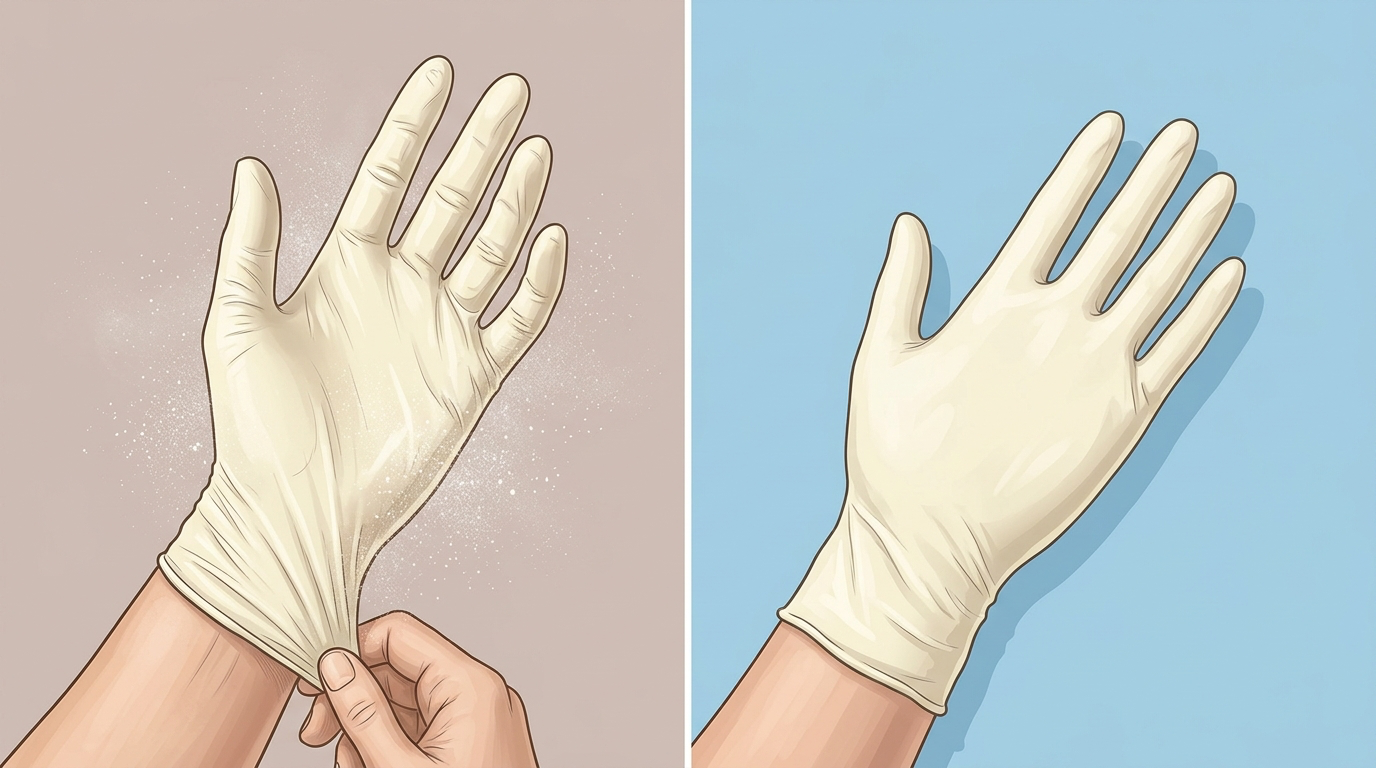
The ban is therefore more precise than statements such as “powder is messy” or “powdered gloves are outdated.” It is a medical-device safety rule. It also should not be distorted into “FDA banned latex gloves.” Powder-free natural rubber latex medical gloves remain a distinct category, subject to applicable medical-device requirements.
For exact regulatory wording, buyers can also consult the current eCFR entry for 21 CFR 895.103, Powdered patient examination glove. Because regulations, guidance pages, and database records can change, a regulated procurement program should recheck the current source rather than copy a supplier's old summary.
Powder-free latex still contains natural rubber latex
Removing donning powder reduces one exposure pathway; it does not remove the natural rubber latex material. A powder-free natural rubber latex glove is still made from natural rubber latex and may contain residual natural rubber latex proteins. It should not be treated as a universal solution for workers or patients with known or suspected natural rubber latex allergy.
Skin complaints also do not all have the same cause. Irritant contact dermatitis, delayed allergic contact dermatitis associated with certain chemicals, and immediate reactions to natural rubber latex proteins are different categories. A blog cannot diagnose which one is present. Workers who develop symptoms, or facilities managing a known sensitivity, should follow the organization's exposure-response procedure and seek evaluation from a qualified medical or occupational-health professional.
The FDA's medical gloves overview identifies synthetic options such as PVC, nitrile, and polyurethane for users or patients with natural rubber latex allergy. This is not a declaration that every synthetic glove is reaction-free or appropriate for every procedure. Formulation additives, fit, task hazards, and individual factors still matter.
Label language deserves the same care. FDA latex labeling recommendations advise manufacturers against unqualified statements such as “latex-free” when complete absence of allergenic natural-rubber-latex components cannot be reliably assured. The recommended concept is more specific: the product or container is not made with natural rubber latex. Buyers should review the exact package and regulatory file rather than infer material from color or a marketplace filter.
Compare powder-free latex and non-latex examination gloves
Powder-free natural rubber latex
Natural rubber latex is valued for elasticity, close fit, and tactile sensitivity. INTCO's Latex Exam Gloves product family page includes powder configuration information and medical-examination applications. It does not establish that every configurable SKU is powder-free. For U.S. medical purchasing, the quote and supporting file must identify an exact powder-free item and verify the manufacturer, FDA listing or clearance where applicable, labeling, current test reports, and natural-rubber-latex warning information.
This category may be considered where natural rubber latex is permitted by facility policy and the needs of workers and patients have been addressed. It is not appropriate to call the category non-latex merely because it is powder-free.
Nitrile examination gloves
Nitrile is a common synthetic alternative when an organization is reducing natural rubber latex exposure. INTCO's Nitrile Exam Gloves options page lists medical-grade products in multiple thicknesses and colors. For regulated purchasing, verify the exact material statement, package wording, and FDA record rather than relying on a product-family description.
Nitrile formulations vary in fit, elongation, thickness, texture, accelerator chemistry, and resistance to specific substances. A generic claim that nitrile is always “safer” or “more chemical-resistant” is too broad. Select against the task, anticipated exposure, product labeling, and the facility's risk assessment.
Other synthetic examination-glove options
Product terminology can be confusing. A phrase such as “synthetic latex” may describe a synthetic elastomer and should not be interpreted as a complete material declaration. INTCO's Syntex™ synthetic latex examination gloves are made from synthetic latex and are not made from natural rubber latex. Buyers should still verify the exact product documentation, labeling, regulatory record, performance specification, and intended-use documentation.
Vinyl/PVC, polyurethane, polychloroprene, and other polymers may also appear in the market. The correct shortlist depends on the procedure, exposure, required barrier, fit, tactile needs, duration, staff and patient considerations, and facility policy—not on material name alone.
Verify the exact medical glove, not a marketplace claim
“Medical grade,” “exam grade,” and “FDA approved” are not enough as unsupported sales phrases. FDA describes medical gloves as Class I reserved devices that generally require 510(k) premarket notification. A buyer should verify the applicant/manufacturer and device record for the exact product and intended use.

Build the procurement file around evidence that can be traced to the quoted SKU:
- legal manufacturer, manufacturing site, brand, model, catalog number, and UDI or other identifiers where applicable;
- intended use and glove type, such as patient examination versus surgical or non-medical use;
- powder-free status and exact material statement on current labeling;
- applicable FDA registration, listing, classification, and 510(k) record, checked in FDA databases rather than copied from a marketplace page;
- current physical-performance, barrier, biocompatibility, and residual-powder documentation applicable to the product;
- size range, dimensions, thickness, texture, cuff length, handedness, sterility status, and packaging configuration;
- lot traceability, shelf life, storage conditions, change notification, complaint handling, and recall communication;
- facility review for natural rubber latex exposure, skin complaints, and procedure-specific hazards.
An ASTM reference is useful only when it matches the glove type, edition, claimed result, and actual report. A standard name on a webpage does not prove that every SKU in a family was tested or that the product is cleared for the buyer's intended use.
Transition an organization away from powdered medical gloves
For most U.S. facilities, the transition happened years ago. A new acquisition, donated inventory, secondary-market purchase, or old emergency cache can still introduce questionable stock. Use a documented process:
- Search inventory by product code, description, package image, and powder status—not only by supplier name.
- Quarantine any powdered patient examination or surgeon's gloves from clinical use.
- Confirm the exact item and regulatory status with the manufacturer and current FDA sources.
- Choose a powder-free replacement based on task, material needs, fit, performance, regulatory record, and facility policy.
- Conduct a controlled size and usability trial without relaxing infection-prevention requirements.
- Update contracts, formulary records, substitute rules, storage locations, and training materials.
- Communicate the difference between powder-free and non-latex so employees do not treat them as synonyms.
- Route disposal, adverse-event, exposure, or recall questions through the organization's qualified regulatory and clinical channels.
Do not solve a shortage by accepting an unverified “equivalent.” Confirm the replacement's identifiers and documentation before distribution. A product with the same color and material can differ in thickness, fit, labeling, performance, and regulatory status.
Buyer checklist and FAQ
Are powdered latex exam gloves safe for U.S. medical use?
The covered powdered patient examination gloves are banned devices in the United States. They should not be purchased or used as a current patient-examination option.
Are powder-free gloves the same as latex-free gloves?
No. Powder-free refers to powder status; latex/non-latex refers to material. A powder-free glove may still be made from natural rubber latex.
Did FDA ban all latex gloves?
No. The final rule covers specified powdered medical glove devices and lubricating powder. It does not ban every powder-free natural rubber latex medical glove.
Is nitrile always the best replacement?
No universal replacement exists. Nitrile is a common synthetic candidate, but the exact product must fit the procedure, exposure, user, patient, regulatory, and performance requirements.
What should buyers request first?
Start with the exact product identifiers, current label, material and powder statement, intended use, FDA database records, performance reports, lot traceability, shelf life, and change-control process. Then run an approved fit and usability trial.
The practical conclusion is clear: U.S. healthcare buyers should not treat powdered versus powder-free latex examination gloves as two equivalent modern options. Exclude banned powdered medical gloves, separate powder status from material, and qualify the exact powder-free glove against the clinical task and regulatory record.