
Fast Food Gloves: Best Options for High-Volume QSR Teams
The best fast food gloves are the ones matched to a specific QSR station, backed by appropriate food-contact documentation, available in the right sizes, and easy to change at the correct moment. For many restaurants, that means a small system rather than one universal glove: a fast-changing option for brief assembly tasks, a closer-fitting option for demanding prep, and task-specific protection for cleaning, heat, or cut hazards.
Price per box matters, but it is not the whole purchasing decision. A low-cost glove that tears, slows donning, or fits poorly can raise the cost of every completed order. A tougher glove can also waste money if it is used for a five-second task and discarded immediately. QSR operators should start with the station, observe the real change cycle, and then select the material and specification.
For a broader overview of glove selection for restaurant food handling, see our Best Gloves for Food Handling: Restaurant Guide.
Food-safety note
This guide provides general educational information for U.S. food-service operations. The FDA Food Code is a model code, while enforceable requirements vary by state and local jurisdiction. Follow current local rules, the exact product documentation, the restaurant's food-safety plan, and the regulatory authority with jurisdiction.
The short answer: choose QSR gloves by station
No material wins every fast food task. Begin with a controlled station map like the one below, then validate the choice in the actual restaurant.
| QSR station or task | Operational priority | Practical starting point | Change trigger | Important boundary |
|---|---|---|---|---|
| Sandwich, salad, garnish, and ready-to-eat assembly | Clean dispensing, dexterity, rapid changes | TPE, CPE, vinyl, or fitted nitrile candidate that is documented for the intended food contact | New task, interruption, contamination, soil, damage, or removal | Gloves do not replace handwashing |
| Raw-protein preparation | Fit, grip, durability, controlled transition | Fitted nitrile candidate with suitable documentation | Before touching ready-to-eat food or clean equipment; also when damaged, soiled, or interrupted | A disposable glove does not prove cut protection |
| Bakery, pastry, and short portioning tasks | Fast on/off and economical changes | Loose-fit CPE or a suitable TPE candidate; use vinyl only for documented non-fatty food-contact tasks. | Every task change and any process break | Trial precision and fit with real motions |
| Fryer or grill support | Oil handling, dexterity, strict heat boundary | Suitable disposable glove only for non-hot food-contact steps | When changing tasks or after contact with contaminated surfaces | Use task-specific thermal PPE for hot equipment or food |
| Cashier-to-food transition | Clear separation of money, screens, doors, and food | Remove gloves, wash and thoroughly dry hands before the food task, then don a fresh pair if that task calls for one | Every transition | Wearing gloves at the register can spread contamination |
| Cleaning and sanitation | Chemical compatibility and cuff coverage | Reusable or disposable chemical glove selected from the cleaner label/SDS and PPE assessment | Per the chemical and PPE procedure | Food-prep gloves may be unsuitable for cleaners |
The correct row is determined by the work, not by a broad label such as “food grade.” Even within one material, formulation, thickness, texture, size, cuff length, and intended-use documentation can differ.
Start with the food-safety workflow, not the material
Fast food gloves are a barrier used inside a larger hygiene system. The 2022 FDA Food Code is a model for retail and food-service regulation. Its provisions generally address preventing bare-hand contact with exposed ready-to-eat food, washing hands at required times, and using single-use gloves for one task. State and local adoption can differ, so a chain needs a process for translating the applicable code into store-level instructions.
For procurement, the important lesson is simple: a glove's usable “life” is often set by the task transition, not by whether the film still looks intact. A glove worn for only 30 seconds may need to be discarded after handling money, touching a phone, moving from raw food, taking out waste, or leaving the station. A glove worn during a stable, uninterrupted prep task may remain in use longer, subject to the operation's procedure and applicable requirements.
That makes change behaviour part of the specification. A glove should be easy to take from the box without pulling out several more. Staff should be able to don it on properly washed and dried hands. The dispenser must sit near the point of use but away from splashes, raw-product contamination, heat, and food-contact surfaces. If correct behavior is awkward during the lunch rush, the purchasing decision is incomplete.
Compare CPE, TPE, vinyl, and nitrile for fast food work
CPE for brief, frequent-change tasks
CPE (Cast Polyethylene) gloves are typically loose-fitting and quick to put on and remove. That can make them a useful candidate for short bakery, counter, or portioning tasks where dexterity demands are modest, and changes are intentionally frequent. Their suitability still depends on the exact product and food-contact conditions.
INTCO's cost-effective CPE gloves page lists Food Processing as an industry and features a rhombus texture. A buyer should request the current declaration for the exact SKU, color, thickness, manufacturing site, food type, contact time, and temperature rather than relying on a family-level webpage.
TPE for a closer, flexible alternative
TPE gloves can offer a more flexible and closer fit than some loose polyethylene-style options while retaining convenient donning for repetitive food-service work. They may be worth trialling on sandwich, salad, bakery, cafeteria, or catering lines where employees need more control than a very loose glove provides but still change often.
INTCO describes its disposable TPE gloves for food prep in several colours and textures and lists food handling and preparation among the applications. Treat those statements as the start of supplier qualification. Confirm the product’s documents and test it under the restaurant’s actual foods, temperatures, movements, and change rate.
Vinyl for light-duty, cost-controlled use
Vinyl can be considered for short, light-duty, non-fatty food-contact tasks when a latex-free option and predictable unit cost are priorities, provided the exact product documentation covers the intended conditions of use. Fit is often looser than nitrile, so it should be tested for bunching, slippage, finger control, tearing during donning, and employee acceptance. An inexpensive glove is not economical if staff double-glove without authorisation or discard several attempts to get a usable fit.
INTCO lists its disposable vinyl gloves as powder-free, non-sterile, latex-free PVC gloves for selected food-processing and general-use applications. For food contact, the exact SKU's declaration and conditions of use must match the intended food type, contact time, and temperature.
Nitrile for fitted, higher-control prep
Nitrile is often a practical trial candidate when closer fit, grip, tactile control, or durability is more important than the lowest unit price. Examples include demanding preparation tasks, oily ingredients, raw-protein portioning, and stations where repeated tears would interrupt production, provided the exact glove is documented for the intended food-contact conditions. Thickness and texture can change performance substantially.
Nitrile is not automatically the best choice for every QSR station. It may be unnecessary for extremely brief tasks, and a generic nitrile glove should never be assumed to protect against every cleaner, blade, or hot surface. Natural-rubber-latex-free construction also does not mean that no user can react to any formulation ingredient. Employee skin concerns belong in the operation's occupational-health process.
Match the glove to six common QSR stations
Ready-to-eat assembly. Prioritise clean dispensing, correct fit, fingertip control, and rapid changes. Tongs, deli tissue, spatulas, or other suitable utensils may sometimes be the better control. Follow the restaurant’s approved procedure and local requirements for glove and utensil choices.
Raw-protein prep. Use a glove that maintains grip and fit throughout the defined task. The critical control is the transition out of the raw area: remove the glove, discard it, wash and thoroughly dry hands before the ready-to-eat food task, don a fresh glove if that task calls for one, and prevent contaminated clothing from touching food, clean utensils, refrigerator handles, or touchscreens.
Fryer and grill support. Separate food-contact steps from heat exposure. A thin disposable glove is not a substitute for a mitt or glove selected and rated for thermal hazards. The same boundary applies to knives and slicers: food-contact status does not establish cut resistance.
Drive-through and cashier work. A gloved hand can contaminate a screen, payment device, headset, handle, cup lid, or food wrapper just as a bare hand can. Define when employees remain in a non-food role and when they must transition, wash, and put on a new glove for a food task.
Orders requiring allergen cross-contact controls. A fresh glove may be one step, but it is not the entire control. Follow the restaurant's complete procedure for hands, contact surfaces, utensils, equipment, ingredients, labels, and communication. Do not market a glove color or material as “allergen-safe.”
Cleaning. Read the cleaner label, safety data sheet, and the employer's PPE assessment. A disposable food glove may lack the required chemical compatibility or cuff coverage. Never return a cleaning glove to food preparation.
Make correct glove changes easy during the rush
Training should describe observable actions, not vague reminders to “change often.” A practical cycle is:
- Stop and identify the next defined task.
- Remove the used glove without contacting its contaminated exterior, then discard it.
- Wash and thoroughly dry hands before beginning the food task and before donning fresh gloves for food preparation. Applicable local rules and the restaurant's procedure may add requirements.
- Take a fresh glove from a clean, undamaged dispenser and don it without contaminating the glove.
- Perform one task without touching unrelated surfaces.
- Change immediately after contamination, soil, damage, removal, interruption, or a task transition.
- After removal, wash and thoroughly dry hands before another food task or a new pair, consistent with CDC guidance and any additional applicable local requirements.
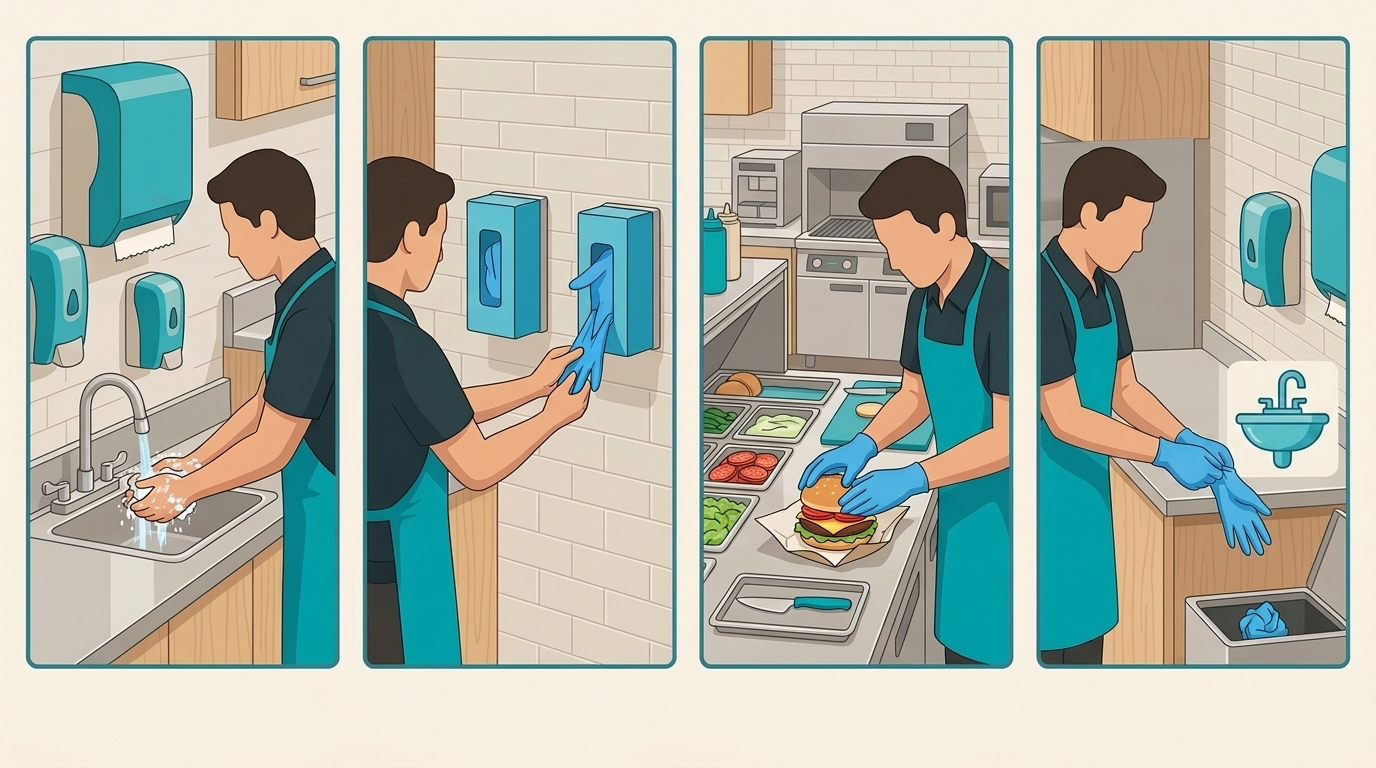
The CDC's norovirus information for food workers reinforces that gloves and utensils are used alongside careful handwashing and illness controls. A box of premium gloves cannot compensate for an employee working with symptoms contrary to public-health guidance or for a workflow that moves contamination across stations.
Placement matters. Put the approved glove and required sizes within easy reach of the designated task, but do not mount boxes where splash or raw-food contact can contaminate them. Make removal and waste disposal equally convenient. During a rush observation, count how often employees must leave the station to find a size, fight an overfilled dispenser, or touch a cabinet with contaminated gloves. Those small frictions reveal why written rules fail in practice.
Calculate cost per completed task
Compare candidates with the same observation period and the same food-safety rules. A practical trial metric is:
Total glove cost per completed task = [(gloves consumed × landed cost per glove) + interruption cost + glove-related discarded-food cost] ÷ completed tasks.
Record the task definition, orders completed, gloves consumed, tears, failed donning attempts, fit-related changes, redonning time, and any food discarded after a process break. Keep observation windows comparable. Do not compare a “per sandwich” number at one store with a “per labor hour” number at another without converting both to the same basis.
A higher-priced fitted glove may reduce tears on a demanding station. A lower-priced CPE, TPE, or vinyl glove may win on a brief task with frequent intentional changes. The right answer comes from a controlled trial, not a material stereotype.
Also include logistics in landed cost: case quantity, pallet configuration, freight, minimum order, lead time, damaged boxes, remaining shelf life, and the risk of emergency substitutions. For a multi-unit chain, a small saving per glove can be material, but so can a wrong size mix that strands unusable inventory.
Standardize the chain specification without over-standardizing
Most QSR systems benefit from fewer approved SKUs, but “one glove everywhere” can create safety and usability gaps. Standardize at the task-family level. For each approved glove, document:
- manufacturer and exact product code;
- material, color, texture, thickness, cuff length, and size range;
- approved stations and prohibited tasks;
- food-contact declaration and covered conditions of use;
- lot identification, shelf life, storage conditions, and traceability;
- case and pallet configuration, lead time, and complaint process;
- primary supplier and a technically reviewed backup SKU;
- change-control notification for formulation, factory, or documentation updates.
Use workforce data for the size mix. A medium-heavy case allocation may look efficient but can drive tearing and fatigue for employees who need large gloves and loss of control for employees who need small. Trial every offered size with normal motions such as opening bags, using tongs, placing garnish, sealing containers, and reaching across the station.
An approved substitute should be qualified before a shortage. “Same color and material” is not enough. Compare dimensions, film thickness, texture, fit, food-contact scope, packing, dispenser behavior, and actual use data. Give stores a controlled substitution rule so local teams do not buy an undocumented product during a supply disruption.
Consider a two-week QSR glove trial
A two-week trial can be a practical starting point. Select no more than two documented candidates per task family. Train the same handwashing and change procedure, then test across representative quiet and peak shifts. Score fit by size, donning speed, grip, dexterity, tears, glove consumption, employee acceptance, and supervisor-observed compliance. Investigate skin complaints through the appropriate occupational-health channel.
At the end of two weeks, choose the glove that produces the best safe completed work—not simply the fewest gloves used. Confirm the primary and backup SKU, publish the station map, set par levels by size, and schedule a review after the first full purchasing cycle. Re-open the decision when the product, supplier, menu, equipment, regulation, or work process changes.
For quick-service restaurants, the strongest glove program is deliberately boring: a few verified products, obvious placement, correct sizes, clear task boundaries, easy disposal, and change behavior that survives the lunch rush. That operating system—not a single “best” material—is what turns fast food gloves into a dependable food-safety and procurement control.