
Best Gloves for Food Handling: Restaurant Guide
The best gloves for food handling are the gloves that fit the specific restaurant task, carry appropriate food-contact documentation, and can be changed at the right moment without slowing the line. There is no universal winner. A fitted nitrile glove may suit longer, oily prep; vinyl may suit short, light-duty work; and CPE may suit brief tasks with frequent changes.
Start with the work, not the material or colour. Map each kitchen station, identify whether hands will touch ready-to-eat food, estimate how often the task changes, and separate food prep from chemical, heat, and cut hazards. Then trial the shortlisted glove in the sizes employees actually need.
Food-safety note: This guide provides general educational information for U.S. food-service operations. The FDA Food Code is a model code, while enforceable requirements vary by state and local jurisdiction. Follow current local rules, the exact product documentation, the restaurant's food-safety plan, and the regulatory authority with jurisdiction.
The best gloves for food handling depend on the task
A restaurant does not need one glove for every job. It needs a small, controlled glove system. The table below is a starting point for a site trial, not a substitute for local rules or product-specific documentation.
| Restaurant task | Selection priority | Practical starting point |
|---|---|---|
| Ready-to-eat plating, garnish, deli, or salad assembly | Tactile control, clean dispensing, reliable fit | A fitted disposable glove or a suitable utensil |
| Repetitive sandwich, bakery, or counter prep | Fast donning and frequent economical changes | Vinyl or CPE trial, if the exact SKU is suitable for the food and conditions of use |
| Oily ingredients, raw-protein portioning, or longer prep | Fit, grip, durability, and task compatibility | Nitrile trial |
| Order requiring food-allergen cross-contact controls | Clean hands, a new glove, clean tools and surfaces, and controlled ingredients | A new glove suitable for the food and conditions of use, as one part of the restaurant's food-allergen procedure |
| Worker with natural-rubber-latex sensitivity | Worker safety, correct material identification, and occupational-health procedure | A natural-rubber-latex-free glove selected under the operation's PPE and occupational-health procedure |
| Dishwashing and chemical sanitation | Chemical compatibility, cuff coverage, reuse policy | Task-specific chemical glove selected from the chemical label or safety data |
| Knife, slicer, oven, or hot-pan work | Cut or heat protection | Certified task-specific protective glove |
The first five rows may involve disposable restaurant gloves. The final two require a different hazard assessment. A glove labelled for food contact is not automatically cut-resistant, heat-resistant, or suitable for concentrated cleaners.
The FDA Food Code provides the operating foundation. Its model provisions generally prevent bare-hand contact with exposed ready-to-eat food unless an approved alternative procedure applies. They also state that single-use gloves are for one task and must be discarded when damaged, soiled, or when an interruption occurs. Hands must be washed when required, including before donning gloves for food preparation.
Verify food-contact suitability before comparing materials
“Food grade” is not a complete purchasing specification. Ask for evidence covering the exact glove, manufacturer, formulation, and intended conditions of use. Do not assume that a certificate for another color, thickness, factory, or product family applies to the SKU being quoted.
The FDA explains that a food-contact substance is evaluated or authorised in the context of its intended use. Its overview of how food-contact substances are regulated is a useful reminder not to reduce a complex status to the marketing phrase “FDA approved.” For procurement, request the supplier's food-contact declaration and the supporting regulatory references for the specific product and market. Check at least these items:
- product name, catalogue number, material, color, thickness, and manufacturing site;
- food types and temperatures covered by the declaration;
- any limits on contact time or conditions of use;
- powder-free and natural-rubber-latex status;
- lot identification, traceability, and change-notification process;
- storage instructions and remaining shelf life at delivery;
- test reports or certificates required by your customer, brand standard, or jurisdiction.
INTCO's separate guide to food-safe glove requirements covers that prerequisite in more depth. This article addresses the next question: which suitable glove is operationally right for each restaurant task?
Compare nitrile, vinyl, and CPE restaurant gloves by task
Nitrile: fitted control for demanding prep
Nitrile is a strong starting candidate when a task benefits from close fit, tactile control, textured fingertips, or greater resistance to tearing than a loose polyethylene-style glove. It is commonly considered for oily food prep, raw-protein portioning, longer assembly tasks, and stations where an unexpected tear would cause repeated stops.
That does not make every nitrile glove suitable for every food or chemical. Thickness, formulation, texture, and food-contact documentation still matter. INTCO's food-safe black nitrile gloves are listed as powder-free, non-sterile, latex-free, finger-textured, and intended for food and beverage processing among other uses. A purchaser should still match the exact specification and declaration to the restaurant's use.
Vinyl: economical for short, light-duty work
Vinyl can be practical where staff perform brief, low-complexity tasks and change gloves frequently. It is latex-free and usually easier to position as a cost-controlled option for counter service, portioning, or other light work. Its looser fit may be acceptable for some motions and frustrating for others, so a bench trial is more useful than a generic claim.
INTCO describes its cost-effective disposable vinyl gloves as powder-free, non-sterile, latex-free PVC gloves used in food processing and other general tasks. For a restaurant, the decision should turn on the exact food-contact documents, fit during real work, tear rate, and how many gloves a completed task consumes—not the box price alone.
CPE: verify the exact food-handling specification
INTCO's current CPE gloves for food prep page identifies the material as CPE, specifies a rhombus texture, and lists food handling and processing as uses. The page states that the product is compliant for food contact and lists related regulatory references. Procurement should obtain the current supporting declaration for the exact SKU and intended conditions of use rather than relying on the webpage alone.
Latex, TPE, hybrid, and other polyethylene gloves also exist. A complete assortment does not require every material. A restaurant usually benefits more from two or three well-controlled SKUs, available in the right sizes, than from a crowded storeroom of overlapping products.
Build the glove-change SOP before choosing a case pack
Glove performance depends on behaviour. A premium glove used across raw chicken, a refrigerator handle, and a finished plate is a poor control; an economical glove changed correctly may support a stronger process.
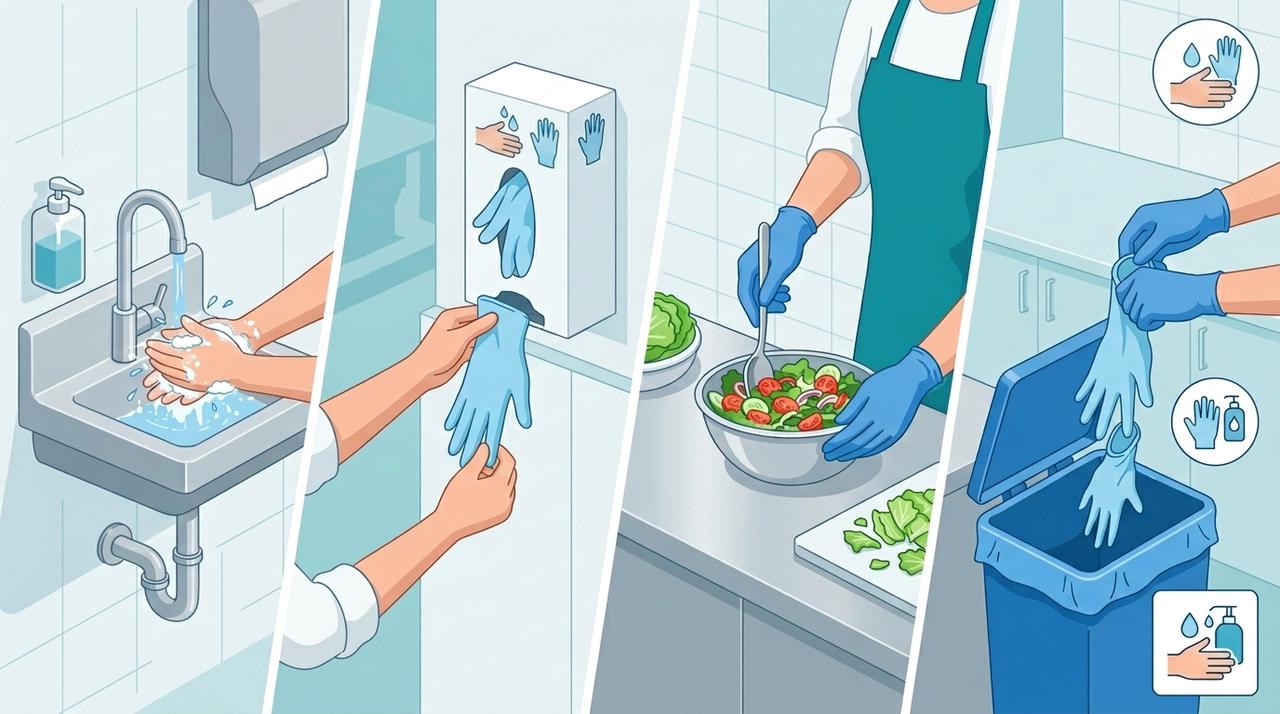
Use a simple sequence that supervisors can observe:
- Stop and identify the new task. Remove jewellery or other items if required by the operation's policy.
- Wash and dry hands correctly. Gloves go onto clean, dry hands; they do not seal contamination away safely.
- Take a glove without contaminating the dispenser. Keep boxes away from splashes, raw-food contact, and dirty equipment.
- Use it for one defined task. Do not move from raw food, waste, money, phones, door handles, or cleaning tools back to ready-to-eat food in the same gloves.
- Change immediately when the task changes or the glove is damaged, soiled, removed, or interrupted. For orders requiring food-allergen cross-contact controls, follow the restaurant's complete allergen procedure, including hands, tools, contact surfaces, and ingredients.
- Remove without touching the contaminated exterior, discard, then wash and dry hands. Complete that handwash before donning another pair or touching food, utensils, or clean equipment. Follow any additional timing, method, or sink-use requirements in the applicable local code and the restaurant's written procedure. Never wash or reuse a disposable glove.
The CDC's guidance for food workers on norovirus reinforces the two controls managers must train together: wash hands carefully and avoid touching ready-to-eat food with bare hands by using gloves or utensils. It also addresses illness exclusion. No glove selection can compensate for an employee preparing food while sick, contrary to public-health guidance and company policy.
Use fit, colour, and station assignment as controls—not safety claims
Buy a size mix based on the workforce, not a default medium-heavy order. A glove that is too tight can fatigue the hand and may be stressed during donning. A glove that is too loose can bunch, snag, and reduce control. During a fit trial, ask employees to pinch garnish, open a bag, use tongs, portion food, and reach across the normal work area. Record tears, slippage, and premature changes in size.
Color can make the system easier to follow. A restaurant might assign blue to general food prep, black to a visible service or raw-protein station, and clear to short counter tasks. But color is only a training cue. Black nitrile is popular partly because it presents a consistent professional appearance and can make light-colored ingredients visible against the hand; it can also make some dark residues harder to notice. Black does not prove food-contact suitability, thickness, barrier performance, or regulatory status.
Avoid creating a color system that is more complicated than the shift can remember. Post a one-page station map, label dispensers with the approved task and size range, and never let color override the change rule. If an employee wearing the “right” color touches the wrong surface, the glove still changes.
Calculate cost per completed task, not price per box
The lowest unit price can produce the highest operating cost if gloves tear, fit poorly, or are changed unnecessarily. Compare candidates with a simple trial metric:
Glove cost per completed task = [(total gloves consumed × landed cost per glove) + total interruption cost + total discarded-food and waste cost] ÷ completed tasks in the same observation period.
Use totals from one defined observation window in both the numerator and denominator. For each station, record the number of completed tasks, total gloves used, tears, changes caused by poor fit, time spent redonning, and food discarded after a process break. Keep the task definition stable. If you instead begin with average gloves consumed per task, combine it only with interruption and waste costs that have also been converted to per-task averages; do not mix per-task inputs with observation-period totals. Comparing “one glove per sandwich” with “one glove per 20-minute prep block” produces meaningless results unless both follow the same food-safety rules.
Also evaluate:
- size availability and the actual size mix per case;
- dispenser-box integrity and ease of taking one glove at a time;
- lot-to-lot fit and thickness consistency;
- case quantity, pallet configuration, lead time, and minimum order;
- supplier continuity, traceability, and handling of complaints;
- remaining shelf life and storage needs on arrival.
A slightly higher-cost glove may win if it reduces tears and interruptions during a demanding task. A lower-cost CPE or vinyl option may win where changes are intentionally frequent, and the task needs little dexterity. The correct answer is visible in controlled use data, not in a material stereotype.
Run a two-week restaurant glove trial
Choose no more than two candidates for each task. Confirm documentation first, then run both options across representative busy and quiet shifts for two weeks. Train the same change rules before the test so hygiene behaviour does not distort the material comparison.
Score each candidate on fit by size, donning, grip, dexterity, tear rate, employee acceptance, gloves consumed per completed task, and supervisor-observed compliance. Review any skin complaints through the restaurant's occupational-health process. Do not ask employees to “push through” irritation or assume latex-free means no one can react to any ingredient.
At the end, approve one primary SKU and one documented backup per task. Put the material, color, size range, product code, approved station, supplier, and food-contact document revision into the purchasing specification. Recheck the file when the supplier changes the formulation, factory, packaging, or regulatory declaration.
The best gloves for food handling are therefore not a single box on a best-seller list. They are a controlled system: verified products, matched to defined tasks, issued in the right sizes, changed at the right moments, and measured by safe completed work. That system protects food more reliably than choosing by colour, material name, or price alone.