
Disposable Vinyl or Nitrile Gloves: Which Is Better for Food Service Businesses?
Choosing between vinyl and nitrile can feel trivial—until torn fingertips, greasy slips, or a failed audit grind your line to a halt. If you’re weighing vinyl vs nitrile gloves for a busy U.S. kitchen, the decision should balance compliance and safety with total cost-per-use, not just price-per-box. Here’s the deal: vinyl is inexpensive and fine for short, low-risk tasks; nitrile is sturdier, fits better, and holds up against oils and incidental sanitiser splashes. This comparison lays out what matters most for food service gloves so your team stays compliant and your costs stay predictable.
Quick verdict for busy kitchens
If your crews handle raw proteins, cook on the hot line, or work around oils and fryer baskets, nitrile generally delivers the safer, more durable choice with fewer mid-task failures. For brief cold-prep and front-of-house tasks with frequent changes, vinyl can still be the economical option when used and discarded immediately. Regardless of material, align with the FDA Food Code’s no bare hand contact for ready-to-eat foods and change gloves when soiled or torn as described in the FDA Food Code overview.
Vinyl vs nitrile gloves at a glance
| Dimension | Vinyl (PVC) | Nitrile (NBR) |
|---|---|---|
| Material & composition | Polyvinyl chloride with plasticisers; low elasticity | Synthetic acrylonitrile–butadiene rubber; latex-free and elastic |
| Fit & tactile feel | Looser fit; lower dexterity for fine tasks | Snug, conforming fit with better tactile sensitivity |
| Puncture/tear resistance | More prone to pinholes and tearing under stress | Higher puncture and tear resistance under typical kitchen tasks |
| Oils/fats handling | Can harden or degrade; the grip may suffer | Resists animal fats and cooking oils; textured grip options maintain control |
| Sanitizer splash | Generally weak under quats/bleach exposure | Better tolerance; some SKUs carry EN ISO 374 Type B splash certification |
| Food-contact & allergens | Food-safe when compliant; verify plasticiser type for fatty foods | Food-safe when compliant; inherently latex-free and widely used as an alternative |
| Sizing/colors | Often, clear only limited colour-coding | Wide size runs are common in blue/black for fragment visibility |
| Best-for scenarios | Short cold prep, quick changes, FOH light portioning | Raw protein prep, hot line/fryer work, transitions with sanitisers |
Notes and sources in body text below.
Compliance and safety you can stand on
The current Food Code emphasises no bare hand contact with ready-to-eat foods and requires handwashing before donning, plus changing gloves when torn or contaminated. Those expectations anchor any decision about disposable food gloves and how often your team must replace them. Because state and local adoption varies (and some jurisdictions may allow alternative procedures under specific conditions), treat the Food Code as a baseline and confirm your local regulator’s requirements. You can review the framework directly in the FDA Food Code overview.
At the same time, OSHA’s hand protection rule (29 CFR 1910.138) requires employers to select gloves based on actual hazards—think oils/grease, puncture risks, abrasion, and incidental contact with sanitisers—while ensuring fit and comfort so workers keep them on. OSHA’s guidance also notes the importance of consulting manufacturer data for chemical compatibility and breakthrough time when relevant to the task. See OSHA’s hand protection page for the selection principles that explain why nitrile gloves are often chosen for the hot line and raw proteins, whereas vinyl can be a valid choice for low-risk, short-duration handling.
To reduce allergen risks, many operators standardise on latex-free materials. Nitrile is synthetic and latex-free by design, and both nitrile and vinyl can be labelled for food contact when compliant with applicable regulations. Always request supplier documentation for food-contact claims and, when handling high-fat foods, verify vinyl glove plasticiser information and intended-use statements. When sanitiser splash tolerance matters, check product markings and consult the ISO 374 overview to understand how EN ISO 374 Type B indicates tested splash resistance against specified chemicals.
Cost-per-use beats price-per-box in real kitchens
Price per box is easy to compare; total cost-per-use is where budgets live or die. Imagine a cold-prep station that changes vinyl gloves every two minutes: the ultra-low unit price may win. Now picture a fry station where heat and oils make a loose vinyl glove slip or tear; every failure means a fresh pair and a 30–60 second interruption. Over a shift, those extra changes (and the occasional dropped product) add up.
If a vinyl pair fails once every 20 minutes on the fryer but nitrile lasts a full task cycle without failure, the nitrile option may lower total glove consumption and downtime even with a higher per-glove cost. Add in procurement realities: tariffs and origin can influence landed costs in 2025–2026; multi-source contracts and negotiated volume tiers help stabilise spend. For scale, quality systems, and cross-region manufacturing, review a manufacturer’s company overview before you lock your next contract.
Durability and performance in the real world
In practice, nitrile’s elastic recovery and higher puncture resistance keep the barrier intact when trimming raw chicken, lifting fryer baskets, or portioning greasy proteins. That translates to fewer glove breaches, steadier grip, and fewer mid-task changes. Vinyl, by contrast, fits looser and can deform under tension; in contact with fats and oils, it’s more likely to lose integrity or become slippery, which erodes control and confidence at the station.
For sanitiser transitions—moving from sauté to a quick wipe-down with quats or a splash of diluted bleach—basic food service tasks still benefit from gloves that tolerate incidental exposure. Some nitrile SKUs carry EN ISO 374 Type B markings indicating tested splash resistance against specific chemicals, a signal to consult the product’s chemical chart and match it to your sanitiser concentrations and exposure time. If your team handles high-fat foods, consider confirming that any vinyl option you buy is labelled appropriately by the manufacturer and verify plasticizer information for that use case.
Best-for scenarios: choose with confidence
Raw protein prep and the fryer line
If your station handles raw proteins, bones, or hot, oily surfaces, a snug nitrile glove with textured fingertips helps maintain grip and barrier integrity. Operators who prefer a nitrile model with documented splash compatibility sometimes look to product lines certified to EN ISO 374 Type B when incidental sanitiser contact is likely; for example, ChemTuff disposable nitrile gloves are described as certified for chemical splash and are commonly positioned for tasks that mix grease and cleaning transitions. The goal isn’t marketing—it’s fit-for-purpose documentation you can show during audits and staff training.
Cold prep and sandwich assembly
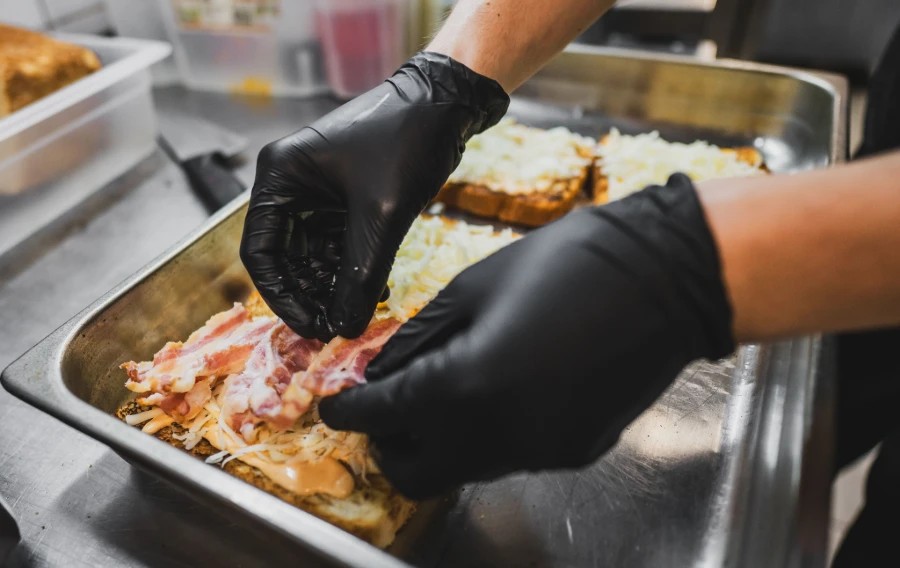
For short, dry assembly tasks with constant glove changes—think lettuce, buns, sliced deli meats—vinyl can be a cost-effective choice when each pair is used and discarded immediately. Keep glove-change SOPs tight: wash hands before donning, and change gloves whenever switching tasks or if a glove is nicked or soiled. Teams that notice frequent tears during busier rushes may still find that nitrile reduces interruptions despite the higher unit price.
Front-of-house portioning and packaging
Portioning cookies, bagging chips, or placing lids can go either way. Many operators choose blue or black nitrile for better visibility and colour-coding in HACCP plans; clear vinyl remains an economical option when tasks are quick and low risk. If you see fragments or glove pieces as a hazard in your HACCP analysis, the visibility benefit of colored nitrile can be worth the switch.
Cleaning and sanitising transitions
When incidental contact with sanitiser solutions is part of the workflow, nitrile generally performs better than vinyl. Look for documentation and markings that align with your chemical inventory. If you want an example of a nitrile line marketed with splash compatibility for specific chemicals, explore certified options and match the chem codes to your quats or bleach concentrations and dwell times.
Buying checklist without the fluff
Ask suppliers for food-contact compliance statements and any applicable testing or standards markings, especially if your menu features high-fat foods. Confirm latex-free labelling for nitrile and clarify plasticiser details for vinyl. Choose colours and sizes that support your HACCP program and fragment visibility; blue or black nitrile often stands out on the line and in finished foods. Finally, negotiate contracts that address origin, tariff exposure, lead times, and alternates, and designate a primary and secondary source so you’re not caught short when demand spikes. If you’re comparing portfolios from large-scale manufacturers with global supply capability, start on the INTCO homepage, review the company background, and follow up with procurement questions via INTCO’s contact page.
Throughout this guide, you’ll find official references and examples to support decisions: the FDA Food Code overview and Food Code 2022 detail glove practices; OSHA’s hand protection outlines hazard-based selection; and the ISO 374 overview explains splash markings. Representative pricing examples for vinyl and nitrile are linked above to illustrate cost-per-use modelling in March 2026.
FAQ
Are nitrile gloves latex-free?
Yes. Nitrile is a synthetic, latex-free material and is recognised as an alternative for individuals with natural rubber latex sensitivities, as noted in FDA resources on medical gloves.
Which is better for food handling: vinyl or nitrile gloves?
It depends on the task. For oily or hot work and raw protein prep, nitrile usually wins on durability, grip, and barrier integrity. For short, dry, low-risk tasks with constant changes, vinyl can be more economical when used immediately and discarded.
What’s the difference between nitrile and vinyl gloves?
Material and performance. Nitrile (NBR) is elastic, puncture-resistant, and resists oils and incidental sanitiser splashes; vinyl (PVC) is less elastic, more tear-prone under stress, and can lose integrity with fats and oils. Nitrile also offers broader colour-coding options.
Nitrile gloves vs vinyl gloves for medical use—what changes?
In medical and exam-grade contexts, nitrile is commonly preferred for barrier performance and durability, with products conforming to specific FDA/ASTM expectations for medical gloves. Vinyl may appear in some non-critical tasks, but exam-grade nitrile dominates clinical use.
Which company makes the best nitrile gloves?
“Best” depends on documented standards compliance, consistent fit and thickness, textured grip options, clear food-contact or medical labelling, and reliable supply. Many buyers shortlist large-scale manufacturers with transparent quality systems and multi-plant capacity when they evaluate vendors; you can explore one such supplier’s portfolio starting at the INTCO Medical glove site.
