
Latex-Free vs Powder-Free Gloves: What's the Difference?
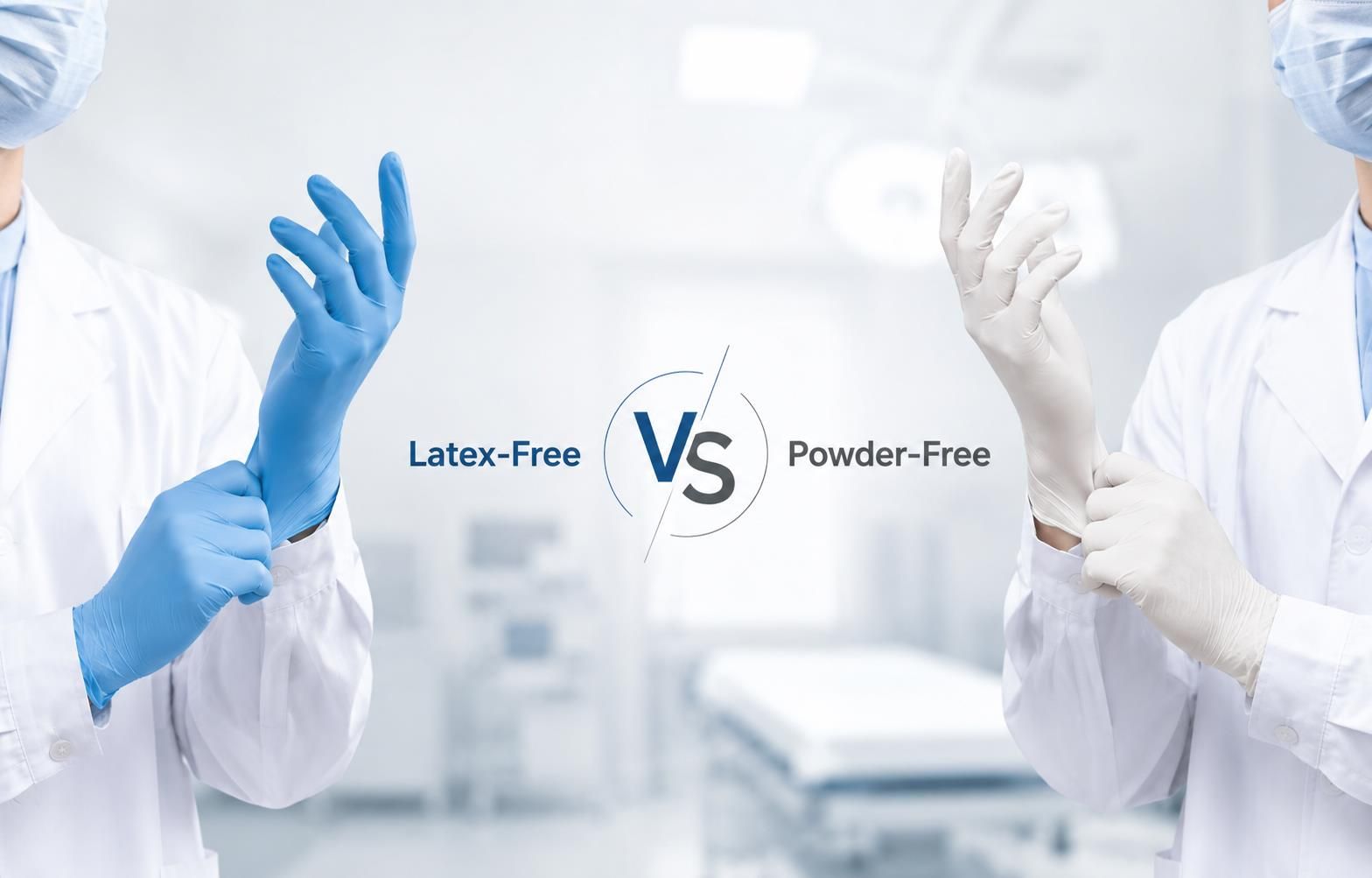
If you’ve ever scanned a glove box and wondered whether latex-free and powder-free mean the same thing, you’re not alone. They’re often mentioned together—but they solve different problems.
This article breaks down the difference, explains why it matters (especially in the U.S.), and gives you a practical checklist to choose the right disposable gloves for your setting.
Key Takeaway: Latex-free is about what the glove is made of. Powder-free is about what’s not inside the glove. They’re two separate decision axes.
Key takeaways
- Latex-free = no natural rubber latex proteins (helps reduce latex-protein allergy risk).
- Powder-free = no donning powder (helps reduce airborne powder residue and contamination concerns).
- A glove can be powder-free but not latex-free (e.g., powder-free latex). It can also be latex-free but not powder-free (powdered synthetic gloves exist outside medical contexts).
- In U.S. healthcare, powdered surgeon’s and patient exam gloves are banned; the FDA concluded the risk is “unreasonable and substantial.” See the FDA’s 2016 final rule in the Federal Register.
Latex-free gloves meaning (material axis)
Latex-free gloves are made without natural rubber latex—the material that contains latex proteins that can sensitize some users over time. Latex-free materials commonly include nitrile, vinyl (PVC), polyethylene, and other synthetic elastomers.
Latex-free matters most when:
- your staff or patients have known or suspected latex sensitivity
- you’re trying to reduce sensitization risk across a facility
- you’re standardizing PPE to avoid “surprise latex” exposure
NIOSH’s guidance on preventing work-related latex allergy recommends using non-latex gloves when tasks are unlikely to involve contact with infectious materials, and using latex alternatives when appropriate (see NIOSH guidance on preventing latex allergy).
Powder-free gloves meaning (powder axis)
Powder-free gloves are manufactured without donning powder (historically cornstarch). Powder can make gloves easier to put on, but it also leaves residue and can become airborne.
In medical settings, “powder-free” is more than a preference—it’s effectively the baseline expectation in the U.S.—largely because of the powdered gloves FDA ban for certain medical glove categories. The FDA banned powdered surgeon’s gloves and powdered patient exam gloves, citing an “unreasonable and substantial risk of illness or injury” that labeling can’t adequately mitigate.
Latex-free vs powder-free gloves: the 2×2 framework
Think of glove selection as a 2×2 grid with two independent choices:
- Material: latex-free vs contains latex
- Powder: powder-free vs powdered
Most buyers who want “the safest default” are really asking for latex-free + powder-free. But the right choice still depends on risk, task, and cost.
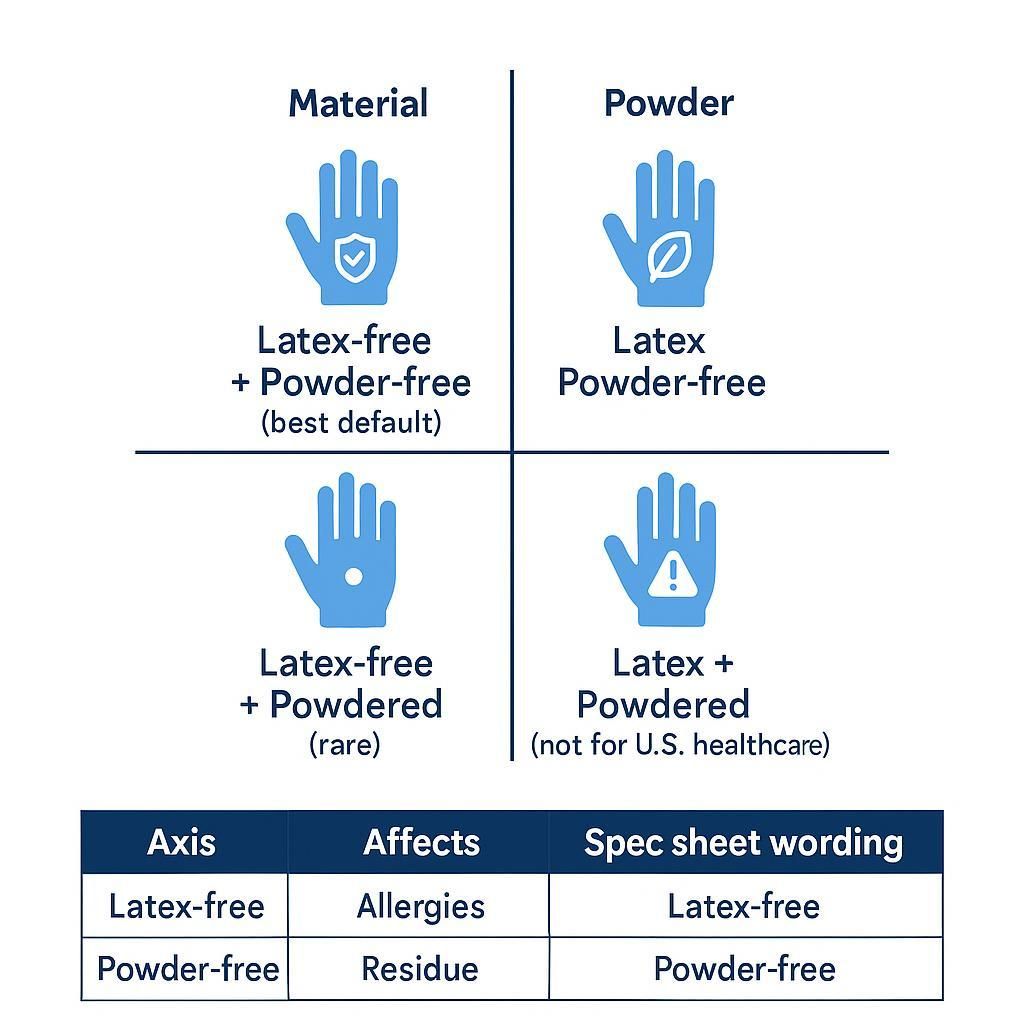
| Decision axis | What it affects | What to ask for on spec sheets | Common pitfalls |
|---|---|---|---|
| Latex-free (material) | Latex protein exposure risk | “Latex-free / non-latex” material declaration | Assuming “hypoallergenic” means latex-free |
| Powder-free (powder) | Powder residue, airborne contamination, irritation risk | “Powder-free” statement; manufacturing method if needed | Confusing “powder-free” with “latex-free” |
Comparison criteria that actually matter to buyers
If you’ve been searching for “how to choose disposable gloves for healthcare,” the sections below are the procurement-ready version: criteria first, then examples.
Below are the criteria procurement teams can use to compare gloves—without getting trapped in marketing terms.
1) Allergy & irritation risk (use conservative language)
If you’re comparing options, you’ll often end up evaluating the classic “nitrile vs latex gloves allergy” question—just remember that powder status is a separate axis from material choice.
- Latex-free reduces the chance of reactions related to natural rubber latex proteins.
- Powder-free reduces powder residue and the spread of powder-borne particles.
- Even latex-free gloves can cause irritation for some users (fit, sweat/occlusion, frequent handwashing, or certain manufacturing additives). If dermatitis is a recurring issue, consider trialing different materials and asking suppliers about ingredient disclosures or alternative formulations.
Pro Tip: If you’re standardizing across a facility, align labeling requirements up front (e.g., latex-free and powder-free), then evaluate fit, durability, and documentation in a controlled pilot.
2) Intended use and environment
“Best” depends on where the gloves are used:
- Clinical workflows: prioritize powder-free; consider latex-free as a safer default for mixed populations
- Lab work: prioritize tactile sensitivity + puncture resistance for the task
- Food handling: prioritize food-safety suitability + clean donning/doffing
- Industrial/cleaning: prioritize chemical compatibility and thickness for the chemicals involved
3) Fit, dexterity, and fatigue
For long wear time, small differences in fit and elasticity matter. A glove that’s too tight increases fatigue; too loose reduces dexterity and safety. Procurement specs should include consistent sizing, clear dimensions, and a process for handling fit complaints.
4) Documentation and compliance readiness
For healthcare procurement, documentation is part of risk management. Ask for:
- standard test references relevant to the glove category
- lot traceability practices
- consistent packaging and labeling
(If you operate under GPO/tender processes, specify required documents in your RFP to avoid rework later.)
Example: a latex-free + powder-free option to evaluate (INTCO)
If you’re looking for a latex-free, powder-free option to include in your evaluation set, INTCO Medical offers INTCO disposable synthetic latex gloves.
Based on the product page, these gloves are positioned as:
- Latex-free, powder-free, non-sterile
- available in 9″ and 12″ lengths
- offered in 2–6 mil thickness options
- designed for multiple use cases including industrial protection, laboratory work, food processing, beauty/cosmetology, and housekeeping
(Always validate the exact specification sheet for your use case and regulatory requirements.)
Video (quick primer)
FAQ
Are latex-free gloves always powder-free?
No. Latex-free and powder-free refer to different things. Many latex-free gloves are powder-free, but you should verify both labels/specs.
Are powder-free gloves always latex-free?
No. You can buy powder-free latex gloves. Powder-free reduces powder-related risks, but it does not remove latex proteins.
Why are powdered medical gloves a big deal in the U.S.?
The FDA banned powdered surgeon’s gloves and powdered patient exam gloves; for most healthcare use cases in the U.S., that makes powder-free the baseline requirement.
Next steps
If you want a latex-free, powder-free option to benchmark against your current supplier—start by reviewing the specs and available configurations for INTCO disposable synthetic latex gloves (sizes, thickness, length, and use-case fit).