
Nitrile Glove Thickness Chart and Selection Guide: 2–8 Mil Explained
Two boxes of nitrile gloves can look identical on the shelf and perform completely differently on the job. The difference usually comes down to one number printed in small type on the side panel: mil thickness. Buy a 3-mil glove for a chemistry lab and you’ll be replacing them every five minutes with chemical breakthrough on your hands. Buy an 8-mil glove for a sushi bar and you’ll be paying double for protection no one needs while your staff complains about lost dexterity.
The right glove for the job is, more often than not, the right thickness for the job. This guide walks through the full nitrile glove thickness chart from 2 mil up to 8 mil, explains what each range is really protecting against, and lays out a selection framework you can apply the next time you renegotiate a glove contract.
What Is a “Mil” and Why Does Thickness Matter?
Glove thickness is measured in mils, where one mil equals one one-thousandth of an inch (0.001 in, or roughly 0.0254 mm). It is not a millimeter — a common point of confusion in international procurement. A 4-mil glove is about 0.1 mm thick at the palm; an 8-mil glove is roughly 0.2 mm.
A nitrile glove is not uniformly thick across its surface. Manufacturers typically report three measurements:
The fingertip thickness is usually the highest number, because fingers contact the most surface area and wear out first. The palm thickness is the most commonly quoted spec on a box — it’s the working area where most contact happens. The cuff thickness is usually thinnest, since the cuff doesn’t need to resist punctures or chemicals.
When a glove is marketed as “4 mil,” that’s almost always palm thickness. ASTM standards require that the minimum thickness anywhere on the glove meet the labeled value, so the actual palm reading is usually slightly higher than the marketed number.
Why does this matter beyond product specs? Three reasons:
Barrier performance. Thicker films take longer for chemicals to permeate. Breakthrough time on a 4-mil glove can be a fraction of an 8-mil glove for the same chemical.
Puncture and tear resistance. Doubling thickness more than doubles puncture resistance in nitrile, because the material has more cross-section to absorb force before failure.
Dexterity and cost. Thicker gloves cost more per piece, last longer per wear, and reduce tactile sensitivity. The trick is matching thickness to the actual hazard — not over-buying out of caution.
The Full Nitrile Glove Thickness Chart
Procurement teams describe “light vs heavy” nitrile gloves in two different ways: film thickness (mil) and weight per glove (g/pc). Your buyers may see grams on quotes and cartons more often than mils.
Below is a practical selection chart that uses grams per glove (g/pc) as the primary unit, with an approximate mil range shown as a reference. (Because formulations, size, and cuff length vary, g and mil do not convert 1:1—treat the mil column as directional, not a lab measurement.)
Weight (per glove) | Typical mil range (approx.) | Positioning | Typical Applications | Wear Duration
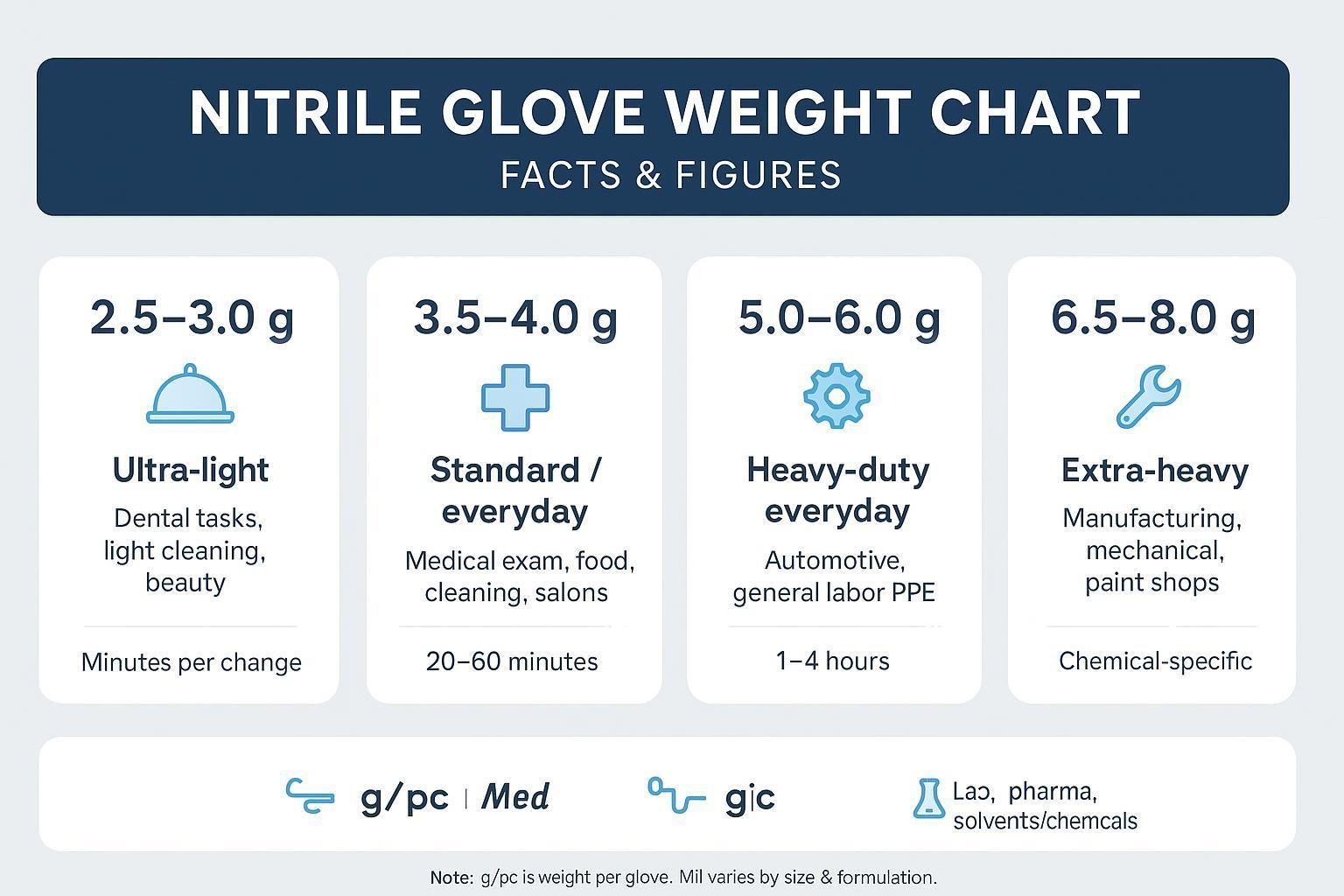
| 2.5–3.0 g | ~2–3 mil | Ultra-light | Dental tasks, high-turnover food handling, light cleaning, beauty/hospitality | Minutes per change |
|---|---|---|---|---|
| 3.5–4.0 g | ~3–4.5 mil | Standard / everyday | Most medical exam and multi-purpose use (food processing, cleaning, salons) | 20–60 minutes |
| 5.0–6.0 g | ~4.5–6.5 mil | Heavy-duty everyday | Auto service, general labor PPE, livestock/fisheries, tougher cleaning agents | 1–4 hours |
| 6.5–8.0 g | ~6–8+ mil | Extra-heavy / chemical-leaning | Lab, life sciences, paint/printing, higher splash/abrasion environments | Half-shift+ (chemical-specific) |
Each band sits next to a different hazard profile. The next sections break them down with the trade-offs that actually matter.
2.5–3.0 g: Ultra-Light for High-Turnover Tasks
The lightest disposable nitrile SKUs are often sold and quoted by weight per glove, commonly around 2.5–3.0 g/pc. They’re built for environments where gloves are changed every few minutes anyway: dental tasks, food prep counters, light janitorial, hairdressing, and beauty services. In hand, they feel almost like a second skin — tactile sensitivity is excellent, and they’re easy to don and remove between tasks.
The trade-off is durability. Ultra-light gloves tear under sustained stretching, puncture easily on sharp edges, and have limited chemical resistance. They are not intended for long-duration wear or direct contact with aggressive solvents.
One important nuance: some manufacturers (and many production lines) treat ~3.0 mil as a regular exam glove rather than “ultra-light,” depending on size and formulation. That’s why g/pc is often the more reliable procurement shorthand across SKUs, while mil remains useful for understanding film thickness at the palm/fingertips.
If your operation is changing gloves every two to three minutes between tasks, paying for heavier exam gloves is usually overkill. Conversely, if a worker is wearing the same glove for an hour, ultra-light is the wrong spec regardless of how affordable the per-piece price looks.
3.5–4.0 g: The Standard Workhorse
This is where the bulk of disposable nitrile glove volume lives — and for good reason. In many supply chains, 3.5–4.0 g/pc is the everyday “default” because it balances barrier performance, dexterity, and cost across healthcare and general-purpose use cases.
Standard medical exam gloves are typically 3.5 to 4 mil at the palm, with reinforced fingertips around 4.5 to 6 mil. This is the thickness specified for routine clinical exams, dental work, lab pipetting, and food processing operations where workers wear the same glove for 20–60 minutes at a time. Standards to look for include ASTM D6319 for medical exam grade and AQL 1.5 or better for pinhole defects.
For general-purpose, non-medical work — food processing lines, light assembly, cleaning crews, tattoo studios, veterinary work — the 4 to 5-mil range delivers the puncture resistance these jobs actually need without the stiffness of heavier gauges. Manufacturers offering both medical and food-contact certification on the same line make procurement simpler for multi-purpose buyers.
When buyers ask which thickness to default to for broad use, standard 3.5–6 mil nitrile gloves typically end up on the floor — they’re cost-effective enough to be changed frequently in food processing, strong enough to handle a clinical shift, and certified to the standards most regulators require.
5.0–6.0 g: Heavier Everyday for Tougher Work
Step up to 5 to 6 mil and you move from “general purpose” into “high-stakes exam and light industrial.” This is the range chosen for phlebotomy (where needle sticks are a daily risk), specialized chemical preparation (where breakthrough time matters), automotive service work, and janitorial tasks involving harsher cleaning agents.
The extra mil or two of nitrile in this range significantly improves puncture resistance — a 6-mil glove typically resists punctures roughly twice as well as a 4-mil glove of the same formulation, not because the material changed but because there’s simply more of it. Wear time also extends: many users get 1 to 4 hours per pair instead of 30 to 60 minutes.
The compromise is dexterity. At 6 mil, you start to feel the glove. Fine-motor tasks — placing a pediatric IV, doing surgical suturing, handling small electronic components — become noticeably harder. For most procurement decisions, that’s a worthwhile trade if the hazard profile justifies it.
6.5–8.0 g: Extra-Heavy and Chemical-Leaning
This is where nitrile gloves cross into territory that latex and vinyl simply can’t follow. Six to eight-mil gloves are built for manufacturing floors, mechanical work, paint shops, agriculture, and heavy janitorial — environments where the glove faces sustained abrasion, oil, light solvents, and the kind of edges that tear lighter gloves in seconds.
Texturing becomes more important in this range. Most industrial-grade nitrile is textured at the fingertips or across the full palm — micro-roughened, diamond-patterned, or sandy-finished — to provide grip on wet, oily, or slippery surfaces. A smooth 8-mil glove handling a greasy bolt is almost worse than a textured 5-mil glove handling the same bolt.
For the thicker end of the chart — 6 mil and up, where wear-and-tear is the dominant concern — heavy-duty 5–8 mil nitrile gloves with full diamond texturing are the practical choice. They handle the abrasion of mechanical work, provide grip in oil and water, and last through a half-shift or longer without the failures that drive up consumption costs on lighter gauges.
When You Need True Chemical Barrier Performance
Once you move into extra-heavy gloves (often 6.5–8.0 g/pc and up) and start using them for solvents, reagents, or industrial chemicals, the key question stops being “Is it thicker?” and becomes “What’s the breakthrough time for this chemical?”
Nitrile can perform well against oils, fuels, many acids, and most organic solvents, but it’s not universal — ketones (like acetone) and certain chlorinated solvents can permeate nitrile quickly regardless of thickness. For those exposures, you may need a different material (for example, butyl or neoprene) or a glove with documented permeation results.
Look for independent permeation testing (commonly EN 374 or ASTM F739) that reports breakthrough times in minutes for specific chemicals, and match that to your contact duration and splash risk.
Choosing Thickness for Laboratory Environments
Lab work deserves its own paragraph because it sits at the intersection of dexterity and chemical contact. A bench chemist needs the fingertip feel of a 4-mil glove to manipulate small samples and pipettes, but the chemical contact profile of a lab can include splash exposure to solvents, reagents, and acids that an exam glove won’t reliably hold back.
The right answer is usually two glove SKUs side by side: a standard 4 to 5-mil exam glove for routine non-chemical handling, and a thicker (6+ mil) chemical-grade glove for any operation involving direct chemical contact or splash risk. When the work involves specific chemical contact — corrosive splash, prolonged solvent contact, plating chemistry — chemical resistant nitrile gloves for labs with documented permeation data are the right call. Buying one “compromise” thickness for both jobs almost always means you’re under-protected on the chemical side and over-paying on the routine side.
How to Read a Nitrile Glove Size Chart
Thickness is half the spec; the other half is fit. A nitrile glove that’s too loose slips off; one that’s too tight tears at the seams and tires the hand. Manufacturers use a standard palm-width measurement to define sizes:
| Size | Palm Width (inches) | Palm Width (mm) | Common Fit |
|---|---|---|---|
| XS | 2.8 – 3.1 | 71 – 79 | Adolescent, small adult hands |
| S | 3.1 – 3.5 | 79 – 89 | Many women, smaller adults |
| M | 3.5 – 3.9 | 89 – 99 | Standard adult |
| L | 3.9 – 4.3 | 99 – 109 | Most adult men |
| XL | 4.3 – 4.7 | 109 – 119 | Larger hands |
| XXL | 4.7 + | 119 + | Industrial / agricultural |
Measure palm width by wrapping a tape measure around the dominant hand at the widest point (just below the knuckles, excluding the thumb). For multi-user environments, stock at least three sizes (S/M/L) and adjust the ratio based on actual usage data — most operations end up using more M and L than they initially order.
4 Mil vs 6 Mil Gloves: What’s the Real Difference?
This is one of the most-Googled questions in nitrile procurement, so it deserves a direct answer. A 6-mil glove versus a 4-mil glove of the same formulation gives you:
A 6-mil glove may offer a different durability and dexterity balance than a 4-mil glove, but puncture resistance, cost, and chemical performance depend on formulation, manufacturing consistency, texture, task conditions, and product-specific test data. Compare the supplier’s published specifications and test reports rather than applying a fixed multiplier.
Use observed failures, contamination risk, task demands, fit, and supplier documentation to decide whether a thicker option is appropriate. A change in thickness should be validated with representative samples rather than a fixed re-gloving rule.
A Selection Framework You Can Use Today
When choosing nitrile glove thickness for a specific task, walk through these four questions in order:
1. What is the hazard? Define biological, mechanical, splash, and chemical exposure separately. Thickness is only one specification; chemical work requires product- and chemical-specific permeation information, while ordinary disposable exam gloves should not be described as needlestick protection.
2. What change conditions apply? Set replacement practice from contamination, visible damage, the task, and the site risk assessment—not from a fixed wear-time promise tied to thickness.
3. How much dexterity does the task require? Compare samples in the actual task. Fingertip feel, grip, fit, texture, and material formulation can matter as much as nominal thickness.
4. What’s the total cost of use? A cheaper, thinner glove that tears and gets changed twice as often is not actually cheaper. Track failures per shift on your current spec for two weeks before deciding the next purchase is “the same as last time, just cheaper.”
Procurement Checks Before You Approve a Thickness Specification
Use the chart as a comparison tool, then make the purchase specification explicit. Ask each supplier to identify the measurement location, unit, method, applicable product standard, size range, cuff length, texture, packaging, lot traceability, and the test documents that support any performance claim.
Mil, millimetres, and measurement location
| Reference | Approximate conversion | Procurement check |
|---|---|---|
| 1 mil | 0.0254 mm | Confirm the stated unit before comparing quotes. |
| 4 mil | 0.10 mm | Confirm whether the figure is nominal or minimum and where it is measured. |
| 6 mil | 0.15 mm | Compare the same measurement location and product size. |
| 8 mil | 0.20 mm | Do not use thickness alone as a chemical-compatibility claim. |
Fingertip, palm, and cuff measurements can differ. For most quote comparisons, request the palm value and its measurement basis; also ask suppliers to state fingertip and cuff values when those areas affect the task. Do not treat a nominal figure as interchangeable with a minimum value without the supplier’s specification and method.
A buyer-ready specification template
Include: material and intended use; palm thickness with unit, nominal/minimum designation, measurement location, and method; fingertip and cuff values where required; size range and palm-width standard; cuff length; texture or grip requirement; colour; powder status; packaging configuration; lot traceability; requested test reports; and representative sample approval before release.
Common buying mistakes to avoid
Do not compare two “mil” claims without confirming the same measurement location. Do not assume thicker automatically means more compliant or chemically compatible. Do not use ordinary disposable examination gloves as needlestick protection. Do not approve a specification without checking samples, packaging, size fit, cuff length, and batch consistency against the intended task.
FAQ
Is a mil the same as a millimetre?
No. A mil is one-thousandth of an inch, approximately 0.0254 mm. Convert units before comparing supplier specifications.
Does a thicker nitrile glove always provide better chemical protection?
No. Thickness is one factor, but chemical protection must be verified against the specific chemical, exposure conditions, glove formulation, and documented permeation or breakthrough data.
What should I request before approving a thickness specification?
Request a product specification, measurement locations and method, relevant standard or test documentation, sample units in the required sizes, packaging details, and lot-consistency information. Validate the product in the intended task before final approval.
The Bottom Line
There is no single best nitrile glove thickness. Select a documented product specification for the defined task, hazard, fit requirement, and verification evidence; use product- and chemical-specific data where chemical exposure is relevant.
Treat the thickness chart as a procurement portfolio, not a single SKU. The safety teams that get the most value out of their glove budget stock two or three thicknesses, label dispensers clearly, and assign each gauge to the tasks where it actually pays for itself. Do that, and a few cents per glove translates into fewer mid-shift re-gloves, fewer near-miss reports, and a workforce that trusts the protection in its hands.