
Nitrile vs. Latex vs. Vinyl Gloves: A Workplace Safety Comparison
Disposable gloves are one of the smallest line items on a safety officer’s purchase order, yet they sit between a worker’s skin and almost every hazard the job can throw at them — chemicals, blood-borne pathogens, foodborne bacteria, micro-abrasions, and contamination risks that can quietly compromise an entire production batch. Choosing the wrong glove doesn’t just waste money; it can put people, products, and compliance records at risk.
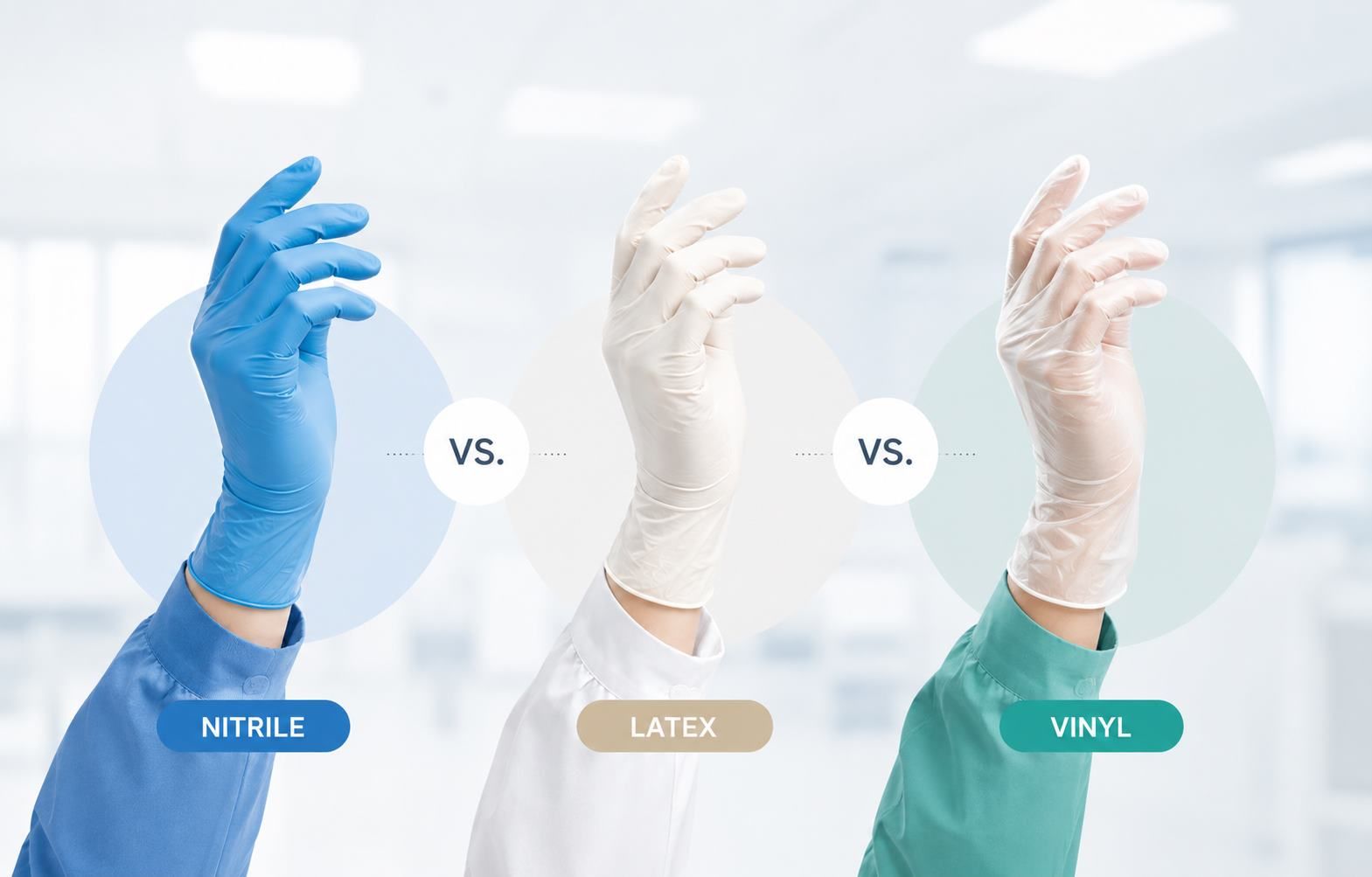
Three materials dominate the disposable glove market today: nitrile, latex, and vinyl. Each has a distinct chemistry, a distinct cost profile, and a distinct set of workplaces it’s built for. This guide walks through what each material actually is, where it performs best, and how to match the right glove to the right task — so the next time you renegotiate a glove contract, you’re buying protection instead of just price.
What Does Nitrile Gloves Mean?
Let’s start with the question most procurement teams quietly Google before placing an order: what does nitrile gloves mean? Nitrile is short for nitrile butadiene rubber (NBR), a synthetic copolymer of acrylonitrile and butadiene. Unlike latex, it contains no natural rubber proteins, which is why it has become the default choice for healthcare, laboratories, automotive shops, and any environment with latex-allergy concerns.
Three properties make nitrile the workhorse of modern workplace safety:
Chemical resistance. Nitrile holds up against a much broader range of solvents, oils, fuels, and specialized chemicals than either latex or vinyl. For a technician handling brake cleaner, a lab tech pipetting reagents, or a tattoo artist working with inks, that resistance is the difference between a protected hand and a contaminated one.
Puncture and tear strength. Nitrile is typically three to five times more puncture-resistant than latex of the same thickness. In needle-rich environments — phlebotomy, dental work, sharps disposal — that margin matters.
Latex-free safety. Roughly 1 to 6 percent of the general population, and a higher share of healthcare workers, have some degree of latex sensitivity. Nitrile sidesteps the problem entirely.
The trade-off is feel. Early nitrile gloves were stiffer and less tactile than latex, but modern micro-textured nitrile is virtually indistinguishable from natural rubber for fine-motor tasks. For labs, clinics, manufacturing lines, and food processing operations that need broad chemical coverage without allergy risk, disposable nitrile gloves have effectively become the default specification — strong, latex-free, and certified to the medical and industrial grades buyers actually need.
When buyers ask whether nitrile is “better” than the alternatives, the honest answer is: better at most things, but not at everything. The next two sections explain where latex and vinyl still win.
Latex Gloves: The Original Standard for Tactile Sensitivity
Latex gloves are made from the milky sap of the Hevea brasiliensis rubber tree — a genuinely natural material with mechanical properties that synthetic rubbers have spent decades trying to copy. For most of the late twentieth century, latex was the only serious option in clinical settings, and there’s a reason it persisted: nothing else feels quite like it on the hand.
Latex’s signature advantages are elasticity and tactile sensitivity. A well-made latex glove conforms to the wearer’s hand like a second skin, returns to shape after stretching, and transmits texture and pressure with very little distortion. Surgeons performing delicate suturing, lab technicians handling small samples, dentists working in confined oral cavities, and electronics assemblers placing tiny components all benefit from that fingertip awareness. Latex also provides excellent barrier protection against water-based contaminants, bacteria, and viruses — which is why it remained the gold standard for surgical applications long after nitrile arrived.
The catch is allergies. Roughly 1 to 6 percent of the general population — and as much as 10 to 17 percent of frequently exposed healthcare workers — develop sensitivity to natural rubber latex proteins, with reactions ranging from contact dermatitis to anaphylaxis. Powdered latex gloves were banned by the FDA in U.S. medical use in 2017 because aerosolized powder carried protein allergens into the air. Powder-free latex remains permitted, but many hospital systems have moved to “latex-safe” environments anyway.
Latex also has weaker chemical resistance than nitrile against oils, fuels, and many solvents. It’s not the right glove for an automotive shop or a chemistry lab handling organic compounds. And while latex is more biodegradable than its synthetic cousins, the agricultural footprint of natural rubber is a real consideration.
So, who should still be using latex? Operations where tactile precision is non-negotiable, the chemicals being handled are aqueous and biological rather than petrochemical, and the workforce has been screened for latex sensitivity. Cleanrooms, certain surgical suites, food prep environments with no allergy risk, and precision assembly all remain reasonable use cases for natural latex disposable gloves, particularly the powder-free, low-protein variants that minimize allergy exposure.
Vinyl Gloves: The Cost-Effective Choice for Low-Risk Tasks
Vinyl gloves are made from polyvinyl chloride (PVC) blended with plasticizers that give the otherwise rigid plastic enough flexibility to be worn as a glove. They are the budget option of the disposable glove world — and in the right context, that’s exactly what you want.
Vinyl’s headline advantage is cost. At scale, vinyl gloves can run 30 to 50 percent cheaper per box than nitrile, which becomes significant when you’re stocking hundreds of dispensers across a quick-service restaurant chain, a janitorial fleet, or a high-volume food processing line. They are also latex-free, eliminating the allergy concerns that come with natural rubber.
Beyond price, vinyl is well-suited to short-duration, low-risk tasks. Food handling — where gloves are changed every few minutes between tasks — is the classic example. Light cleaning, hairdressing, beauty services, painting, and general handling of non-hazardous materials all sit comfortably in vinyl’s wheelhouse. For a worker who plates salads, pulls fries, or wipes counters and changes gloves a dozen times a shift, paying for medical-grade nitrile would be overkill.
The trade-offs are real, though, and worth being honest about. Vinyl is significantly less elastic than either nitrile or latex; it tends to be loose at the cuff and can tear under sustained stretching. It offers limited resistance to oils, fats, and many chemicals, and its barrier performance degrades faster than nitrile during prolonged wear. Vinyl is also not the right choice for sharps environments — punctures occur more easily and may go unnoticed.
Industries built on high-turnover, light-contact glove use — food service, food processing, light cleaning, beauty, and hospitality — have settled on vinyl as the right balance of price, protection, and changeability. For these settings, cost-effective disposable vinyl gloves deliver the barrier protection regulations require without inflating the per-glove cost in operations where gloves are changed every few minutes anyway.
Side-by-Side Comparison
The clearest way to think about the three materials is along five axes: chemical resistance, puncture resistance, tactile sensitivity, allergy risk, and cost.
| Attribute | Nitrile | Latex | Vinyl |
|---|---|---|---|
| Material | Synthetic NBR | Natural rubber | PVC + plasticizers |
| Chemical resistance | Excellent | Moderate | Limited |
| Puncture resistance | High (3–5× latex) | Moderate | Low |
| Tactile sensitivity | High (modern grades) | Excellent | Moderate |
| Elasticity/fit | Good | Excellent | Limited |
| Allergy risk | Very low | Significant (1–6% population) | Very low |
| Best for | Healthcare, labs, industrial, food | Surgery, precision work, cleanrooms | Food service, light cleaning, beauty |
| Relative cost | Higher | Mid to high | Lowest |
| Shelf life | ~5 years | ~3 years | ~3 years |
No single material wins every column, which is exactly the point. Most well-run safety programs stock at least two of the three, and assign them to specific tasks rather than treating “gloves” as a single SKU.
How to Choose: A Practical Decision Framework
When a safety manager sits down to pick gloves for a specific task, the decision usually comes down to four questions:
What’s being handled? If chemicals, oils, fuels, substances, or sharps are involved, default to nitrile. If the contact is aqueous, biological, and requires high precision, latex remains defensible. If the work is brief, light, and the gloves will be changed every few minutes, vinyl is fine.
How long will the glove be worn per change? Vinyl is built for minutes, not hours. For sustained wear — a surgical procedure, a lab session, a vehicle service — nitrile or latex will hold up better.
Are there allergy concerns in the workforce? A single latex-sensitive employee is enough reason to move an entire department to nitrile. The cost of an allergic reaction — medical, legal, operational — dwarfs the per-glove price difference.
What’s the regulatory standard? Healthcare and food contact have specific standards (ASTM D6319 for medical nitrile, ASTM D3578 for medical latex, ASTM D5250 for medical vinyl; AQL 1.5 or better for medical exam grade). Industrial users may also need EN 374 for chemical resistance or EN 455 for medical examination gloves. Buying off the wrong standard is a documentation problem waiting to happen.
A useful exercise: walk the floor, list every task that involves a glove, and assign each task to a material based on those four questions. You’ll typically end up with nitrile for the majority of clinical and industrial work, latex for a small set of precision applications, and vinyl for high-turnover food and light-cleaning tasks.
Compliance, Standards, and What to Ask Suppliers
Material is only half the story. The same glove material can vary widely in quality depending on the manufacturer’s process control, formulation, and testing. When evaluating suppliers, ask for:
Acceptable Quality Level (AQL) documentation — a lower AQL number means fewer pinholes per batch (medical exam grade is typically AQL 1.5 or better; food and general-purpose grades may run 2.5 to 4.0). Material certifications such as ASTM and EN standards relevant to the intended use. Batch traceability so a defective lot can be isolated quickly. Independent lab test reports for chemical permeation if the gloves will be used around specific substances. Statements on powder content, protein content (for latex), and plasticizer composition (for vinyl) — phthalate-free vinyl is increasingly required in food-contact and EU markets.
A reputable manufacturer should be able to produce these documents without hesitation. If a supplier can’t, the price savings probably aren’t worth the audit risk.
Storage, Disposal, and Total Cost of Ownership
The cheapest glove on a per-piece basis is not always the cheapest glove on a per-task basis. Vinyl that tears mid-task and forces a re-glove every two minutes can quietly cost more than a nitrile that lasts the full shift. Latex that triggers a reaction and pulls a worker off the line for the day is the most expensive glove in any inventory.
Store gloves in a cool, dry environment away from direct sunlight and ozone sources — both degrade rubber over time. Rotate stock so older boxes are used first; nitrile typically holds its properties for around five years, while latex and vinyl degrade somewhat faster. Dispose of used gloves according to the waste stream of the contaminant they contacted: regular trash for low-risk tasks, biohazard for clinical and laboratory use, and chemical waste for solvent-contaminated gloves.
The Bottom Line
There is no universal “best” disposable glove — there is only the best glove for a specific task, environment, and workforce. Nitrile has earned its position as the broad-spectrum default for healthcare, labs, and industry thanks to its chemical resistance, puncture strength, and freedom from latex allergens. Latex remains unmatched for tactile precision and surgical-grade barrier performance, where allergy risk has been screened out. Vinyl earns its place in high-turnover, low-risk environments where changeability and cost discipline matter more than long-wear performance.
The safety teams that get the most out of their glove budget treat the three materials as a portfolio rather than a single line item — matching the glove to the hazard, the duration, and the worker. Do that, and a few cents per glove can quietly translate into fewer incidents, cleaner audits, and a workforce that trusts the protection in its hands.