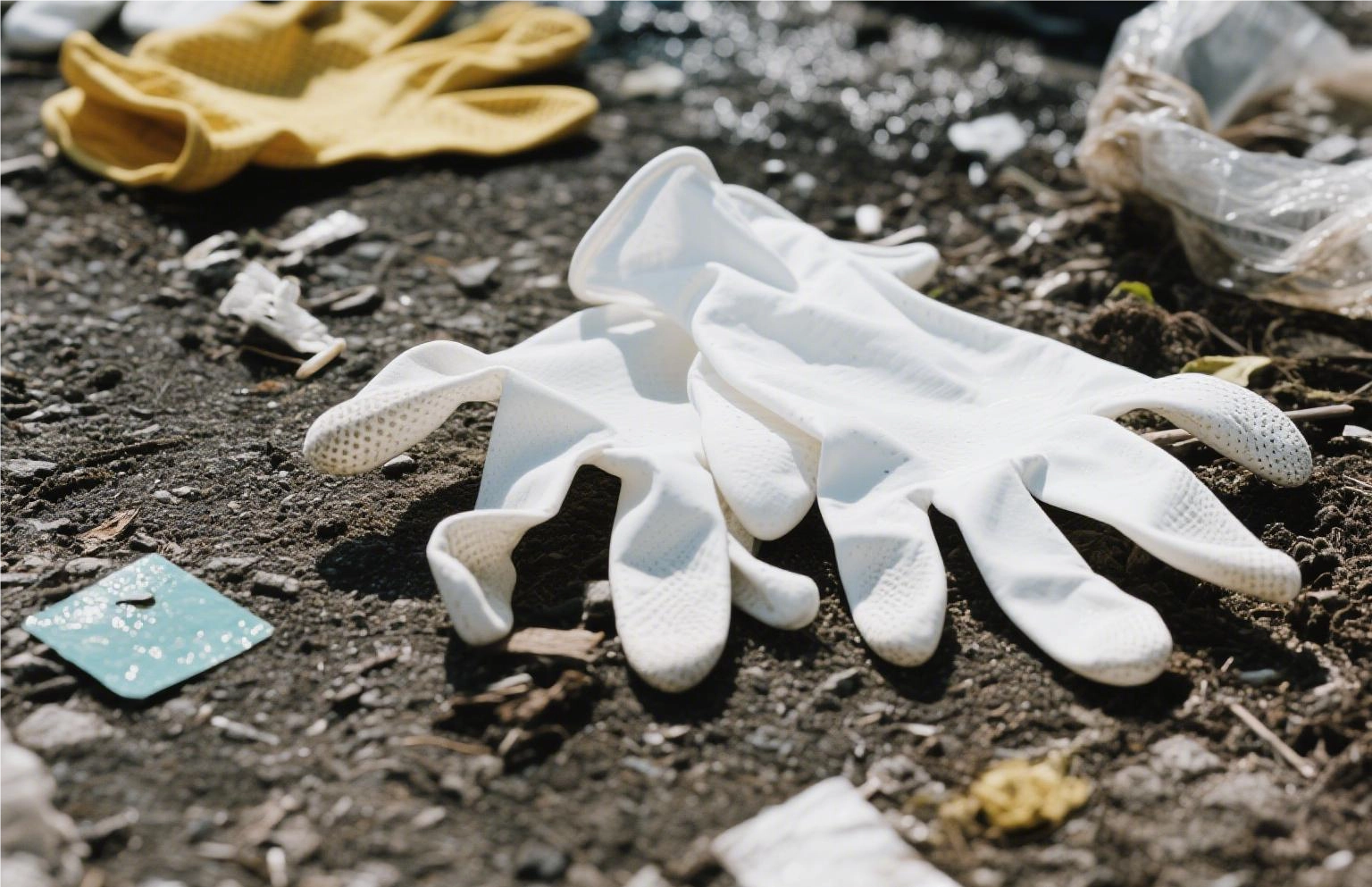
Disposable Glove Waste: What Biodegradable Nitrile Claims Mean
Disposable glove waste cannot be eliminated simply by switching to a product labelled “biodegradable.” Biodegradable nitrile gloves are designed to achieve measurable biodegradation under specified test conditions, but their actual environmental outcome depends on the glove formulation, disposal route, local waste infrastructure, and whether the glove is contaminated.
INTCO’s green biodegradable nitrile glove was independently tested by Intertek in accordance with ASTM D5511-18. The tested sample achieved 6.16% biodegradation after 45 days under specified high-solids anaerobic digestion conditions. This laboratory result applies to the tested product and test conditions; it should not be interpreted as a fixed decomposition timeline for every landfill.
This guide explains what biodegradable nitrile claims mean, how ASTM testing should be interpreted, and how businesses should handle disposable glove waste in real operations.
Key Takeaways
- Disposable glove waste remains a disposal challenge because used gloves may be contaminated and recycling options are limited.
- INTCO’s green biodegradable nitrile glove achieved 6.16% biodegradation after 45 days in an independent ASTM D5511-18 laboratory test conducted by Intertek.
- The result applies only to the tested product and specified anaerobic test conditions; it is not a promise that the glove will fully decompose within a fixed period in every landfill.
- Biodegradable, compostable, renewable and microplastic-free are different claims that require different forms of evidence.
- Used gloves must still be disposed of according to contamination risks, facility procedures and applicable local regulations.
Why Is Disposable Glove Waste Difficult to Manage?
Disposable gloves are designed for single-use protection, which means each task can generate a separate waste item. In healthcare, laboratories, food processing, cleaning, manufacturing, and other workplaces, used gloves may also contain biological material, chemicals, food residue, oils, or other contaminants.
These factors make glove waste difficult to manage through conventional recycling or composting systems. Waste-reduction decisions must therefore consider both the glove material and its condition after use. A clean glove used for a low-risk task may follow a different waste route from a glove contaminated with infectious material or hazardous chemicals.
Biodegradable nitrile technology may improve biodegradation under specified anaerobic conditions, but it does not make all used gloves suitable for the same disposal stream.
Why Do Conventional Nitrile Gloves Persist After Disposal?
Conventional nitrile gloves are made from synthetic rubber designed to provide strength, elasticity, and barrier performance during use. These properties also mean that conventional nitrile is not designed for rapid biodegradation after disposal.
A universal decomposition period should not be assigned to all nitrile gloves because real outcomes vary according to formulation, temperature, moisture, microbial activity, oxygen availability, and waste-management conditions. Long-term decomposition claims should only be used when supported by evidence directly applicable to the product and disposal environment concerned.
How Are Biodegradable Nitrile Gloves Designed to Work?

The Technology Behind Biodegradability
Biodegradable nitrile gloves incorporate additives intended to support microbial activity under specific biologically active disposal conditions. Under suitable anaerobic test conditions, microorganisms can contribute to the conversion of degradable components into biogas, including carbon dioxide and methane, together with other residues.
The rate and extent of biodegradation depend on the glove formulation and environmental conditions. Laboratory results should not be interpreted as a guarantee that the same result will occur in every commercial landfill.
Biodegradability does not automatically demonstrate compostability, recyclability, bio-based content, or performance on a separate microplastic-related claim. Each of these claims requires separate, product-specific evidence.
Performance Comparison: Traditional vs. Biodegradable Gloves
| Comparison area | Conventional nitrile gloves | Biodegradable nitrile gloves |
|---|---|---|
| Intended use | Single-use barrier protection | Single-use barrier protection |
| Biodegradation design | Not specifically designed to accelerate biodegradation | Formulated to support biodegradation under specified conditions |
| Evidence required | Product specifications and applicable safety standards | Product specifications plus product-specific biodegradation testing |
| Disposal route | Depends on contamination and local requirements | Also depends on contamination and local requirements |
| Compostable? | Not automatically | Not automatically; separate evidence is required |
| Recyclable? | Limited by contamination and local collection systems | Biodegradable design does not automatically make the glove recyclable |
| Real-world breakdown time | Cannot be stated universally | Cannot be predicted from a short laboratory test alone |
| Microplastic outcome | Requires evidence | Requires separate evidence; biodegradability alone does not prove “microplastic-free” |
“Biodegradable” describes a tested material behaviour under specified conditions. It does not mean that a used glove can be littered, placed in a home compost bin, or handled without following local waste rules.
What Does INTCO’s ASTM D5511 Test Show?
ASTM D5511 is a laboratory anaerobic-digestion test. It does not establish one universal landfill decomposition timeline.
INTCO’s green biodegradable nitrile glove was independently tested by Intertek in accordance with ASTM D5511-18. The tested sample achieved 6.16% biodegradation after 45 days under specified high-solids anaerobic digestion conditions. This laboratory result applies to the tested product and test conditions; it should not be interpreted as a fixed decomposition timeline for every landfill.
| Test item | Published information |
|---|---|
| Tested product | INTCO green biodegradable nitrile glove |
| Independent laboratory | Intertek |
| Test method | ASTM D5511-18 |
| Test environment | Specified high-solids anaerobic digestion conditions |
| Test duration | 45 days |
| Measured biodegradation | 6.16% |
| Correct interpretation | A product-specific laboratory result under the stated test method and conditions, not a guaranteed decomposition timeline in every landfill |
Test results are specific to the sample and conditions evaluated. Actual disposal environments vary, and biodegradation rates may differ.
What Evidence Should Buyers Request for Biodegradable Glove Claims?
| Claim being evaluated | Evidence buyers should request | Important limitation |
|---|---|---|
| Tested under ASTM D5511 | The exact product tested, test standard, laboratory, test duration and measured result | ASTM D5511 is a laboratory anaerobic-digestion test and does not establish one universal landfill decomposition timeline |
| Biodegradable nitrile glove | Product-specific third-party test documentation and clearly stated test conditions | Results from one glove formulation should not automatically be applied to another product |
| Compostable | Product-specific compostability certification and confirmation that an accepting composting facility is available | Biodegradable does not automatically mean compostable |
| Microplastic-related claim | Product-specific testing using an appropriate and documented analytical method | Biodegradation testing alone does not prove that no microplastics remain |
| Renewable-material claim | Verified documentation of bio-based or renewable material content | Biodegradability does not by itself demonstrate renewable material content |
| Landfill biodegradation claim | Test conditions, test duration and the extent of biodegradation measured | Real landfill conditions vary in moisture, temperature and microbial activity |
Environmental claims should be specific and supported by reliable evidence. The U.S. Federal Trade Commission advises businesses to qualify degradable, compostable, renewable-material, and general environmental-benefit claims according to the evidence and disposal conditions involved.
How Can Biodegradable Nitrile Gloves Fit Into a Waste Strategy?

Can Biodegradable Gloves Reduce the Persistence of Glove Waste?
Biodegradable nitrile technology is intended to increase biodegradation under specified biologically active conditions compared with a formulation that has not been designed for this purpose. However, a laboratory biodegradation result does not by itself establish the product’s complete environmental impact.
Businesses should treat biodegradable gloves as one element of a wider waste-management strategy that also considers appropriate glove selection, unnecessary glove changes, product performance, waste segregation, contamination, transport, treatment, and local disposal infrastructure.
Claims about lower environmental impact, reduced microplastic pollution, or overall sustainability require evidence appropriate to each claim, such as product-specific testing or lifecycle assessment.
How Should Businesses Evaluate Biodegradable Gloves?
Procurement and sustainability teams should review biodegradable glove claims with the same discipline used for safety and performance documentation. Before approving a product, request:
- The exact name and item code of the tested glove
- The test standard and edition
- The independent laboratory and report number
- Test duration, temperature, and environmental conditions
- The measured biodegradation result
- Identification of the control material
- Confirmation that the report applies to the formulation being supplied
- Any limitations on how the environmental claim may be used
Businesses should also compare barrier performance, durability, glove-change frequency, packaging, logistics, and waste routes. A product that fails more frequently or is unsuitable for the task may increase total glove consumption even if its formulation has demonstrated biodegradation under laboratory conditions.
Where Can Biodegradable Nitrile Gloves Be Used?
Biodegradable nitrile gloves may be considered for healthcare, food processing, laboratory, industrial, agriculture, beauty, and cleaning applications when the selected product meets the safety, barrier, regulatory, and performance requirements of the task.
Biodegradable design does not improve infection control by itself. Protection still depends on selecting the correct glove, maintaining glove integrity, changing gloves at the appropriate time, washing hands where required, and following workplace procedures.
Buyers should therefore evaluate biodegradability separately from medical-device compliance, food-contact compliance, chemical resistance, and other application-specific requirements.
How Should Used Disposable Gloves Be Disposed Of?
Can Clean Used Gloves Go Into General Waste?
Gloves used for low-risk tasks may sometimes enter general waste, depending on local rules and workplace procedures. Before disposal, businesses should confirm that the gloves are not contaminated with infectious material, hazardous chemicals, cytotoxic drugs, pharmaceuticals, or other regulated substances.
Local waste requirements take priority over a product’s biodegradable claim.
How Should Contaminated Gloves Be Handled?
Gloves contaminated with blood, bodily fluids, infectious material, hazardous chemicals, pharmaceuticals, or other regulated substances should be segregated and handled according to applicable workplace, healthcare, hazardous-waste, and local disposal requirements.
A biodegradable glove must not be placed in general waste or compost simply because it carries a biodegradation claim. Contamination determines the appropriate waste stream.
What Is the Difference Between Landfill Disposal and Composting?
| Disposal route | Practical guidance |
|---|---|
| Landfill | ASTM D5511 data may describe behaviour under specified high-solids anaerobic conditions, but it does not guarantee the same rate in every commercial landfill |
| Industrial composting | Only appropriate when the exact glove has evidence supporting industrial compostability and the receiving facility accepts the product |
| Home composting | Do not recommend without specific home-compostability evidence |
| Recycling | Usually limited by contamination, glove composition, collection availability, and recycler acceptance |
| Regulated medical or hazardous waste | Follow applicable treatment and disposal requirements regardless of biodegradability |
| Littering or disposal in nature | Never appropriate |
ASTM D6400 addresses plastics designed for aerobic composting in municipal or industrial facilities. It is different from ASTM D5511, which measures anaerobic biodegradation under high-solids digestion conditions. Testing under ASTM D5511 does not establish compostability under ASTM D6400.
What Evidence Supports INTCO’s Biodegradable Nitrile Gloves?
Features of INTCO’s Biodegradable Nitrile Gloves

INTCO Medical offers biodegradable nitrile glove options for selected professional applications. Product characteristics may include powder-free, non-sterile construction, a beaded cuff, and a textured surface, depending on the selected model.
INTCO’s green biodegradable nitrile glove was independently tested by Intertek in accordance with ASTM D5511-18. The tested sample achieved 6.16% biodegradation after 45 days under specified high-solids anaerobic digestion conditions. This laboratory result applies to the tested product and test conditions; it should not be interpreted as a fixed decomposition timeline for every landfill.
Available colors and other specifications should be confirmed for the selected item code. Buyers should confirm that the applicable documentation, specifications, color, formulation, and item code correspond to the product being ordered.
What Should Buyers Confirm for Customized Orders?
INTCO offers selected customization options for B2B orders, including size, color, thickness, and packaging requirements, subject to product and order confirmation.
When a biodegradable glove formulation is customized, buyers should confirm whether applicable technical documentation still corresponds to the product being supplied. Changes to the formulation, additives, color, thickness, or manufacturing process may require a separate technical review or additional testing.
Contact INTCO to request current product specifications, available test documentation, samples, customization information, and bulk-order requirements.
Frequently Asked Questions
What Is Disposable Glove Waste?
Disposable glove waste includes used single-use gloves generated by healthcare, food processing, laboratories, manufacturing, cleaning, and other activities. The correct waste route depends on contamination, local regulations, and available treatment infrastructure.
Are Biodegradable Nitrile Gloves Universally Biodegradable?
Biodegradation claims should be evaluated with product-specific evidence that identifies the tested product, test method, conditions, duration, and measured result. A laboratory result should not be interpreted as a universal disposal outcome.
What Does ASTM D5511 Test?
ASTM D5511 measures anaerobic biodegradation of plastic materials under high-solids anaerobic digestion conditions. Results apply to the tested sample and stated laboratory conditions; they do not establish a universal real-world landfill decomposition time.
What Is INTCO’s Biodegradation Test Result?
INTCO’s green biodegradable nitrile glove achieved 6.16% biodegradation after 45 days when independently tested by Intertek in accordance with ASTM D5511-18 under specified high-solids anaerobic digestion conditions. This is a product-specific laboratory result, not a guaranteed decomposition rate or fixed disposal timeline for all landfill environments.
Are Biodegradable Nitrile Gloves Compostable?
Not automatically. Biodegradability under ASTM D5511 is different from compostability. A compostable claim requires separate product-specific evidence under an applicable compostability standard and confirmation that an appropriate facility accepts the product.
How Should Microplastic-Related Claims Be Evaluated?
Microplastic-related claims require product-specific testing using an appropriate and documented analytical method. Biodegradation testing alone does not establish a microplastic-related outcome.
Can Contaminated Biodegradable Gloves Go Into Compost?
No general recommendation should be made. Gloves contaminated with biological material, chemicals, pharmaceuticals, or other regulated substances must follow applicable waste-disposal requirements and should not be placed in compost solely because they are labelled biodegradable.
Can Biodegradable Nitrile Gloves Be Recycled?
Biodegradable design does not automatically make a glove recyclable. Recycling depends on glove composition, contamination, the available collection program, and acceptance by the recycling facility.
What Documentation Should Buyers Request?
Buyers should request the product specification, tested product identity, ASTM standard and edition, laboratory name, report number, testing conditions, duration, measured result, and confirmation that the report applies to the formulation being supplied.