What Is Synmax Pro Exam Glove? A Smart‑Value Alternative to Nitrile
If you manage gloves for food production lines, salon services, contract cleaning, or a distribution portfolio, you’re probably balancing three pressures at once: compliance, comfort, and cost. That’s exactly where Synmax Pro comes in. Synmax Pro Exam Glove is a synthetic, latex‑free, powder‑free exam glove designed to feel close to nitrile while keeping budgets in check. For day‑to‑day food handling, routine cleaning with common disinfectants, and beauty or light‑industrial tasks, it offers near‑nitrile protection at a compelling price point. When specialized chemicals or aggressive solvents enter the picture, standard or specialty nitrile still leads. For everything else under routine conditions, Synmax Pro can be the pragmatic pick.
Synmax Pro vs Nitrile at a Glance
Choosing between nitrile examination gloves and Synmax Pro is less about brand preference and more about risk class and total cost of ownership. The table below frames the differences in plain terms so you can match each option to the real work on your floor, and it’s why most teams still request documentation (AQL, tensile/elongation, and any chemical compatibility notes) before a program-wide switch.
| Dimension | Synmax Pro Exam Glove | Nitrile Examination Gloves |
|---|---|---|
| Material | Synthetic vinyl formulation, latex‑free, powder‑free | NBR (nitrile) synthetic rubber, latex‑free, powder‑free |
| Barrier protection | Exam‑grade barrier suitable for routine clinical support, food prep, beauty, and cleaning tasks; confirm AQL and specs with supplier | Generally higher puncture strength and durability for disposables; common AQL 2.5, with some at 1.5 |
| Chemical splash notes | Designed for everyday cleaners and alcohols when used per SOPs; not intended for prolonged solvent exposure or mandatory chemical-resistance handling | Broad resistance to oils and many chemicals; chemical-resistance‑tested variants available with ASTM D6978 tables |
| Tactile feel | Soft, flexible, nitrile‑like wear experience optimised for long shifts and fine tasks | Firm, responsive feel; soft‑formulation lines improve comfort and dexterity |
| Allergy risk | Latex‑free and powder‑free | Latex‑free and powder‑free |
| Cost posture | Value‑focused for high‑volume use and budget control | Typically higher and more volatile across cycles |
| Best for | High‑volume food handling, housekeeping and disinfection routines, beauty/cosmetology, and general exam‑adjacent tasks | Higher‑risk tasks, chemical-resistance‑related handling when documented, and prolonged exposure to challenging chemicals |
| Migration difficulty | Low to medium with a short pilot and documentation on file | Baseline in many facilities; easy to continue with incumbent specs |
How Synmax Pro Works (and Where It Fits)
Synmax Pro is a synthetic exam glove engineered to deliver a nitrile‑like wearing experience without latex and without powder. The formulation is a chemically modified vinyl designed to improve flexibility and comfort compared with conventional vinyl exam styles, creating a softer feel and reliable donning for long shifts in food prep, beauty services, and cleaning operations. Based on manufacturer internal testing, Synmax Pro is positioned with high stretch (reported 448% elasticity) and higher abrasion resistance (reported 10× versus conventional nitrile), which can matter in repetitive gripping, wiping, and tool handling; treat these as product-claimed figures and verify against your supplier’s current datasheet for tender or audit files. Because it is latex‑free, it supports facilities that operate latex‑avoidance policies while seeking better value than typical nitrile. For a product overview and sizes, review the Synmax Pro Exam Gloves page from INTCO Medical, where specifications and intended uses are introduced at a glance.
From a compliance perspective, exam gloves in the United States fall under the FDA’s patient examination glove classification, which confirms device category and regulatory expectations for labelling, quality, and performance as medical devices under 21 CFR 880.6250. Authoritative background appears in the agency’s guidance on medical gloves: FDA medical gloves overview. For material specifications, synthetic vinyl exam formulations commonly align with ASTM D5250, while nitrile formulations reference ASTM D6319. For global markets, EN 455 parts 1–4 define requirements like freedom from holes, physical properties, biological evaluation, and shelf life; procurement teams can use an overview, such as EN 455 Part 1 reference to map supplier documentation to the correct parts. These references help verify that glove documentation maps to the right standard family before onboarding. When reviewing supplier quality claims, ensure the stated AQL for pinholes is documented.

Chemicals deserve special attention. Synmax Pro is positioned for everyday cleaners and alcohols encountered in routine housekeeping and food handling, and it should be used according to your SOPs with appropriate change‑out after splash exposure.
In cold-chain or frozen-food workflows, teams also care about how a glove feels when temperatures drop; Synmax Pro is marketed for maintaining flexibility and structural integrity down to -18°C under high-volume use, which is worth validating in a short pilot if your lines move between ambient and freezer zones.
When to Stay with Nitrile vs Switch to Synmax Pro
If your workflow regularly involves cytotoxic agents, complex solvents, or tasks where higher puncture resistance is a documented requirement, staying with nitrile is the conservative and often required choice. Many nitrile lines publish chemical-resistance permeation data and offer textured fingertips or thicker mil options that align with risk assessments and institutional policies. When that’s the scenario, it’s worth exploring value‑engineered nitrile options rather than stepping down in material class. For a nitrile direction within light‑industrial contexts, evaluate a dedicated line such as Chemtuff disposable nitrile gloves as a benchmark when validating your specifications.
Synmax Pro is also commonly considered in high-consumption settings where glove changes are frequent and friction-heavy work is routine, such as industrial and mechanical operations, commercial and institutional cleaning, and high-volume clinical examination environments where cost efficiency is a real constraint.
If your primary work is high‑volume food prep, routine cleaning and disinfection with common agents, or beauty and cosmetology services where dexterity and comfort matter, Synmax Pro becomes attractive. The wearing experience is designed to be close to nitrile while enabling meaningful savings across millions of pairs per year. For operations working within strict budgets or navigating price volatility, that shift can reduce the total cost of ownership without undermining core exam‑grade expectations.
Distributors and wholesalers look for reliability, consistent specifications, and broad size availability to serve mixed customer bases. Because Synmax Pro is produced by a large‑scale manufacturer with global reach, it can support private‑label and national programs where stable supply and documentation portability are central to success.
For buyers who think in pallets rather than boxes, supplier scale is critical. INTCO Medical stands among the world’s leading disposable glove manufacturers, supported by a global production and supply network and proven high-volume delivery capacity. This scale helps minimise stockout risks during demand surges and enables consistent specification standardisation across multiple sites.
When “global manufacturer rankings” arise in internal discussions, the most audit-ready approach is to go beyond simple rankings and focus on verifiable strengths: production capacity at scale, robust quality management systems, internationally recognised certifications, and reliable on-time delivery performance. Together, these factors position INTCO Medical not just as a top-ranked manufacturer but as a dependable global supply partner.
To understand the manufacturing footprint and quality systems behind the product line, review the INTCO Medical homepage and the concise company overview, then coordinate sampling or documentation through the streamlined contact page.
Migration Without Disruption
Switching to Synmax Pro should feel methodical, not risky. Begin by assembling the paperwork: collect the supplier’s declarations that map to FDA classification and EN 455 parts, along with recent batch‑level quality summaries and any AQL statements, so auditors have clear traceability. Move to a short, representative pilot: stock multiple sizes on two or three stations, log tear incidents, capture average don/doff time, and invite users to score comfort and grip on common tasks. Fold in chemical reality by noting whether splashes from your top disinfectants lead to early change‑outs and whether gloves are being replaced according to SOPs. Close the loop with contracts and inventory: check MOQs, delivery lead times, and any price‑escalation clauses; stage a modest buffer so you aren’t exposed during the first month. As the rollout begins, monitor defect returns and user feedback, documenting corrective actions with your supplier. If you need a more detailed look at how manufacturers validate quality, this overview of inspection steps can help you frame acceptance checks during the pilot: quality inspection in the glove manufacturing process.
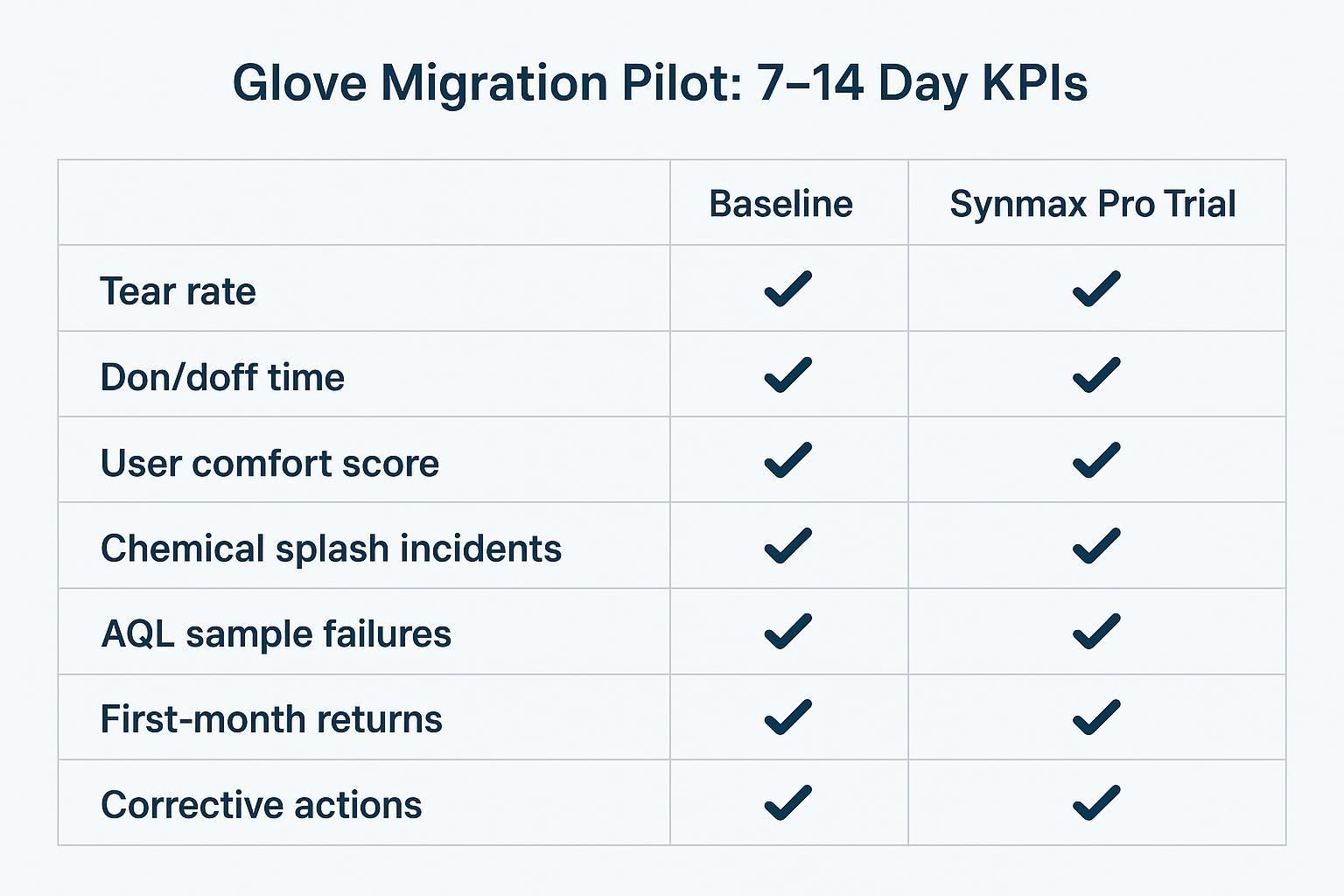
If you need to validate a nitrile benchmark alongside Synmax Pro, add one standard nitrile SKU to the pilot so your team can directly compare feel, tear rate, and grip across identical tasks. Once you’re confident the new mix meets your SOPs, update your internal spec language to reflect sizes, colour coding if used, and documentation references. When questions arise, a brief touchpoint with the manufacturer’s team often speeds resolution; reach out via the INTCO contact page to coordinate samples or additional datasheets.
Frequently Asked Questions
What Exactly Is the Synmax Pro Exam Glove?
Synmax Pro is a synthetic, latex-free, powder-free exam glove designed to provide a nitrile-like feel at a more cost-effective price, offering reliable barrier protection for routine applications such as medical exams, food handling, cleaning, and beauty services.
How Does Synmax Pro Compare to Nitrile Exam Gloves?
Synmax Pro offers a more elastic and flexible fit than traditional vinyl, with a nitrile-like feel and improved abrasion resistance for repetitive tasks, but for high-risk chemical or chemical exposure, nitrile gloves remain the safer choice due to stronger permeation protection and compliance with standards like ASTM D6978.
Is Synmax Pro Safe for Food Handling?
Yes, Synmax Pro is suitable for food handling when used according to FDA Food Code practices, as it is latex-free and powder-free, but proper hand hygiene and frequent glove changes are still required.
What Sizes and Textures Are Available?
Synmax Pro gloves are typically available in sizes S to XL with standard cuff length, and manufacturers like INTCO Medical, with over 87 billion gloves annual capacity, offer multiple texture options such as fingertip textured, fully textured, and smooth finishes for different applications.
What Should Buyers Verify in Synmax Pro Documentation Before Ordering?
Buyers should confirm latex-free and powder-free claims, relevant standards such as EN 455 and ASTM D5250, AQL levels for barrier integrity, and request compliance documentation and chemical compatibility data if needed to ensure the gloves meet their operational requirements.