
Best Nitrile Alternative Gloves for High-Volume Users
When buyers say they’re searching for nitrile alternatives, they’re rarely abandoning nitrile altogether—they’re trying to solve specific problems: stabilise cost at scale, keep dexterity high, reduce changeouts in abrasive tasks, maintain food-contact compliance, or preserve flexibility in cold environments. This guide translates those goals into practical choices across materials—vinyl/PVC, TPE/CPE, polyethylene, latex, chloroprene/neoprene, and engineered hybrids—so healthcare, food/cold-chain, cleaning, and procurement teams can switch with confidence.
What buyers really mean by nitrile alternatives
For most high-volume programs, the decision hinges on total cost per use rather than unit price alone. That means matching material properties to your work: elasticity for dexterity, abrasion tolerance to cut change frequency, and appropriate compliance for the job. For food handling, buyers typically reference the U.S. food-contact framework in the federal code; you can review the official language in the eCFR’s section for rubber articles intended for food contact in FDA 21 CFR Part 177 Subpart C. In medical and PPE contexts, standards clarify what “exam-grade” and chemical protection entail. The CDC’s PPE-Info pages summarise core specs such as ASTM D6319 for nitrile exam gloves and ASTM D6978 for chemical resistance permeation testing. For EU-sourced SKUs, medical single-use requirements are mapped in the Commission’s EN 455 harmonisation notes, while chemical/microorganism protection follows the EN ISO 374 family via standards bodies like BSI’s PPE overview. As you evaluate options, think in terms of jobs-to-be-done: What must the glove survive in one shift, and how will that affect consumption, safety, and audits?
Side-by-side look at common glove materials
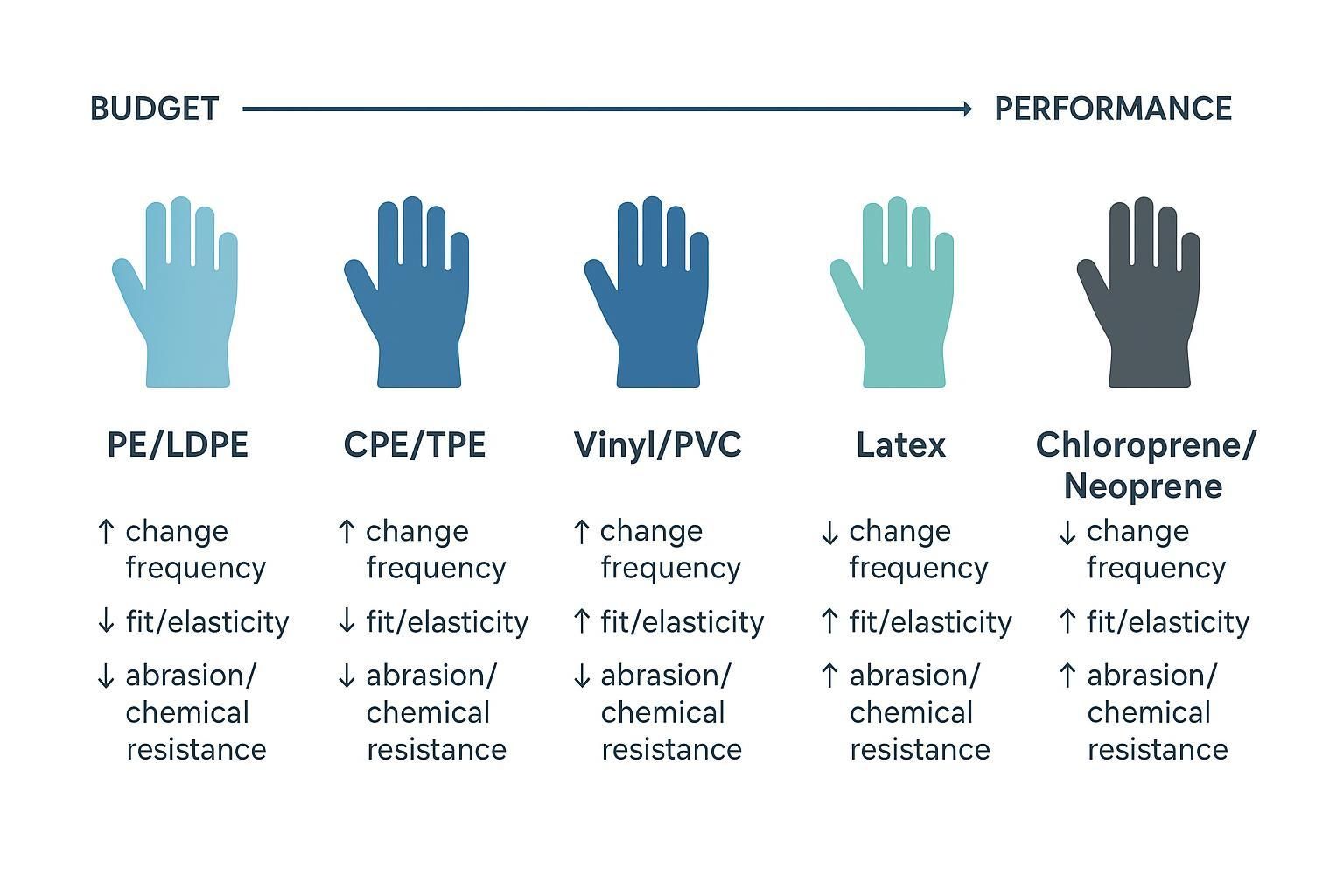
Below is a concise, procurement-friendly snapshot to compare materials on cost band, fit, durability, chemical resistance, food-contact suitability, and allergy risk. Figures are generalised; confirm against product data sheets and compliance documentation during sourcing.
| Alternative | Typical cost band (directional) | Fit and elasticity | Abrasion and puncture | Chemical resistance | Food-contact suitability | Allergy risk | Notes |
|---|---|---|---|---|---|---|---|
| Vinyl/PVC | Low (budget) | Looser fit; lower stretch vs elastomers | Lower vs nitrile under friction | Limited | Common for food handling (verify per SKU) | Latex-free | Good for frequent changes and audits |
| TPE/CPE | Ultra-low (rapid-change) | Modest, non-elastomeric | Very low; intended for quick tasks | Limited | Suitable for quick food tasks (verify per SKU) | Latex-free | Ideal where gloves are changed every few minutes |
| Polyethylene (PE/LDPE) | Lowest | Very low | Very low | Limited | Quick-prep food tasks | Latex-free | Thinnest option; minimal durability |
| Chloroprene/Neoprene | Mid-to-high | Medium-high | Medium-high | Better than vinyl/TPE/PE | Varies by SKU | Latex-free | Popular in chemical-heavy cleaning; confirm EN/ASTM data |
| Latex (exam) | Mid | High, elastic, latex-like feel | Medium | Good but chemical-specific | Widely used in medical (policy-dependent) | Allergy risk | Excellent dexterity; ensure latex policies allow |
| Engineered hybrid (nitrile-inspired) | Mid (quote-based) | Elevated stretch and comfort | Enhanced vs vinyl; confirm test data | Not a chem gauntlet | Food/exam options to verify | Latex-free | Targets nitrile-like fit with lower TCO |
Two quick realities often decide the winner. First, frequent-change stations (sandwich lines, tasting stations, basic prep) tend to benefit from ultra-budget PE or CPE/TPE because durability matters less than speed and cost. Second, repetitive gripping, tool handling, and sanitation workflows often justify spending a bit more on abrasion-friendly synthetics so you cut replacements and keep hands comfortable.
Best-fit scenarios for high-volume operations
Healthcare and clinical exam settings with relentless patient throughput usually need exam-grade documentation and a comfortable, elastic fit to preserve dexterity. Where budgets are tight and hazardous chemical exposure is low, an engineered hybrid can be the cost-effective glove choice, provided it meets exam and skin-contact expectations in pilots. For food processing and cold-chain operations, gloves must stay flexible in low temperatures and remain audit-ready as food-safe gloves. PE and CPE/TPE excel for quick-change stations; in frozen packing or wet handling, you’ll want enhanced formulations or textured surfaces that keep flexibility and grip when things get slick. In industrial maintenance and commercial cleaning, abrasion tolerance and chemical compatibility dominate. Chloroprene/neoprene disposables or enhanced synthetics tend to reduce breakage during scrubbing and repetitive tool work; check applicable EN ISO 374 or ASTM chemical data for your detergents and solvents.
For centralised procurement managers handling multi-site programs, the decision tree revolves around cost-per-use modelling, SKU rationalisation, and supply reliability. Consider the change frequency per task, the elasticity your teams actually need, and whether a slightly more durable glove reduces total consumption across shifts. Think of it this way: the cheapest box is not always the cheapest shift. For a broader look at glove programs and material options from a single manufacturer’s vantage point, you can scan the INTCO Medical website to understand the scope before you request specifications from any supplier.
A closer look at an engineered hybrid option
Synmax Pro exam gloves—nitrile-like stretch at vinyl-level cost
Engineered hybrids bridge the gap between vinyl’s affordability and nitrile’s comfort. One representative option is the Synmax Pro exam glove line from INTCO Medical. Built on a chemically modified vinyl-based formulation inspired by nitrile, this disposable exam glove is powder-free, latex-free, and non-sterile, with sizes from S to XL and color options such as black, blue, and white for program differentiation. The formulation targets a nitrile-like fit and tactility while maintaining a vinyl-level cost profile—an appealing combination for high-consumption programs that need to control spend without sacrificing comfort.
In high-friction tasks, internal testing indicates elevated abrasion tolerance compared with conventional baselines, which can help reduce mid-shift replacements in repetitive gripping or tool handling. Elastic response is verified above 400% in internal assessments, approaching the stretch performance typically associated with nitrile exam gloves, and the gloves are designed to stretch without tearing during normal use. For cold-chain environments, the material maintains practical flexibility down to sub-freezing conditions cited in product guidance (−18°C), making it a strong candidate for frozen food processing lines that struggle with stiff gloves. For exam-grade and food-contact use, buyers should request documentation aligning with the appropriate standards and regulations during sourcing.
Where does this glove shine? Routine healthcare examinations with predictable contamination risk but aggressive cost targets; fast-paced food prep and packing where durability plus dexterity lowers total glove consumption; industrial and commercial cleaning workflows where repeated friction can quickly wear down lighter materials. Where is caution warranted? Chemical permeation tasks that demand specialised EN ISO 374 or ASTM-rated gauntlets; situations where institutional policy requires specific certifications that must be validated SKU by SKU before rollout.
If you want the full product overview, review the official page for the Synmax Pro exam gloves with nitrile-like stretch and vinyl-level cost positioning on INTCO’s site via this natural anchor: nitrile-inspired Synmax Pro exam gloves. For teams still committed to nitrile in certain lines, a contrasting INTCO product resource on textured, exam-grade nitrile options can help you calibrate expectations on thickness and grip, as outlined in the Chemtuff disposable nitrile gloves overview.
When to stay with nitrile vs when to switch
Nitrile remains the best option when your tasks involve notable chemical exposure, frequent risk of puncture, or institutional requirements that explicitly call for a nitrile exam glove standard. It’s also the sensible choice where staff prefer the familiar, elastic feel, and the price fits your budget. Consider switching where total cost-per-use balloons due to rapid changeouts, where abrasion and repetitive motion drive tearing in standard nitrile, or when cold environments are creating stiffness that slows work. In food-only environments with rapid glove changes and low mechanical risk, ultra-budget materials like PE or CPE/TPE often pass audits and win on speed and cost. In mixed environments, a hybrid approach—maintaining nitrile in higher-risk lines while deploying engineered hybrids or food-service synthetics elsewhere—often yields the best overall TCO.
Migration playbook for smooth switching
Begin with compliance. For food-contact programs, confirm that the specific SKU is suitable under the applicable provisions of federal food-contact rules; the eCFR index for rubber articles under FDA 21 CFR 177 Subpart C is your primary reference. For medical exam use, confirm exam-grade documentation, understand how ASTM D6319 and related standards apply, and assess whether chemical resistance permeation testing like ASTM D6978 is required for your facility. Then pilot in representative departments and shifts. Track change frequency, breakage modes, donning/doffing ease, and any skin responses; compute cost-per-use by dividing total pairs consumed per shift into your landed cost.
Validate performance in context. In frozen rooms, log any stiffness or loss of dexterity at or below −18°C; in wet and oily areas, evaluate texture and grip under real detergents and sanitisers. Map SKUs to your inventory system, confirm dispenser and storage compatibility, and rationalise sizes and colours to reduce confusion. Close by checking supply reliability—production capacity, lead times, and backup plants—so your program can scale. Lock pricing tiers, MOQs, and logistics SLAs contractually, and update SOPs and training materials to reflect the new glove’s replacement intervals and any allergy reporting processes.
Procurement toolkit and next steps
A simple cost-per-use model changes the conversation. Suppose your sandwich line changes gloves every five minutes. A glove that cuts changeouts by even 10–15% through better fit or abrasion tolerance can remove thousands of pairs from monthly consumption, more than offsetting a slightly higher unit price. The same math applies in outpatient clinics with continuous exams or in sanitation crews where scrubbing shreds lighter materials. If you need a refresher on food-contact concepts to brief your team, INTCO’s educational content explains what to look for in FDA-compliant non-latex disposable gloves for safety and how to judge whether nitrile gloves are food safe for food-service businesses. For a broader context on medical consumables programs and how gloves fit into clinical workflows, the corporate site for INTCO Medical provides background on manufacturing scope and quality systems, while the company overview gives a snapshot of scale and global supply coverage. To explore options across glove materials and program design, browsing a manufacturer’s glove program resources can help you frame questions for any vendor before you finalise specs. If your team is preparing an RFP or wants to run a structured pilot, you can start a conversation through INTCO’s contact page to obtain product documentation and packaging details.
FAQ
How do I decide between vinyl/PVC and TPE/CPE for food prep lines?
Choose based on task duration and audit needs. TPE/CPE and PE work well for ultra-quick changes where durability matters less than speed, while vinyl/PVC offers a slightly closer fit and feel. Always verify food-contact suitability for the exact SKU and train staff on change intervals.
Are latex gloves still relevant as nitrile alternatives in clinical settings?
They can be, primarily for dexterity and tactile sensitivity. However, latex allergy policies limit adoption in many institutions. If allowed, confirm exam-grade documentation and monitor for reactions, especially during onboarding.
What makes chloroprene/neoprene compelling for cleaning contractors?
A balanced chemical and abrasion profile for detergents and routine sanitisers, with better wet-grip options than thin food-service synthetics. They generally cost more, so confirm that reduced breakage offsets the unit price in your exact workflows and review applicable EN ISO 374 or ASTM data.
What are Synmax Pro exam gloves?
Synmax Pro exam gloves are a high-performance, latex-free disposable exam glove engineered on a nitrile-inspired, chemically modified vinyl formulation to deliver elevated elasticity, comfort, and durability with vinyl-level cost efficiency. They target high-volume use across routine healthcare exams, food processing, industrial operations, and commercial cleaning. See the product overview for nitrile-inspired Synmax Pro exam gloves.
Why are Synmax Pro exam gloves considered a cost-effective alternative to nitrile gloves?
The resin blend is designed to provide nitrile-like stretch and dexterity at a significantly lower unit price typical of vinyl-based gloves. In practice, this can lower cost-per-use in frequent-change environments when pilots show stable fit and fewer mid-shift replacements.
How do Synmax Pro exam gloves compare to traditional vinyl exam gloves?
Internal test data indicates higher elasticity—around the 400%+ range for Synmax Pro compared to typical vinyl figures in the mid-300% band—supporting better mobility during exams and professional tasks. Buyers should request the latest test summaries for their records.
What packaging options are available for Synmax Pro exam gloves?
Standard exam-glove formats are common—100 gloves per dispenser box and 10 boxes per carton—supporting routine storage and distribution. Confirm counts with your supplier and specify sizes S through XL based on staff mix.
Can Synmax Pro exam gloves support private label or custom packaging?
Yes. Supported by high-capacity manufacturing and a broad global supply network, Synmax Pro can be private labelled with flexible box designs, labelling, and carton specifications to meet individual branding needs.
Which industries benefit most from Synmax Pro exam gloves?
Healthcare examinations, food processing and cold-chain lines, industrial manufacturing, and commercial cleaning all benefit from the balance of elasticity, abrasion tolerance, and cost efficiency—especially where gloves are changed frequently and reliability matters.