
Nitrile Glove Colors by Profession: A Buyer’s Guide
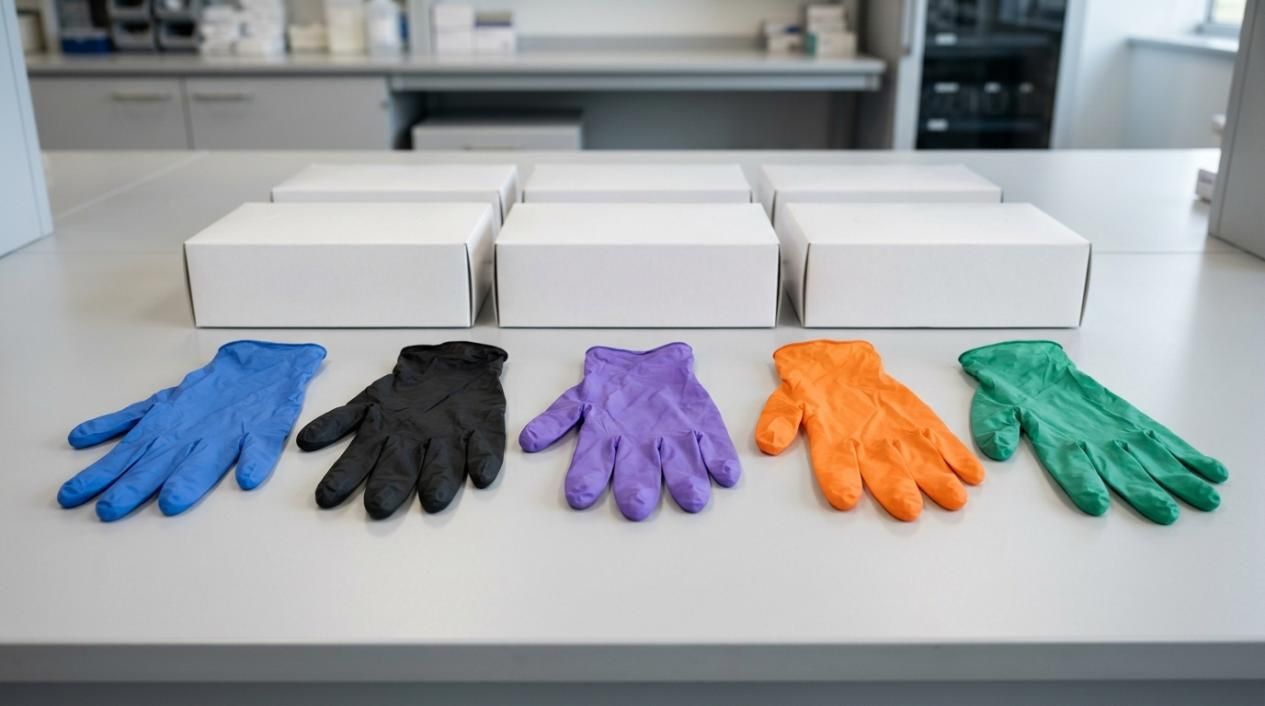
Nitrile glove colors usually function as workplace cues, not safety grades. A hospital may assign one color to isolation supplies, a kitchen may use another to separate tasks, and an automotive shop may prefer a high-visibility or stain-masking color. None of those colors alone proves medical-device status, food-contact suitability, chemical resistance, cleanroom compatibility, ESD performance, sterility, thickness, or quality. Choose the glove for the hazard and intended use first; choose color last.
That distinction answers the most important question behind “what do different color nitrile gloves mean?” There is no universal profession-to-color code that makes every blue glove medical, every purple glove chemotherapy tested, every white glove cleanroom compatible, or every black glove heavy duty. Color can make a good control system easier to follow, but it cannot replace product-specific evidence.
Use one decision order in every profession
Start with the task rather than a favorite color. The defensible order is:
- Identify the task, contact type, duration, environment, and foreseeable hazards.
- Define the required intended use, regulatory status, and product claims.
- Verify the exact SKU’s test results, quality controls, formulation, and documentation.
- Evaluate thickness, cuff, texture, fit, sizes, dexterity, and change frequency.
- Select a color that supports the organization’s workflow without overstating protection.
This approach follows the logic of OSHA’s hand-protection rule, which bases selection on performance relative to the task, conditions, duration, and hazards. Color is not one of those performance characteristics unless visibility or identification is itself part of the evaluated task.
Nitrile glove colors by profession
The table below describes common operational choices, not mandatory industry meanings. A facility may reasonably choose another color if the approved product and written program meet its needs.
| Profession or setting | What color can help with | Evidence to verify separately |
|---|---|---|
| Healthcare and dental | Department, size, material, or task identification; contrasting inner and outer layers in a defined double-gloving procedure | Exact medical-device status and intended use; applicable examination or surgical standard; barrier and quality data; powder and sterility status; fit and change protocol |
| Laboratory, cleanroom, and electronics | Zone or process identification; contrast with light powders or parts; quick distinction between controlled-area SKUs | Chemical compatibility for each chemical and contact condition; cleanliness, particle and extractable specifications; ESD resistance or system qualification; cuff and packaging requirements |
| Foodservice and food processing | Raw versus ready-to-eat task separation; allergen or production-line coding; visibility if a fragment enters food | Food-contact formulation evidence; facility HACCP/SOP requirements; task-specific change rules; durability and fit; local food code |
| Tattoo, beauty, and salon | Visual consistency, contrast with light barriers or bright products, and stain masking | Applicable body-art or cosmetology rules; examination status where required; barrier evidence, powder status, fit, and event-based change procedure |
| Automotive and general industry | High visibility around dark machinery, or stain masking around oil, ink, and grease; job or team coding | Chemical permeation/degradation data for each substance and contact pattern; cut, puncture, thermal, or electrical protection supplied by separate appropriate PPE where needed |
| Cleaning and facilities | Restroom, kitchen, patient-area, or chemical-task segregation; size and team identification | Safety-data-sheet guidance, chemical manufacturer information, glove compatibility, contact duration, cuff coverage, and a doffing/disposal plan |
Healthcare and dental: color supports a protocol
Blue, violet, green, pink, white, and other colors all appear in medical supply channels. A healthcare organization can assign colors to departments, materials, sizes, or special procedures, but the scheme only works if it is documented and staff can identify the approved SKU.
The FDA classifies a non-powdered nitrile or polymer patient-examination glove by intended medical use, not color. Its current product-classification record also lists recognized standards such as ASTM D6319 and D5151. A violet glove is not a chemotherapy glove merely because some chemotherapy-tested products are violet; resistance must be supported for the exact glove and relevant drugs under the claimed test practice.
Likewise, color never replaces Standard Precautions. The CDC’s infection-control guidance makes PPE selection risk based and keeps hand hygiene, environmental cleaning, equipment handling, and sharps safety in the same system.
INTCO’s nitrile exam gloves in multiple colors provide a product-family starting point for healthcare buyers. Request the current exact-SKU regulatory and technical file rather than transferring every family-page statement to every color, market, or procedure.
Laboratories, cleanrooms, and electronics: specifications outrank appearance
White or light colors can make some dark particles visible; dark colors can improve contrast with pale powders or components. Facilities may also code gloves by room classification, process step, chemical family, or approved material. Those are local controls.
A white nitrile glove is not automatically cleanroom processed. Cleanroom buyers may need documented particle, extractable, ionic, packaging, cuff, sterilization, and lot requirements. An electronics buyer should verify the glove’s place in the full ESD control program. The ESD Association’s glove working group discusses glove resistance testing and system limits; the important point is that ESD behavior is measured, not inferred from pigment.
For chemicals, never select by “industrial” color. OSHA notes that no glove protects against all hand hazards. Compare the exact formulation against the exact chemical or mixture, concentration, temperature, contact mode, and duration. A splash task and immersion task are not equivalent.
Foodservice: use color to separate work, not to certify food contact
Blue is popular in food operations partly because it contrasts with many foods. Other colors can distinguish raw-protein preparation, allergen-controlled work, cleaning, and ready-to-eat handling. A plant can build a useful visual system around those distinctions, but the glove’s formulation and permitted use still require evidence.
The 2022 FDA Food Code is a model offered for adoption by jurisdictions, not a self-executing nationwide rule. Section 3-304.15 says that, when used, single-use gloves are for one task and must be discarded when damaged, soiled, or when interruptions occur. Buyers must check the code actually adopted by the responsible jurisdiction. A color does not extend wear time, sanitize a contaminated glove, or make handwashing optional.
Color-fragment detectability is also not automatic. If a facility relies on visual or machine detection, test the actual glove color and detection system under real product, lighting, line-speed, and contamination conditions. Record the approved SKU; “any blue glove” is not a controlled substitute.
Tattoo, beauty, and salon: presentation is secondary to the barrier workflow
Black is common because it matches studio presentation, masks many stains, and can create contrast with light barriers and bright products. The same stain-masking benefit creates a trade-off: contamination may be less visible. Glove changes must follow touch events, tears, task boundaries, and the applicable procedure rather than appearance.
Disposable black nitrile gloves may suit several nonsterile professional settings, depending on the exact product and task. Body-art buyers should separately verify whether an examination glove is required, what the local rule says, and which product documents support blood-exposure work. Beauty and salon buyers should map dyes, adhesives, cleaners, and other products to compatibility evidence rather than assuming black nitrile handles them all.
Automotive, industrial, and cleaning: visibility versus stain masking
Black can keep grease and ink from dominating the glove’s appearance, while orange, lime, or another bright color can improve hand visibility in a busy workspace. Some teams use color to identify technicians, job stages, chemical tasks, or glove thicknesses.
The buyer must still separate disposable chemical splash protection from cut, puncture, impact, heat, and electrical hazards. A dark, thick-looking glove is not proof of any rating. Use the workplace assessment and manufacturer data to determine whether a disposable glove is appropriate at all, and add or select other PPE where the task requires it.
Cleaning programs often benefit from simple zone coding—such as one color for restrooms and another for food or patient areas. The code reduces cross-use only when boxes stay in the correct zone, staff change gloves and clean hands at task boundaries, and purchasing does not introduce an unreviewed substitute.
What the main nitrile glove colors can communicate
Instead of assigning fixed professions to pigments, think in five practical functions:
- Identification: distinguish materials, sizes, departments, rooms, lines, or approved SKUs.
- Visibility: use contrast so hands, fragments, soil, powders, or product are easier to see in the actual environment.
- Layer contrast: help a defined double-gloving procedure reveal a breach, provided both products and the procedure are approved.
- Stain management: reduce visual distraction, while remembering that hidden stains do not mean a clean glove.
- Brand and presentation: reinforce a professional appearance after safety and documentation requirements are satisfied.
Black, blue, violet, green, orange, pink, white, gray, and other colors can each perform one or more of these functions. No color owns them. Even gloves that look identical may differ in formulation, thickness, dimensions, texture, quality level, processing, packaging, regulatory status, and test data.
Custom color or printing can make a controlled SKU easier to recognize. INTCO’s custom-printed nitrile gloves illustrate branding options for several industries. Buyers should treat printing as an identification feature and confirm that the approved construction, intended use, tests, and market requirements remain valid for the exact customized item.
What color never proves
A glove color alone cannot establish:
- medical examination or surgical status;
- sterility, powder level, biocompatibility, or freedom from holes;
- food-contact suitability or compliance with a facility’s food-safety plan;
- chemical or chemotherapy-drug permeation resistance;
- cleanroom particle or extractable performance;
- ESD resistance or compatibility with an electronics control program;
- thickness, tensile strength, elongation, puncture, cut, heat, or electrical protection;
- sustainability, biodegradability, recycled content, or lower environmental impact;
- freedom from all allergens, irritants, or chemical accelerators.
This is why “purple means chemotherapy,” “green means eco-friendly,” and “blue means medical grade” are unsafe purchasing shortcuts. A color can label a verified capability inside a facility; it cannot create the capability.
Build a color-coding program that survives substitutions
A color program needs governance, not just a poster. Use this sequence:
- Map tasks and hazards. Group only tasks that truly share requirements.
- Approve exact SKUs. Record manufacturer, model, size range, color, intended use, tests, formulation, shelf life, and storage.
- Write a short legend. State what each color means locally and, equally important, what it does not mean.
- Plan for accessibility. Pair colors with box labels, symbols, storage locations, or SKU names so color-vision differences and low light do not defeat the control.
- Train using scenarios. Include task changes, glove damage, hand hygiene, doffing, disposal, and what to do when the approved color is unavailable.
- Control substitutions. Never accept “same material, size, and color” as the full equivalence test. Technical review comes before issue.
- Audit behavior. Check boxes, locations, staff understanding, stock rotation, complaints, and whether the code actually prevents cross-use.

The substitute rule is essential. Supply interruptions tempt teams to preserve the color while changing the product. Reverse that priority: preserve the required performance and documentation first. If the best reviewed substitute has a different color, temporarily update the legend, storage, labels, and training.
Procurement checklist for colored nitrile gloves
Before a case or contract purchase, record:
- legal manufacturer, factory, brand, model, catalog number, and market;
- intended use and current regulatory status where applicable;
- standards and reports relevant to that use, with sample, lot, date, and pass criteria;
- material, formulation disclosures, powder status, colorants, processing, and sterility;
- dimensions, thickness by location, cuff, texture, sizes, and packaging;
- chemical, cleanroom, ESD, food-contact, or chemotherapy evidence only when the task needs it;
- shelf life, storage, lot traceability, change notification, complaint handling, and recall process;
- worker fit-trial results across all required sizes and representative tasks;
- approved primary and backup SKUs, including how the color legend changes during substitution.
FAQ
What do nitrile glove colors mean?
Usually, they mean whatever the manufacturer offers or the workplace defines. Color may support identification, contrast, task separation, branding, or stain management. It is not a universal protective grade.
What is the best color for nitrile gloves?
There is no universally best color. Choose the exact product for the hazard, intended use, evidence, fit, and workflow; then choose a color that improves visibility or organization in the real setting.
Are purple nitrile gloves more chemical resistant than blue ones?
Not because they are purple. Compare the exact products’ formulation and test data against the exact chemical, concentration, temperature, contact type, and duration.
Why are food gloves often blue?
Blue can contrast with many foods and may support visual control. Food-contact evidence, task separation, glove changes, hand hygiene, and the facility’s food-safety procedure still determine acceptable use.
Can one company use different colors for departments?
Yes, as an internal identification system. Document the legend, pair color with text or SKU controls, train staff, manage substitutions, and audit whether the system is followed.
The practical conclusion is simple: select protection by evidence and use color to make the approved system easier to follow. When a color program preserves that order, it can reduce confusion across professions without pretending that pigment is a safety standard.