
Nitrile Glove Colors for Industrial Applications
Nitrile glove colors are usually operational cues, not protection grades. Blue may identify one approved SKU, orange may improve visibility, and black may mask grease—but none of those colors proves chemical resistance, food-contact suitability, medical-device status, thickness, or durability. Industrial buyers should approve the glove for the task and hazards first, then choose a color that makes the approved system easier to follow.
| Color | Common operational use | What it does not prove |
|---|---|---|
| Blue | General identification; contrast in food and clinical settings | Food-contact or medical status |
| Black | Stain masking; contrast with light powders and parts | Heavy-duty or chemical performance |
| Orange | High visibility; quick task or team recognition | Cut, impact, or heat protection |
| Green | Zone, size, material, or process identification | Sustainability or biodegradability |
| Purple | SKU, layer, or department identification | Chemotherapy or chemical resistance |
| White | Visibility of dark soil; controlled-area identification | Cleanroom compatibility or sterility |
| Pink and other custom colors | Size, role, brand, or task distinction | Fit, quality, or suitability for a profession |
What nitrile glove colors can—and cannot—tell you
Color can answer a local workflow question: Is this the approved glove for this line, room, task, or size? It cannot answer the more important safety question: Will this exact glove perform under the expected exposure?
The OSHA hand-protection rule requires employers to select hand protection based on the tasks, conditions, duration of use, and hazards identified. That leads to a defensible buying order:
- Define the task, contact type, duration, temperature, and foreseeable hazards.
- Establish the required intended use and regulatory or customer requirements.
- Verify the exact SKU's test data, quality controls, formulation, and documentation.
- Evaluate thickness, cuff, texture, fit, sizes, dexterity, and change frequency.
- Choose a color that supports identification, contrast, or workflow.
Reversing that order is risky. Two blue gloves can differ in formulation, thickness, quality level, processing, and permitted uses. Two black gloves can have different grip patterns, cuffs, chemical data, and tear performance. A color label should point to an already qualified product; it should never substitute for qualification.
Common nitrile glove colors and their industrial uses
The following nitrile glove colors and uses are common associations, not mandatory codes. A facility can choose another scheme if it documents the meaning and controls the approved products.
Blue: a familiar baseline with useful contrast
Blue is common across food processing, laboratories, healthcare, and general industry. In food operations, it can contrast with many products and may make a fragment easier to see. In mixed-material inventories, blue can also identify a specific nitrile SKU or distinguish one production zone from another.
That visibility advantage is site-specific. A blue glove fragment may still be hard to see in a blue product, under poor lighting, or at line speed. If detection is part of the control plan, test the actual glove, product, lighting, and detection equipment. The FDA Food Code 2022 is a model offered for adoption by jurisdictions, not a federal rule that applies everywhere. Its model provisions call for handwashing at specified points and, when single-use gloves are used with food, one-task use and disposal when damaged, soiled, or interrupted. Check the code actually adopted in the facility's jurisdiction. Color does not extend wear time or sanitize a contaminated glove.
Black: stain masking and visual contrast
Black nitrile gloves are popular in automotive work, tattoo and cosmetology settings, sanitation, foodservice, and other appearance-sensitive tasks. The dark surface can keep grease, ink, dye, and other stains from dominating the glove's appearance. It can also contrast with pale powders, parts, or cleaning residues.
Stain masking is a trade-off, not a performance upgrade. Soil may be less visible, so workers must change gloves according to events—damage, task changes, contamination, and written procedures—not appearance alone. INTCO's current black nitrile gloves product page lists black/customized color options and industrial, laboratory, and food-processing applications. Buyers should still request the exact SKU's current documentation for the intended task rather than treating "black" as a specification.
Orange: high visibility in busy environments
Orange can make hands easier to notice against dark machinery, vehicle interiors, storage areas, and low-contrast backgrounds. Maintenance teams may also use it to identify a specific job, contractor group, inspection status, or higher-visibility inventory.
Brightness does not turn a disposable glove into cut-, impact-, heat-, or electrical-protective PPE. If a task involves those hazards, the risk assessment may call for another glove type or additional controls. Orange is valuable only when visibility itself solves a defined problem.
Green: a flexible code, not an environmental claim
Green works well as a local identifier because it is visually distinct from common blue and black inventory. A plant might assign green to an allergen-controlled line, a sanitation team, a size, an approved formulation, or a controlled material flow.
Green pigment does not make a glove biodegradable, lower carbon, recycled, or environmentally preferable. Environmental claims require product-specific evidence and clearly defined test conditions. Procurement teams should separate a visual color choice from sustainability documentation in the approval file.
Purple: useful distinction, but no universal performance meaning
Purple or violet gloves may help separate departments, distinguish exam inventory from general-purpose stock, or create layer contrast in a defined double-gloving procedure. The color can be operationally useful when two approved layers need to remain visually distinct.
Purple alone does not prove chemotherapy-drug testing, chemical resistance, or medical-device status. The FDA's current LZA patient-examination glove classification is based on intended medical use and applicable controls, not pigment. Medical and hazardous-drug buyers must verify the exact product, claims, test methods, substances, and conditions.
White: strong soil contrast with controlled-area associations
White or very light nitrile can reveal dark soil, ink, or particles that might be less visible on black gloves. Laboratories, inspection operations, electronics teams, and controlled environments may also use white to identify a specific room, process, or cleanliness program.
A white glove is not automatically cleanroom processed, low particle, sterile, or ESD suitable. Those properties require specifications for particles, extractables, packaging, processing, electrical resistance, sterility, and lot control as applicable. "White nitrile" is a visual description, not a controlled-environment grade.
Pink, gray, and custom colors: identification and brand consistency
Less common colors can be effective when a company needs a highly distinct code. Pink might identify a size or care area; gray might fit a maintenance program; a custom shade could connect a controlled SKU to a production line or private-label program.
Avoid assigning colors to gender or professional competence. Fit depends on dimensions and size availability, not whether a color is marketed as masculine or feminine. Where brand presentation matters, INTCO's live custom-printed nitrile gloves page supports logo, text, pattern, and OEM customization. Printing should remain an identification or branding feature; the approved construction and exact-use evidence still govern performance.

Black, orange, and blue can support different visual tasks, but color alone does not establish a protection level.
Match color to the workplace, not a stereotype
The best color depends on what workers need to notice and distinguish in the real environment.
| Setting | Useful color function | Evidence to verify separately |
|---|---|---|
| Food processing | Separate raw/ready-to-eat tasks, allergens, zones, or lines; reinforce controls intended to reduce cross-contamination and allergen cross-contact | Food-contact documentation, adopted local code, facility procedures, handwashing and change rules, fit, durability |
| Automotive and MRO | Mask grease or improve visibility; identify jobs, teams, or glove thicknesses | Chemical compatibility, cuff, grip, thickness, and other PPE for cut/heat/impact hazards |
| Laboratory | Identify processes, materials, rooms, or approved chemical-task SKUs | Exact chemical, concentration, temperature, contact duration, permeation/degradation data |
| Cleanroom and electronics | Identify controlled areas or approved inventory | Particle/extractable limits, packaging, processing, ESD data, lot controls |
| Healthcare and life sciences | Distinguish departments, materials, sizes, or layers | Intended medical use, applicable standards, quality data, sterility and powder status |
| Cleaning and sanitation | Keep restroom, production, patient, and food-area inventory separated | Safety-data-sheet guidance, compatibility, cuff coverage, change and disposal procedures |
This table describes ways a facility might use color. It is not a global glove color code. One plant may use orange for sanitation while another reserves it for maintenance. Both systems can work if the assigned glove is suitable, the legend is documented, boxes stay in the correct location, and workers understand the rule.
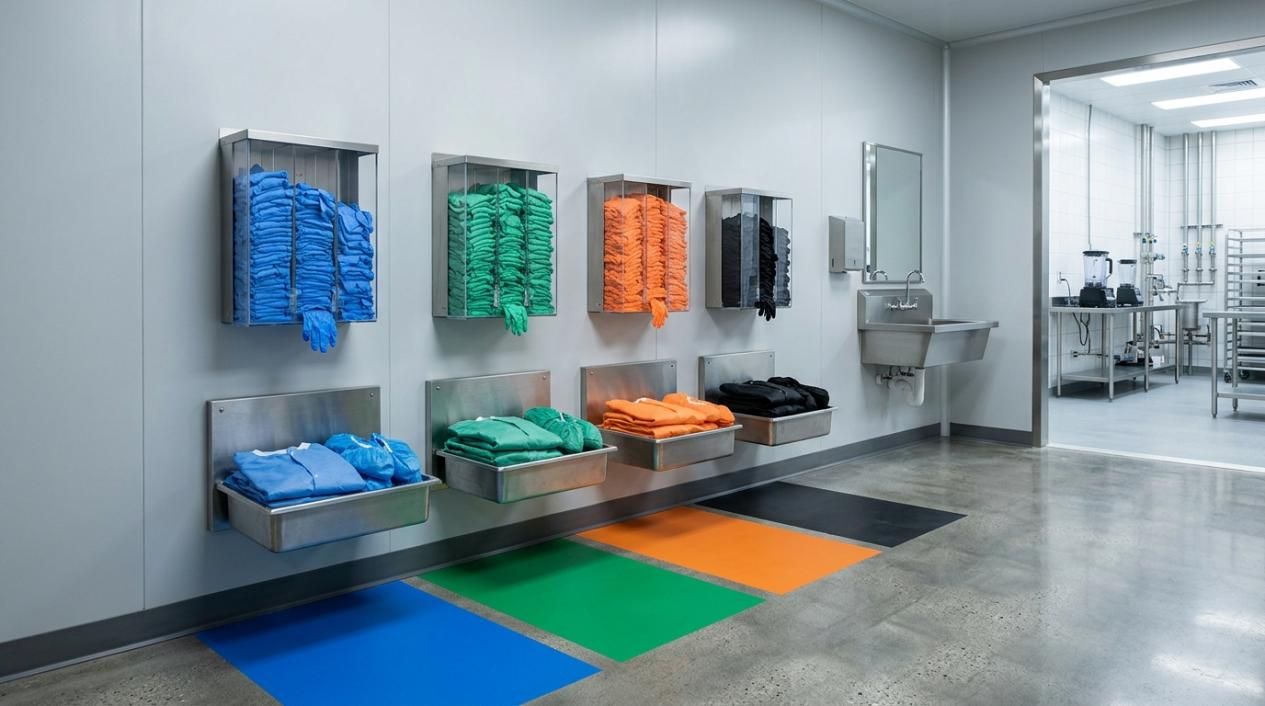
Concept illustration only—not storage or donning guidance. A color system becomes useful when protected dispensers, labels, locations, and approved SKUs reinforce the rule.
Build a color-coding program that survives substitutions
A nitrile glove color coding program needs more than a wall chart. Use this implementation sequence:
- Map tasks and hazards. Group jobs only when they share the same exposure, dexterity, quality, and intended-use requirements.
- Approve exact products. Record the legal manufacturer, model, catalog number, size range, color, formulation, intended use, test reports, shelf life, and storage conditions.
- Assign colors locally. State what each color means at this site and what it does not mean.
- Pair color with another cue. Use box labels, symbols, SKU names, storage locations, or dispenser shapes so color-vision differences and poor lighting do not defeat the system.
- Train around events. Cover glove damage, task changes, contamination, doffing, hand hygiene, disposal, and approved backup inventory.
- Control substitutions. Technical review comes before color matching. "Same color and material" is not an equivalence test.
- Audit the system. Check storage locations, worker understanding, substitution records, complaint trends, and whether the code actually reduces mix-ups.
Substitution control is the stress test. During a shortage, buyers may find a reviewed replacement that meets the task requirements but comes in a different color. Preserve the performance and evidence first. Then update the legend, labels, storage, and training for the temporary color. Keeping the old color at the expense of the approved specification defeats the program.
For facilities that need several local codes, INTCO's live multi-color disposable nitrile gloves product page lists blue, black, orange, and customized options for industrial, laboratory, and food-processing applications. Treat that family page as a sourcing starting point; approve the exact offered SKU and its documents before adding it to the legend.
Procurement checklist for colored nitrile gloves
Before approving a case, contract, or private-label run, record:
- manufacturer, factory, brand, model, catalog number, and target market;
- intended use and current regulatory status where applicable;
- material, formulation disclosures, colorants, powder and sterility status;
- dimensions, thickness by location, cuff, texture, sizes, and packaging;
- test reports relevant to the task, with sample or lot, date, method, and pass criteria;
- chemical, food-contact, cleanroom, ESD, or medical evidence only when the task needs it;
- shelf life, storage, lot traceability, change notification, complaints, and recall process;
- worker fit trials across representative sizes and tasks;
- approved primary and backup SKUs, including the color-code change process.
Ask suppliers to identify which statements apply to the family, which apply to the exact SKU, and which apply only in a particular market. A product page can start the conversation; the approval file must finish it.
FAQ
What do different nitrile glove colors mean?
Usually, they mean what a manufacturer offers or what a workplace defines. Colors can identify tasks, zones, materials, sizes, teams, or approved SKUs. There is no universal industrial code that turns color into a protection rating.
Does glove color affect chemical resistance?
Not in a way a buyer can infer from color alone. Chemical suitability depends on the exact formulation, thickness, chemical or mixture, concentration, temperature, contact type, and duration. Review product-specific compatibility and test data.
Are blue nitrile gloves always food safe or medical grade?
No. Blue is a visual characteristic. Food-contact suitability and medical-device status depend on the exact product, intended use, applicable rules, and supporting documentation.
Why do mechanics often use black or orange nitrile gloves?
Black can mask grease and provide contrast with light materials. Orange can improve visibility against dark equipment. Neither color proves thickness, grip, puncture resistance, or chemical performance.
Can custom colors or printing replace box labels?
No. They can reinforce identification and branding, but the program should also use text, SKU controls, locations, or symbols. Workers and buyers need a cue that remains understandable when colors look similar or lighting is poor.
Colored nitrile gloves can make a well-designed PPE and hygiene system easier to use. The durable rule is simple: approve protection by task, hazard, intended use, and evidence; then assign color for visibility and control. That order gives procurement teams flexibility without turning pigment into a safety claim.