
Cleanroom Nitrile Gloves: ISO Class 5, Particle Counts and Ionic Contamination Explained
INTCO Medical is one of the drafting organisations of GB/T 46165-2025, China's national standard for nitrile cleanroom gloves. With large-scale ultra-clean production lines, INTCO supplies cleanroom nitrile gloves for semiconductor, biopharmaceutical and precision laboratory applications.
In semiconductor manufacturing, electronics, pharmaceuticals, biopharmaceuticals, laboratories and other controlled environments, disposable gloves do more than provide basic protection. The gloves themselves can also contribute particles, extractable ions, specific chemical residues and, where relevant, electrostatic characteristics that matter in contamination-sensitive processes.

That is why buyers should look beyond material, thickness and mechanical performance when evaluating cleanroom gloves. ISO classification, particle performance, extractable ions, chemical-residue testing, surface resistivity, clean processing, packaging and test evidence may all matter.
This guide explains how to read cleanroom class, particle, ionic and FTIR data when evaluating cleanroom nitrile gloves for technical sourcing and qualification.
What Are Cleanroom Nitrile Gloves?
Cleanroom nitrile gloves are disposable nitrile gloves designed and clean-processed for use in controlled environments.
Compared with conventional disposable nitrile gloves, cleanroom gloves are usually evaluated not only for material, thickness and mechanical properties, but also for:
- Liquid Particle Count (LPC)
- Extractable ionic content
- Specific chemical residues such as silicone oil, amide and DOP
- Surface resistivity
- Clean processing and packaging configuration
INTCO's 12-inch disposable nitrile cleanroom glove model CS5L-1002 uses double vacuum packaging, and its technical documentation includes LPC, surface ions, FTIR, TNVR and surface-resistivity performance items.
For comparison, general-purpose nitrile gloves may provide excellent barrier protection and grip, but they are not necessarily processed, tested or packaged to the same contamination-control requirements expected in cleanroom applications.
ISO Class 4, ISO Class 5 and ISO Class 6: What Do They Mean for Cleanroom Gloves?
ISO 23464:2020, Nitrile cleanroom gloves — Specification, specifies requirements for nitrile cleanroom gloves intended for ISO Class 4, ISO Class 5 and ISO Class 6 cleanrooms. In industry, older “Class 10 / 100 / 1000” terminology is still commonly used alongside ISO classifications.
| Legacy Class | ISO Classification |
|---|---|
| Class 10 | ISO Class 4 |
| Class 100 | ISO Class 5 |
| Class 1000 | ISO Class 6 |
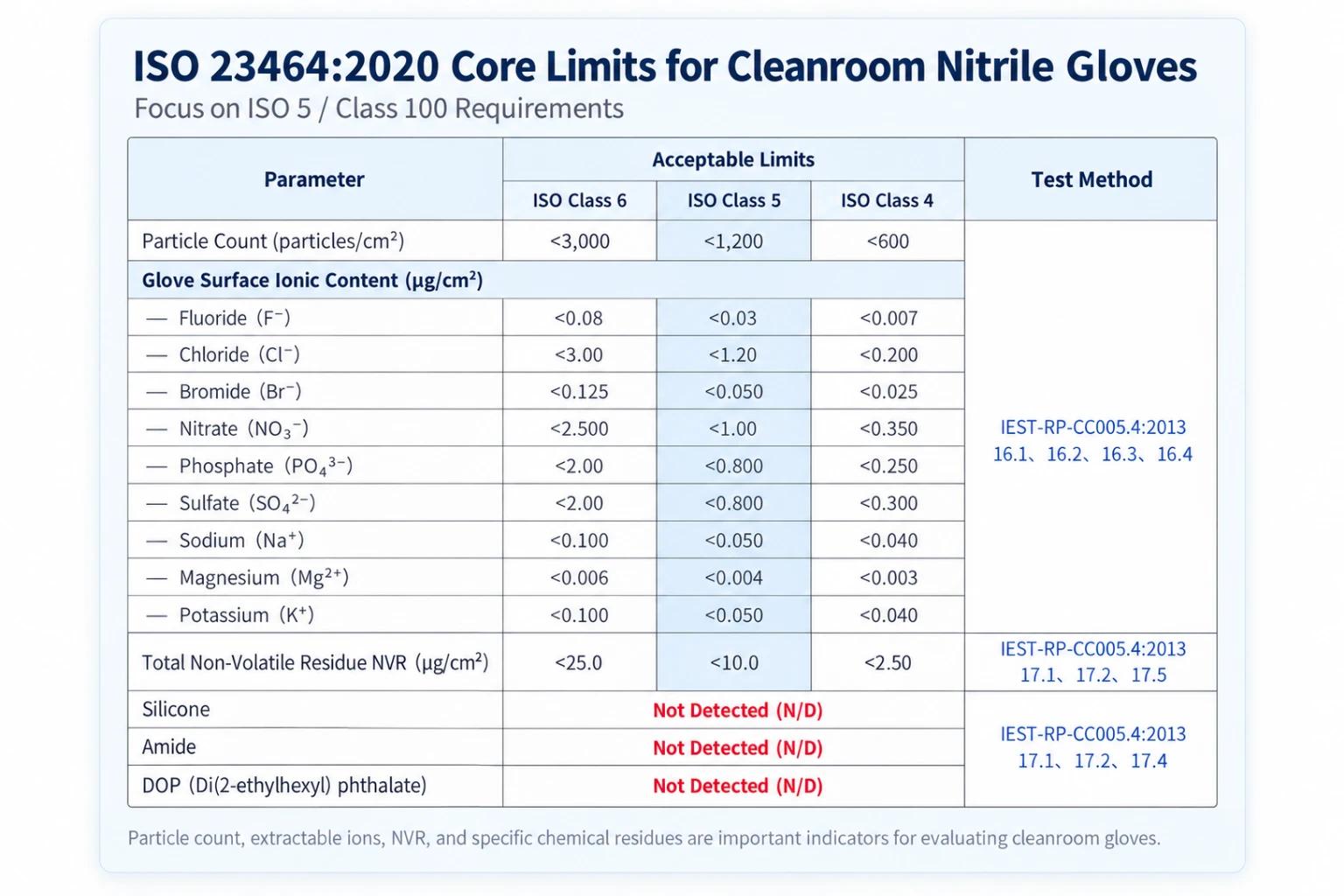
Standard note: ISO 23464:2020 sets technical requirements for particle count, extractable surface ions, non-volatile residue (NVR), silicone, amide and DOP for nitrile cleanroom gloves. Acceptance limits are used for class assessment, while a test report shows the measured result of a submitted sample under defined test conditions.
Beyond the class labels, buyers can also review limits for extractable particles, ions and non-volatile residue. The selected ISO 23464:2020 values below are glove-surface test criteria, not airborne particle concentration limits for the cleanroom itself.
| Glove-surface metric | Class 10 (ISO Class 4) | Class 100 (ISO Class 5) | Class 1000 (ISO Class 6) |
|---|---|---|---|
| Liquid Particle Count (particles/cm²) | <600 | <1,200 | <3,000 |
| Chloride, Cl⁻ (μg/cm²) | <0.200 | <1.20 | <3.00 |
| Non-Volatile Residue, NVR (μg/cm²) | <2.5 | <10.0 | <25.0 |
The class label is useful, but it should not be the only purchasing criterion. Buyers should also review particle, ionic and other contamination-control data for the exact glove model being considered.
What Performance Metrics Matter in Cleanroom Gloves?
Liquid Particle Count (LPC)
Liquid Particle Count measures particles extracted from the glove surface under a defined liquid extraction method. IEST-RP-CC005.4 provides test procedures used for gloves and finger cots in cleanrooms and controlled environments.
In a 2025 third-party test of an INTCO disposable nitrile cleanroom glove sample, particles ≥0.5 μm were measured at 284, 354 and 329 particles/cm² across three readings, with an average of 322 particles/cm².
| Reading | LPC Result (particles/cm², ≥0.5 μm) |
|---|---|
| Data 1 | 284 |
| Data 2 | 354 |
| Data 3 | 329 |
| Average | 322 |
Report No. AW/EL/0406/25. Compared with a general claim such as “low particle,” quantitative LPC results provide buyers with a clearer view of how the submitted sample performed under the stated test conditions.
Extractable Ionic Contamination
For gloves used in clean environments, extractable ions are an important contamination-control metric. They are particularly relevant to semiconductor, electronics and other ion-sensitive processes.
In a 2025 anion test performed according to IEST-RP-CC005.4, the tested INTCO cleanroom glove sample recorded the following results:
| Ion | Test Result (μg/cm²) |
|---|---|
| Fluoride (F⁻) | Not detected (<0.001) |
| Chloride (Cl⁻) | 0.067 |
| Nitrite (NO₂⁻) | Not detected (<0.001) |
| Bromide (Br⁻) | Not detected (<0.001) |
| Nitrate (NO₃⁻) | 0.200 |
| Phosphate (PO₄³⁻) | Not detected (<0.001) |
| Sulfate (SO₄²⁻) | 0.020 |
The same 2025 test set also measured cations including ammonium, lithium, sodium, potassium, magnesium and calcium. Reported values included sodium at 0.058 μg/cm², potassium at 0.072 μg/cm² and magnesium at 0.001 μg/cm².
Individual ion results should not be generalised into a conclusion about the glove's overall cleanroom performance. Evaluation should combine the exact product specification with multiple relevant test items.
In technical terms, when the test method, extraction system and units are the same, lower extractable-ion values generally indicate less ionic material extracted from the glove surface and can be preferable for ion-sensitive processes. Whether a result meets the intended use still requires item-by-item comparison with the target cleanroom class, customer specification or process limit. “Not detected (N/D)” means below the detection limit of the stated method, not absolute zero. For the anion results in this test that can be directly compared with the cited ISO Class 5 limits—F⁻, Cl⁻, Br⁻, NO₃⁻, PO₄³⁻ and SO₄²⁻—each result was below the corresponding limit. Chloride measured 0.067 μg/cm² versus the ISO Class 5 limit of <1.20 μg/cm². This conclusion applies only to the submitted sample and the listed test items.
FTIR: Silicone Oil, Amide and DOP
For cleanroom operations that need to control specific organic residues, FTIR testing can be used to examine characteristic peaks associated with those substances. A submitted INTCO disposable nitrile cleanroom glove sample was evaluated for silicone oil, amide and dioctyl phthalate (DOP), with the following results:
- Silicone oil characteristic peaks were not detected
- Amide characteristic peaks were not detected
- DOP characteristic peaks were not detected
The analysis used Fourier-transform infrared spectroscopy (FTIR) and referenced ASTM E1252-98(2021). The results should be interpreted only for the submitted sample and the stated test method.
Airborne Particle Release (APC)
In addition to LPC, cleanroom gloves can be evaluated with other particle-release methods. In 2025, an INTCO disposable nitrile cleanroom glove sample was also tested using the IEST-RP-CC003.4 Helmke Drum Method. For particles ≥0.5 μm, the reported result was 8 particles/piece.
LPC and APC use different test methods, conditions and units, so the two values should not be directly converted or simply compared.
The 8 particles/piece result reflects airborne particle release from the submitted sample under the Helmke Drum test conditions. Under the same test conditions, a lower value generally indicates fewer particles released. Considered together with LPC, the two methods provide complementary views of particle control: liquid-extracted particles and airborne particle release.

What Does ISO 23464:2020 Evaluate?
ISO 23464:2020, Nitrile cleanroom gloves — Specification, addresses particle count, extractable ions, non-volatile residue and specific organic-residue checks. Key items include:
- Particle count
- Extractable surface ions
- Non-volatile residue (NVR)
- Silicone
- Amide
- Dioctyl phthalate (DOP)
Different cleanroom classes have different acceptance limits. Two concepts should be kept separate: the standard limit is the technical requirement defined for a cleanroom class, while an actual test result is the measured performance of a specific submitted sample under stated conditions. Technical review is more meaningful when both are considered together.
INTCO Disposable Cleanroom Nitrile Gloves: Export Product Options
INTCO offers two 12-inch disposable nitrile cleanroom glove ranges, providing choices in fit, handling characteristics and contamination-control performance. The product options below help buyers compare available cleanroom classes and identify suitable models for their applications.
| INTCO cleanroom glove options | Model / cleanroom class | Features and application |
|---|---|---|
| Disposable Cleanroom Nitrile Gloves 12" | CS5L-1002 / Class 100 (ISO Class 5); CS5L-10002 / Class 1000 (ISO Class 6) | 12-inch nitrile gloves with a comfortable, latex-like feel and textured fingertips for precise handling. Designed for cleanroom applications requiring particle and ionic contamination control. |
| Disposable Cleanroom Nitrile Gloves | C4L-852 / Class 10 (ISO Class 4); C5L-852 / Class 100 (ISO Class 5); C6L-852 / Class 1000 (ISO Class 6) | 12-inch nitrile gloves with a choice of cleanroom classes for different controlled environments. Model-specific options help buyers match glove performance to production requirements. |
The 12-inch CS5L range combines comfortable handling with Class 100 (ISO Class 5) and Class 1000 (ISO Class 6) options. The C4L/C5L/C6L range offers Class 10 (ISO Class 4), Class 100 (ISO Class 5) and Class 1000 (ISO Class 6) options. Each model can be selected according to the cleanliness requirements of the intended process.
The LPC, ion, APC and FTIR data in this guide describe the submitted samples under the stated test conditions. They should not be interpreted as identical results for every model or production batch.
Applications: Where Are Low-Particle and Low-Ion Gloves Used?
Different applications place different demands on cleanroom gloves. Where particle and ionic contamination control is important, buyers commonly review cleanroom class, LPC, extractable ions, specific organic residues, packaging and batch-level test documentation. Typical applications include:
- Electronics manufacturing and precision electronics
- Semiconductor and related clean manufacturing
- Pharmaceutical and biopharmaceutical manufacturing
- Laboratory work
- Medical device manufacturing
- Other clean environments where particle and ionic contamination control matters
For procurement, it is better not to select a cleanroom glove by a class label alone. Buyers should also review the model-specific specification and relevant test documentation for the intended process.
For more background on contamination-control use cases, see INTCO’s article on cleanroom nitrile gloves and contamination control.
How to Choose Cleanroom Nitrile Gloves
For technical sourcing and product qualification, it is useful to review the following items together rather than selecting a glove from a single headline specification.
- ISO cleanroom class: Confirm whether the glove is specified for ISO Class 4, 5 or 6 applications.
- Liquid Particle Count (LPC): Check the particle size threshold, unit, test method and actual result.
- Extractable ions: Review key ions such as chloride, sodium and potassium against the relevant process or product requirements.
- FTIR / chemical residues: Check whether silicone oil, amide, DOP or other restricted residues are part of the qualification criteria.
- Glove length, thickness and material: Review dimensions such as 9-inch or 12-inch length, nitrile material, powder-free design and other construction details relevant to the task.
- Packaging and technical documentation: Confirm cleanroom-compatible packaging and request the specification or test evidence that corresponds to the product being purchased.
For professional procurement, a combination of cleanroom class, quantitative test data and model-specific technical documentation is usually more useful than a single marketing claim.
Frequently Asked Questions
Is Class 100 the same as ISO Class 5?
Yes. Class 100 is a widely used legacy classification corresponding to ISO Class 5. The exact glove model should still be checked against the target process and cleanroom requirements.
How are cleanroom nitrile gloves different from general-purpose nitrile gloves?
Cleanroom nitrile gloves are clean-processed and controlled for contamination-related characteristics such as particles, extractable ions, packaging cleanliness and other model-specific technical requirements. General-purpose nitrile gloves are not necessarily processed or tested to the same cleanroom criteria.
What does LPC mean for cleanroom gloves?
LPC stands for Liquid Particle Count. It evaluates particles detected after liquid extraction from the glove surface and is reported at a defined particle-size threshold.
What was the LPC result for the tested INTCO cleanroom glove sample?
In the 2025 submitted sample, the three LPC results for particles ≥0.5 μm were 284, 354 and 329 particles/cm², with an average of 322 particles/cm².
Why are extractable ions tested in cleanroom nitrile gloves?
Extractable ions are an important part of contamination-control evaluation. Testing ions such as Cl⁻, Na⁺ and K⁺ helps buyers understand the level of extractable ionic contamination measured from the submitted sample.
What was the chloride result for the tested INTCO sample?
The 2025 submitted sample recorded a chloride result of 0.067 μg/cm² under the stated test method.
What does “silicone-free” mean for cleanroom gloves?
A more precise evidence-based statement is that FTIR testing did not detect characteristic peaks of silicone oil in the submitted sample. The same test also reported no characteristic peaks for amide and DOP.
What cleanroom classes are available from INTCO?
INTCO offers 12-inch disposable nitrile cleanroom glove options for Class 10 (ISO Class 4), Class 100 (ISO Class 5) and Class 1000 (ISO Class 6) applications. Available classifications vary by model.
Need model-specific specifications or cleanroom performance information? Explore INTCO Disposable Cleanroom Nitrile Gloves and contact INTCO for the documentation relevant to your application.