
How to Use Nitrile Gloves: Select, Change & Remove
To use nitrile gloves properly, first match an exact glove SKU to the task and hazard. Clean and fully dry your hands, inspect the glove, don it without contaminating the working surface, and change it whenever it is damaged, contaminated, soiled, or carried across a patient, task, food, or work-zone boundary. Remove it without touching the contaminated exterior, dispose of it according to what contacted it, and perform hand hygiene again.
That sequence sounds simple, but the most important decision happens before the box is opened. “Nitrile” identifies a material family; it does not prove that every nitrile glove is suitable for medical care, food contact, a chemical mixture, a sterile procedure, sharps, heat, or prolonged wear. Correct technique cannot rescue the wrong product.
The correct nitrile-glove workflow
A defensible procedure has eight linked actions:
- Assess the task, exposure, and required dexterity.
- Select the correct glove type, size, and exact product.
- Prepare clean, dry hands and a clean work area.
- Inspect and don the gloves without unnecessary contact.
- Work only within the glove’s documented limits.
- Change immediately when a trigger event occurs.
- Doff without transferring material from the exterior to skin or clothing.
- Dispose correctly and perform hand hygiene.
The workflow is event-driven. There is no single universal number of minutes that makes every disposable nitrile glove safe. A glove used for a brief clean task may need changing immediately after crossing a work-zone boundary; a glove exposed to a chemical may require a change schedule derived from exact permeation data and workplace controls. A separate wear-duration assessment should own detailed timing guidance.
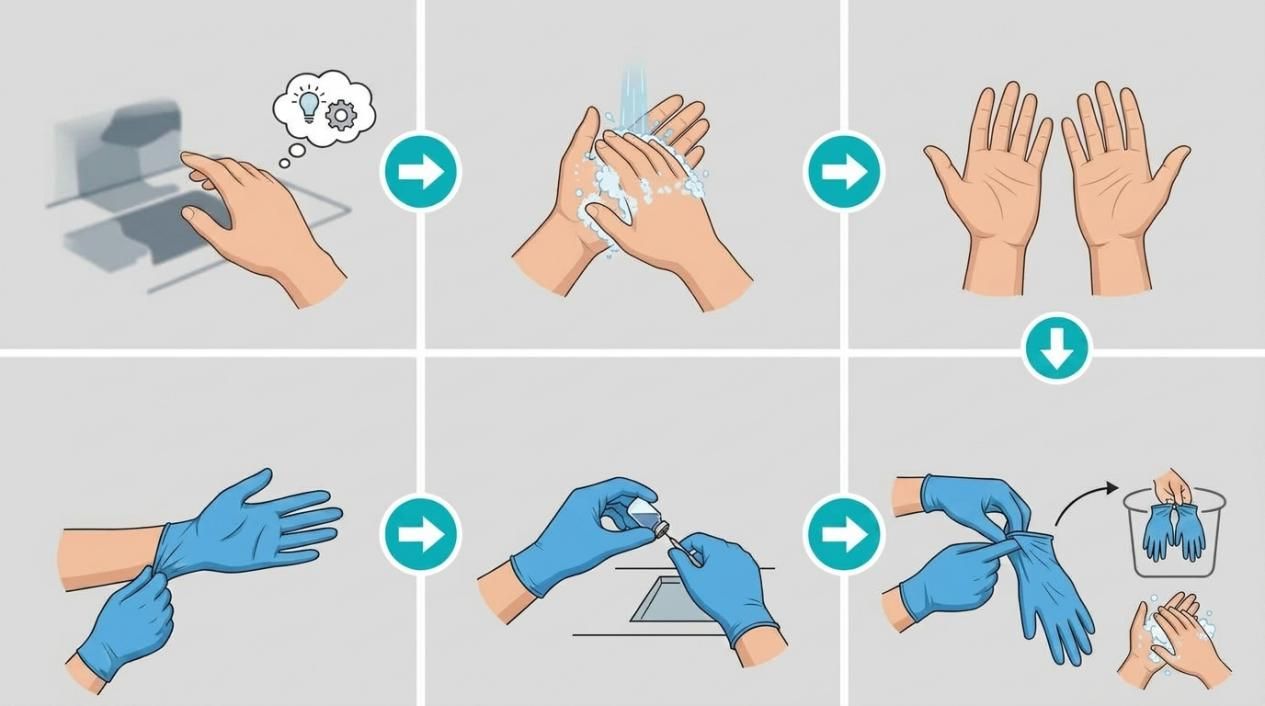
Step 1: assess the task and hazard
Start with what can contact the hands and what the hands can contact. Consider biological material, food, cleaning agents, oils, solvents, powders, allergens, sharp edges, heat, and the risk of transferring contamination between zones. Also consider how much grip and fine-motor control the task needs.
OSHA’s hand-protection requirement calls for employers to select hand protection based on the task, hazards, conditions, duration, and glove characteristics. In practice, a responsible selection record should identify:
- the exact product name and SKU, not only “blue nitrile glove”;
- intended use and destination-market labeling;
- size, thickness range, texture, cuff, and sterility status where relevant;
- food-contact, medical-device, or chemical-protection evidence required for the task;
- chemical name, concentration, temperature, contact type, and expected duration;
- foreseeable tears, snags, sharps, heat, or mechanical hazards;
- change triggers, disposal route, and other PPE or controls.
For routine examination-type tasks, INTCO’s nitrile glove category and disposable nitrile examination-glove range are candidate starting points, not automatic authorization for every clinical task. Match the exact model, market file, labeling, size, and current supporting records.
Step 2: prepare hands, glove, and work area
Follow the hand-hygiene method required for the setting. CDC clinical guidance states that gloves are not a substitute for hand hygiene and instructs healthcare workers to clean their hands before donning and after removing gloves. Let hands dry fully before donning; residual moisture can make gloves harder to put on and can worsen skin discomfort.
Remove hand or wrist items if the workplace procedure identifies them as a tear, entanglement, cleaning, or hygiene risk. Check that fingernails and damaged skin are managed according to the applicable procedure. Do not apply a lotion unless its compatibility with the glove and the workplace task has been established.
Then inspect the package and product:
- confirm the correct SKU, size, expiration or use-by information, and package condition;
- look for wet, dirty, discolored, brittle, tacky, or damaged gloves;
- verify that the glove is stored as the manufacturer directs;
- use a new pair if there is doubt about integrity or prior contact.
Do not inflate a glove by mouth or snap it through the air to “test” it. Those actions can spread contamination and do not replace a defined integrity or quality test.
Step 3: put on nitrile gloves correctly
Use this basic donning sequence unless a validated sterile or specialized procedure requires another method:
- Select the correct size. A glove should cover the hand without excessive tension, loose fingertips, or folds that interfere with grip.
- Touch the first glove mainly at the cuff and guide the hand in gently.
- Pull the cuff into its intended position without overstretching or rolling it unnecessarily.
- Don the second glove the same way.
- Check the fingertips, web spaces, palm, and cuff for visible defects or abnormal tightness.
- Replace the pair if either glove tears, does not fit, or contacts an unclean surface during a clean or aseptic workflow.
Do not assume that “tighter” means safer. An undersized glove can fatigue the hand and place the film under more strain; an oversized glove can reduce control and catch on tools. Where cuffs interact with gowns or other PPE, use the organization’s validated sequence rather than improvising.
Step 4: keep gloved hands inside the task boundary
Once work starts, treat the glove exterior as task-specific. Avoid touching phones, pens, door handles, face, hair, clothing, keyboards, drawers, or clean supplies unless they are part of the controlled workflow. A glove can protect the wearer’s skin while still carrying contamination to another surface.
Change the glove pair immediately when:
- it is torn, punctured, split, visibly degraded, or suspected of leaking;
- it becomes visibly soiled or contaminated;
- the user moves from a contaminated site to a clean site on the same patient or product;
- the patient, customer, food task, specimen, chemical, or work zone changes;
- the user leaves the task and touches an uncontrolled surface;
- the glove’s documented chemical contact or workplace change limit is reached;
- the user’s hands feel wet because of a suspected breach rather than ordinary perspiration;
- the applicable procedure, label, or supervisor requires replacement.
Do not wash, disinfect, or reuse a single-use glove. FDA’s medical-glove guidance says medical gloves should not be reused or washed. Surface treatment can miss defects, spread contamination, or change material performance. If repeated processing is required, select a separate reusable glove labeled for the task and follow its validated instructions.
Healthcare: add infection-control boundaries
For healthcare, use the facility’s infection-control and isolation procedures. CDC’s clinical hand-hygiene guidance emphasizes cleaning hands before gloves and after removal, changing gloves when moving from a soiled site to a clean site on the same patient, and not wearing the same pair for more than one patient.
Gloves also do not eliminate sharps risk. Never treat a nitrile examination glove as puncture-proof. Use engineered sharps controls, safe handling and disposal systems, and other required PPE. For occupational exposure to blood or other potentially infectious material, the employer’s plan must align with OSHA’s Bloodborne Pathogens standard.
“Medical grade” should not be inferred from color, thickness, or the word nitrile. Verify intended use, labeling, market authorization or listing where applicable, and exact-SKU quality evidence.
Food handling: verify product and local rules
Food operations need both a suitable glove and correct food-safety behavior. The US 2022 FDA Food Code is a model code; jurisdictions decide whether and how to adopt it. Section 3-304.15 describes single-use gloves as being used for one task and discarded when damaged or soiled or when interruptions occur. Always verify the locally adopted code and the establishment’s procedure.
A material name alone does not establish food-contact compliance. Confirm the exact glove’s documentation for the intended market and type of food contact. Change gloves between raw and ready-to-eat work, after cleaning or waste tasks, and whenever the local procedure requires it. Hand hygiene still applies; a clean glove placed over unclean hands is not a clean process.
Chemical work: require exact compatibility evidence
Disposable nitrile can be appropriate for some splash and incidental-contact tasks, but no general “nitrile resists chemicals” statement is safe enough for selection. Chemical behavior varies with formulation, thickness, concentration, mixture, temperature, contact mode, movement, and time. Permeation can occur without a visible hole or obvious swelling.
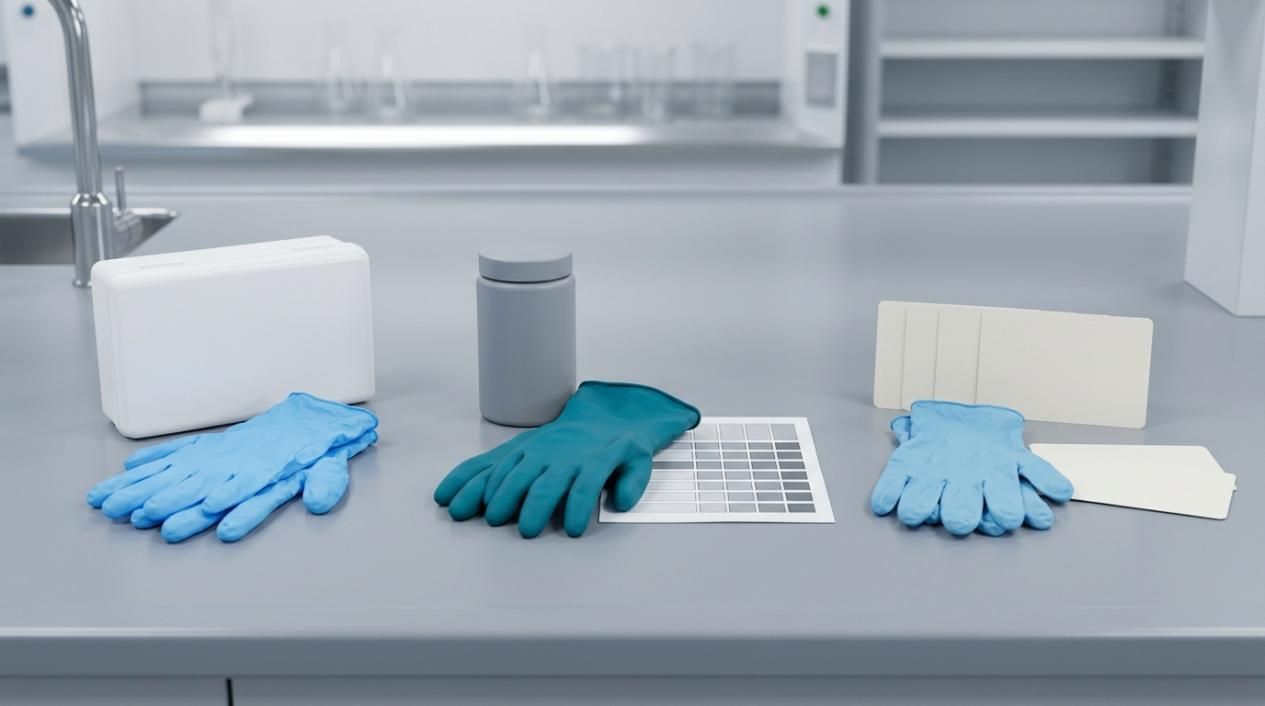
Before chemical use, review the safety data sheet, workplace hazard assessment, manufacturer instructions, and exact-SKU test data. Ask for the test method, chemicals and concentrations, temperatures, breakthrough or permeation results, degradation observations, and the basis of the change schedule. A family-level chart should not be silently applied to another color, thickness, model, or factory.
For any disposable nitrile product promoted for chemical-splash tasks, obtain the current report for the exact ordered SKU and compare it with actual conditions. A commercial product link should be added only after its chemical, concentration, temperature, duration, sharp-tool, and intended-use statements have been reconciled with the supporting records. Disposable nitrile is not a substitute for a task-specific cut-, heat-, electrical-, or immersion-protection glove.
Step 5: remove disposable gloves without transferring contamination
Use a controlled glove-in-glove removal method:
- Pinch or grasp the exterior of one glove near the wrist without touching bare skin.
- Peel it away from the hand, turning it inside out.
- Hold the removed glove in the still-gloved hand.
- Slide bare fingers under the remaining glove at the wrist; do not touch its exterior.
- Peel the second glove off over the first so both are contained together.
- Place them directly into the designated waste container.
- Perform hand hygiene immediately.
If the exterior touches skin or clothing, follow the site’s exposure or decontamination procedure. Removing gloves is not the moment to shake, squeeze, carry, or sort them. Specialized PPE ensembles, sterile workflows, hazardous-drug tasks, and high-consequence biological work may require a validated sequence beyond this general method.
Skin symptoms and accelerator-free options
Stop and report persistent redness, itching, cracking, blistering, swelling, or other suspected skin reactions according to workplace procedure. Seek appropriate medical evaluation rather than diagnosing the cause from glove material or color.
Some users may need products formulated without selected rubber accelerators, but “accelerator-free” is not the same as allergy-free. Verify which accelerators are excluded, the full exact-SKU formulation controls available to the buyer, and any occupational-health recommendation. A commercial link should be added only after its excluded-accelerator and allergen statements have been reconciled with the product records. Irritant contact dermatitis, Type IV reactions to additives, and other causes require different investigation.
Storage and disposal
Store unopened gloves in their original packaging under the manufacturer’s stated temperature, humidity, light, and shelf-life conditions. Keep boxes away from direct sunlight, ozone-generating equipment, excessive heat, moisture, and contamination sources when the product instructions identify those risks. Rotate stock by expiration or approved inventory rules and quarantine damaged cartons.
Waste classification depends on what contacted the glove. A clean glove, a food-soiled glove, a chemical-contaminated glove, and a glove from a regulated clinical waste stream may require different containers and handling. Do not label all nitrile gloves “recyclable” or “general waste” without checking contamination, local rules, and the receiving program.
A supervisor’s one-page SOP checklist
Before approving a glove procedure, document:
- task, hazard, work zone, and prohibited uses;
- exact product, sizes, intended use, and supporting evidence;
- hand-hygiene and hand-drying requirements;
- donning and doffing sequence;
- surfaces that may and may not be touched;
- immediate change triggers and any validated chemical change schedule;
- other PPE, engineering controls, and emergency actions;
- waste route and post-removal hand hygiene;
- training, observation, incident reporting, and revision owner.
Training should include demonstration and observed practice, not only a box-side instruction. Supervisors should watch for cross-contamination habits—especially phones, pens, door handles, and shared equipment—and revise the workflow when the task, chemical, product, regulation, or supplier record changes.
FAQ
Should you wash your hands before putting on nitrile gloves?
Yes when the applicable hand-hygiene procedure requires it; healthcare guidance calls for hand hygiene before donning. Let hands dry fully and repeat hand hygiene after removal.
How often should nitrile gloves be changed?
Change on defined events such as damage, contamination, task or zone changes, patient changes, interruption, and any exact-SKU chemical limit. There is no universal safe time for every task.
Can you sanitize nitrile gloves and keep using them?
No. Do not wash, disinfect, or reuse a single-use glove. If the task requires a reusable glove, select that separate product category and follow its validated cleaning and inspection instructions.
Are nitrile gloves safe for every chemical?
No. Require exact-SKU compatibility data for the actual chemical, concentration, temperature, contact type, and duration, plus a workplace change plan.
Does wearing two pairs make the task safe?
Double gloving can be part of a defined procedure, but it does not correct the wrong material or establish protection against an untested hazard. Follow the validated task-specific protocol.
Proper nitrile-glove use is not simply “put on a pair.” It is a controlled barrier system: select with evidence, prepare correctly, keep the glove inside its task boundary, replace it at the first trigger, remove it without transfer, and clean the hands again.