
Nitrile Gloves for Mechanics: How to Choose the Right Gloves for Mechanical Work
In modern workshops, service centres, and industrial maintenance facilities, mechanics rely on disposable gloves as functional tools rather than simple protective accessories. While often associated with healthcare settings, non-latex gloves have become a standard choice in mechanical environments where chemical resistance, hand protection, and precision handling must coexist. From engine repair and automotive assembly to equipment maintenance and quality inspections, nitrile gloves now play a critical role in industrial protection across North America.
Mechanical work exposes hands to petroleum oils, solvents, metal edges, and repeated friction throughout the day. Unlike latex or vinyl, nitrile gloves provide stable resistance to these substances while remaining latex-free, reducing allergy risks for mixed workforces. However, long-term performance in real mechanical workflows depends not only on material formulation, but on how gloves are produced, inspected, packaged, and delivered at scale. For buyers sourcing gloves for mechanics, understanding this full process is essential to making reliable procurement decisions.

Why Nitrile Gloves Are the Preferred Choice for Mechanics
Mechanics often switch tasks multiple times within a single shift, moving from fine electrical diagnostics to heavy component handling and chemical cleaning. Nitrile gloves are favoured because they maintain flexibility while resisting oils, greases, and common automotive solvents that quickly degrade other materials. In practice, glove failures observed on workshop floors rarely result from incorrect material selection alone. More often, they stem from inconsistent thickness, poor fit control, or variability between production batches.
In environments where gloves are also used for inspection and contamination control, such as gloves for quality control during automotive assembly or component verification, nitrile gloves help prevent oil transfer and surface damage. These dual-use scenarios require gloves that perform consistently, not only in strength but also in tactile response and surface integrity. That consistency is achieved through controlled manufacturing processes rather than product descriptions alone.
Understanding Thickness in Mechanical Applications
One of the most common technical questions raised by buyers is: What Thickness of Nitrile Gloves Is Best for Mechanics? Field use shows that thickness directly affects both durability and dexterity. Thin gloves in the 4–5 mil range offer excellent sensitivity but are prone to tearing during repetitive gripping or torque application. For most mechanical work, 6–8 mil gloves have become the practical standard.
This leads naturally to another frequent comparison: Are 6 mil or 8 mil nitrile gloves better for mechanical work? In daily operations, 6 mil gloves are widely used for routine maintenance, diagnostics, and light assembly. For heavier mechanical tasks involving suspension systems, transmission components, or prolonged chemical exposure, 8 mil gloves provide additional resistance without fully sacrificing hand feel. Experienced workshops often stock multiple thickness options to match glove performance with task intensity rather than forcing a single solution.
The best disposable nitrile gloves for mechanics are therefore not defined by maximum thickness, but by how effectively thickness is controlled and matched to real-world use.
Cut Risk and Practical Safety Limits
Mechanical work frequently involves sharp metal edges, broken parts, and abrasive surfaces. This raises an important safety consideration: Do Mechanics Need Cut-Resistant Nitrile Gloves? Disposable nitrile gloves are not designed to replace dedicated cut-resistant gloves. While certain reinforced nitrile formulations can reduce minor abrasions, high-risk tasks require appropriate protective equipment or glove removal to prevent entanglement hazards.
In workshops with strong safety cultures, mechanics are trained to recognise when disposable gloves should be used and when they should be removed. Clear task-based guidelines reduce injury risks more effectively than relying on glove thickness alone. Acknowledging these limits openly improves trust and reflects a realistic understanding of industrial safety practices.
Black Nitrile Gloves in Automotive Work
Demand for the best black nitrile gloves for mechanics has increased steadily in automotive environments. Black gloves improve visual contrast, making oil leaks, grease contamination, and surface defects easier to detect. This visibility advantage directly supports diagnostic accuracy and cleanliness standards in repair and service operations.
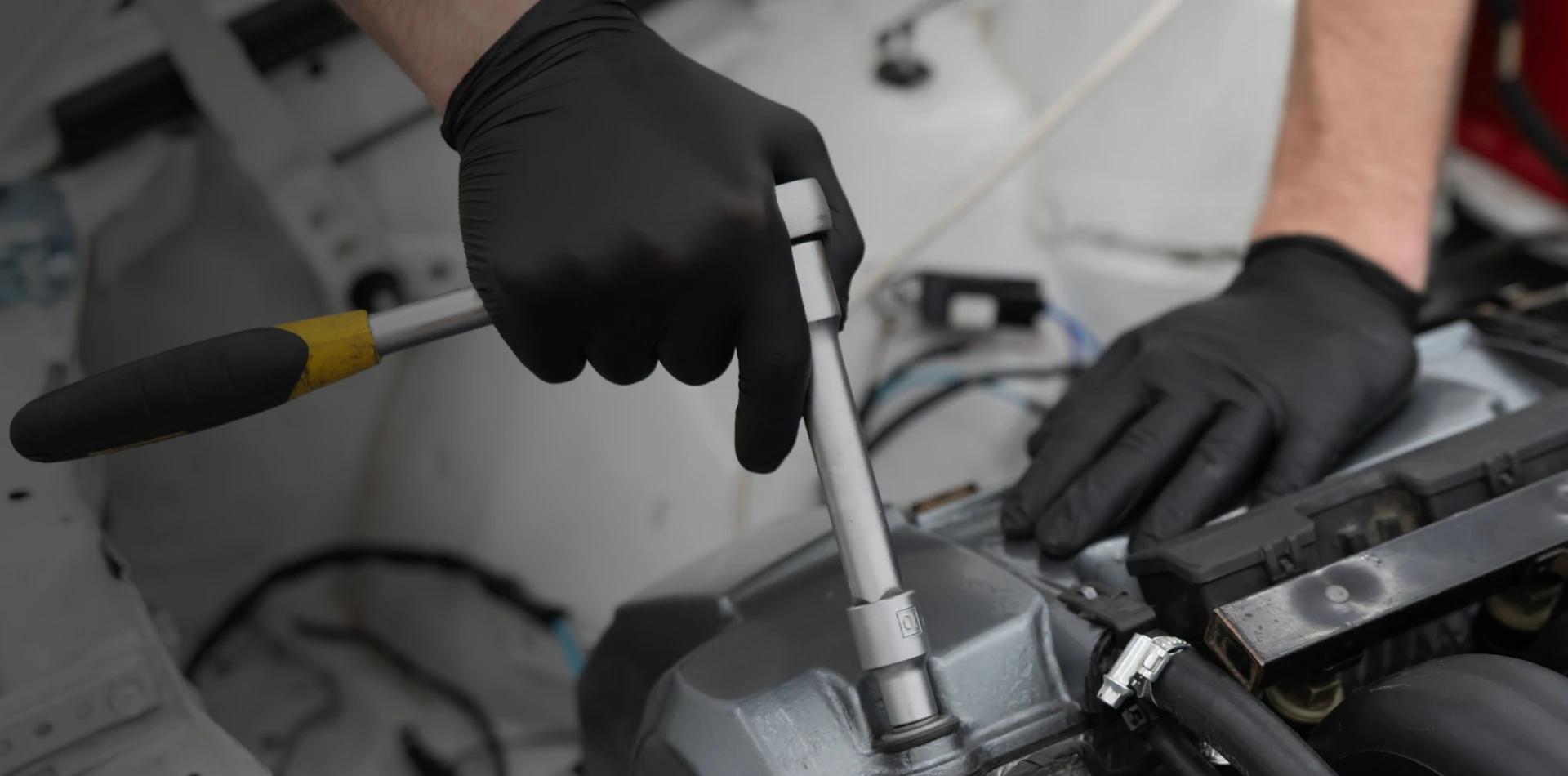
Beyond function, black nitrile gloves also contribute to a professional workshop appearance, especially in customer-facing service centres. This balance of practicality and presentation has made black gloves a preferred option in many automotive facilities.
Manufacturing Consistency Beyond Material Selection
While glove formulation determines baseline performance, consistency across large volumes depends on manufacturing control. In high-output glove factories supplying industrial markets, variability most often arises during production transitions, packaging changes, or rapid scale-up periods. Addressing these risks requires integrated process management rather than isolated quality checks.
In glove manufacturing operations where automatic boxing systems are deployed across production lines, packaging consistency becomes a controllable variable rather than a source of error. Automated systems developed specifically for glove packaging handle compressed, elastic products reliably, accommodating different box sizes while maintaining consistent fill density and alignment. Running continuously in daily production rather than limited pilot lines, these systems achieve equipment efficiency levels exceeding 98 per cent while reducing manual labour requirements by approximately half.
For mechanical glove buyers, this directly translates into cartons that stack uniformly, ship efficiently, and arrive without deformation that complicates storage or dispensing on the workshop floor. Consistent packaging is not cosmetic; it supports downstream efficiency across logistics and end use.
Quality Assurance Through Full-Process Inspection
Quality stability in mechanical gloves depends on detecting defects before products reach the user. Traditional sampling methods struggle to identify low-frequency defects in high-volume output, especially for issues such as micro-tears or surface contamination. To address this, some glove manufacturers have implemented intelligent visual inspection systems that operate continuously across production lines.
These systems use multiple cameras to capture images of each glove from the palm, back, and cuff areas, associating all images with the same individual glove. Powered by deep learning algorithms, they enable 100 per cent online inspection rather than statistical sampling. Defective gloves are automatically removed, while defect data is analysed to identify patterns linked to specific process stages.
This approach not only improves outgoing quality but also shortens problem-resolution cycles by pinpointing root causes within production. For applications involving industrial protection and gloves for quality control, this level of inspection provides a tangible quality advantage that cannot be replicated through final-stage checks alone.
Logistics, Traceability, and Delivery Reliability
For large mechanical glove programs, supply reliability is as important as product performance. Delays, mixed batches, or incorrect shipments create operational disruptions that outweigh marginal cost differences. Facilities equipped with integrated warehouse management systems address these risks by maintaining real-time inventory visibility and batch traceability across finished goods.
Automated shuttle storage systems, AGV transport, and high-density automated warehouses work together to reduce manual handling and minimise picking errors, particularly during peak demand periods. By synchronising production output with warehouse operations, manufacturers can maintain predictable lead times even when order volumes fluctuate. This operational transparency supports long-term sourcing decisions and helps buyers manage risk proactively.
Manufacturers operating at scale through platforms such as INTCO Glove and supported by the broader capabilities of INTCO Medical, integrate these systems into daily operations rather than treating them as standalone upgrades.
Compliance, Authority, and Market Confidence
Mechanical glove buyers frequently evaluate suppliers based on their ability to meet regulatory and market-specific requirements consistently. Beyond certifications, buyers look for evidence that quality systems, inspections, and logistics controls function together as part of a stable operation. Companies recognised among the top disposable glove suppliers in the world typically demonstrate this stability through large-scale manufacturing, verified inspection systems, and documented delivery performance.
Choosing the Best Gloves for Mechanics in Practice
Selecting the best mechanic gloves requires aligning glove properties with actual working conditions. Thickness, fit, colour, and inspection standards should be evaluated together rather than in isolation. The best automotive gloves are those supported by manufacturing processes that control variability, packaging systems that preserve consistency, and logistics operations that deliver predictably.
In mechanical environments where safety, efficiency, and reliability intersect, nitrile gloves have become a foundational tool. When backed by scalable production, full-process inspection, and integrated logistics, they provide the performance and confidence that modern industrial operations demand.
FAQ
What Thickness of Nitrile Gloves Is Best for Mechanics?
Most mechanical applications use 6–8 mil nitrile gloves, adjusting thickness based on task intensity and chemical exposure.
Are 6 mil or 8 mil nitrile gloves better for mechanical work?
6 mil gloves offer better dexterity for routine tasks, while 8 mil gloves provide added durability for heavy mechanical work.
Do Mechanics Need Cut-Resistant Nitrile Gloves?
Disposable nitrile gloves are not a substitute for cut-resistant gloves and should be used with task-specific safety assessments.
Why are black nitrile gloves popular among mechanics?
Black gloves improve the visibility of oils and contaminants while maintaining a professional appearance.